



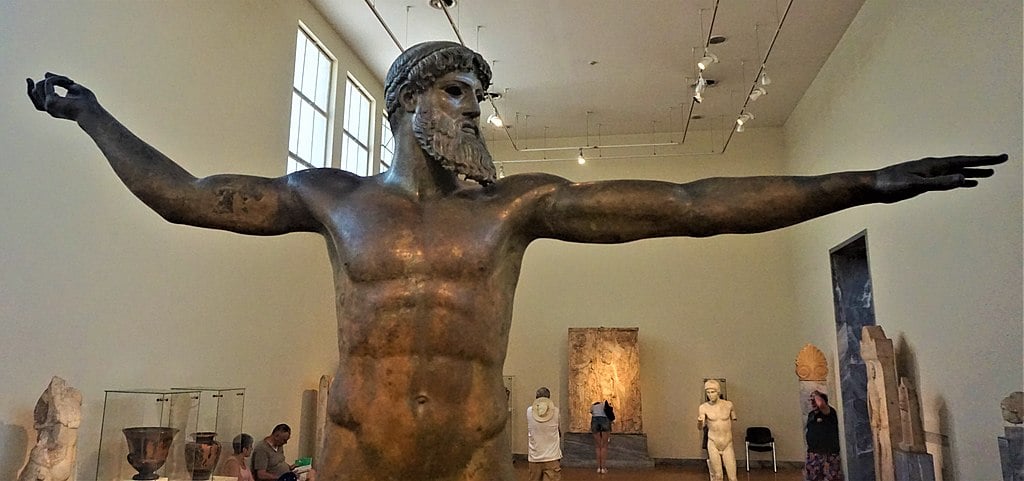
Anyone who spends time wandering the halls of Greece’s many archaeological museums begins to notice a recurring detail: from the intense gaze of bronze charioteers to the serene marble faces of philosophers, most Ancient Greek statues feature elaborately curly hair. It might be tempting to dismiss this as a stylistic quirk of the era, but those heavy, coiled locks are anything but incidental. They reflect a combination of practical constraints, deeply rooted customs and traditions, and the basic realities of Mediterranean genetics.
How curly hair in Greek statues became the norm
Parian and Pentelic marble were prized by sculptors in the Ancient Greek world for their radiant, almost luminous quality. Yet they came with a critical limitation. While marble can bear substantial compressive weight, it is far weaker under tension. Carving thin, unsupported elements made the material highly vulnerable to cracking. If a sculptor attempted long, flowing strands of hair, even the vibration of the mallet could cause the stone to fracture.
To address this, artists compacted the hair into tightly controlled forms. By shaping the locks into dense, interlocking curls, they kept the mass anchored close to the head and neck. With no fragile strands projecting outward, the sculpture avoided structurally vulnerable points. This practical solution helped protect the work from damage both in the workshop and during transport.
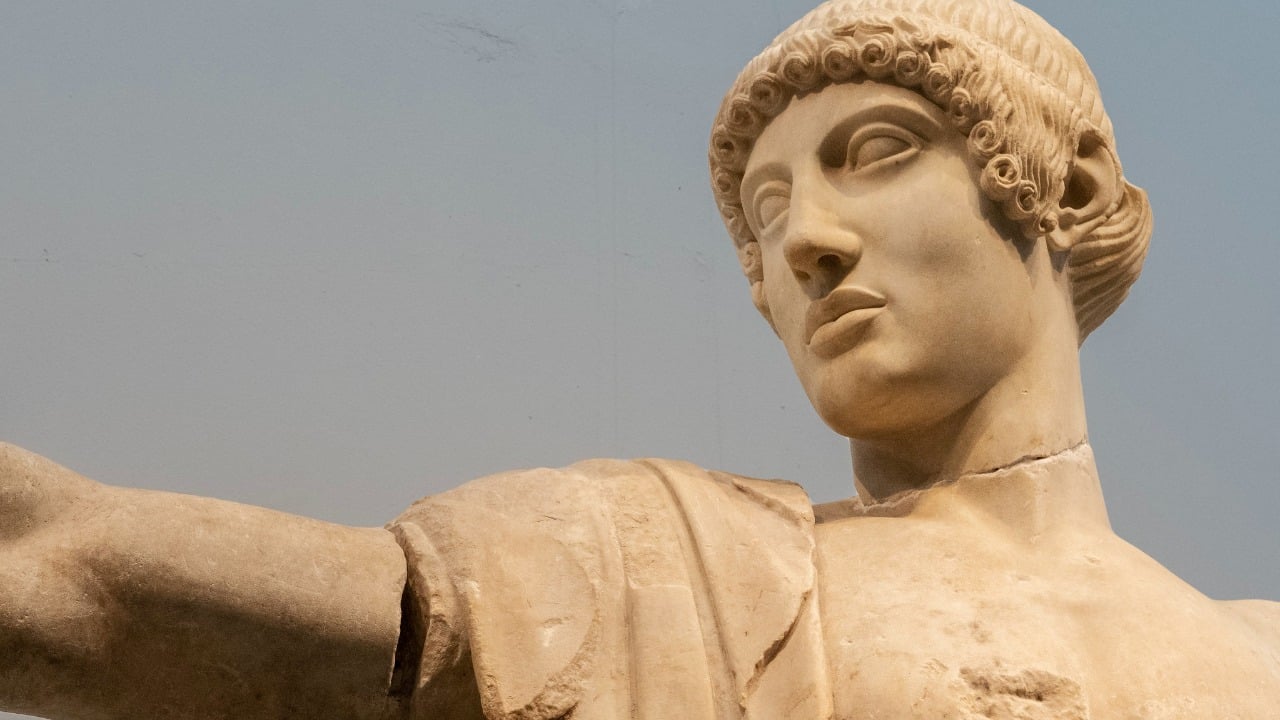
Over time, artisans leaned into this reality. They began using drills to carve deep recesses within the curls, allowing light and shadow to do much of the work. Under the harsh Mediterranean sun, these carved hollows cast dramatic shadows across the stone, creating a striking illusion of depth and movement that smooth marble could never achieve.
Even so, practical concerns alone do not fully explain the phenomenon. The Ancient Greeks were guided by the principle of kalokagathia, an ideal that fused physical beauty with moral excellence. A person’s outward appearance was believed to reflect the quality of their inner character, and within this framework, hair carried significant symbolic weight.
A full, animated head of curls signified a person’s thymos—their spirited energy, vitality, and heroic drive. In contrast, flat, thinning, or receding hair suggested the opposite, often serving as a visual cue for illness, lower social standing, or the diminishing strength of old age. Apollo, the god of light and artistic mastery, was traditionally depicted with abundant, flowing hair. By giving athletes or civic leaders similarly rich locks, sculptors imbued them with a touch of divine beauty and presence, elevating mortal figures toward the realm of the gods.
This Greek tradition was passed on to the Romans
Our modern perception of these masterpieces is somewhat misleading. We tend to imagine pristine white galleries, yet many of the marble antiquities we admire today are actually Roman copies of lost Greek originals.
Working with bronze involved the lost-wax casting technique in which artists first shaped their figures in soft, pliable beeswax. In this medium, pulling, twisting, and coiling hair into intricate ringlets was effortless, with no risk of breakage. Centuries later, when Roman artisans set out to reproduce these celebrated bronzes in marble, they preserved the hairstyles exactly as they were. They meticulously carved each curl, prioritizing fidelity to the original works over practical convenience.
For all the mathematical precision applied to these figures, classical sculpture never fully detached from the physical world. The people of Athens, Corinth, and Sparta naturally had textured, often wavy or curly hair—a trait that remains common across the Mediterranean. Sculptors were, in part, reflecting the reality they saw around them.
Curly or not, these works continue to captivate with their intricacy and beauty even thousands of years after their creation.
See all the latest news from Greece and the world at Greekreporter.com. Contact our newsroom to report an update or send your story, photos and videos. Follow GR on Google News and subscribe here to our daily email!

