



The name of Christos Davelis has become a Greek legend. He was a hardened highway robber, a loved and feared outlaw, a ladies’ man, and had a treasure cave named after him.
Christos Natsios (his real name) was born in Steiri, a village in Boeotia, to a family of shepherds from Epirus in 1832. This was shortly after Greece was liberated from Ottoman rule. When he was young, he worked as a shepherd in the pastures of the Daou Monastery in Penteli until one day his life changed dramatically.
A hegumen gave him a letter to deliver to a nun. Out of curiosity, the young shepherd took it to someone to read, since he couldn’t read himself. He found out that it was a lover’s letter and decided to meet the nun himself. Natsios was a handsome young man and the nun surrendered to his charms. When the hegumen found out, he was enraged and accused Natsios of theft. He was arrested and was consequently severely beaten with a cane. After this event, he returned to his village.
There, he fell in love with the daughter of a priest and had an affair with her. However, the priest had arranged for his daughter to marry a rich farmer. When the farmer discovered that his future bride had had an affair, he decided to avenge himself against the young man. He pointed Natsios out to a Greek army detachment looking for a deserter named Nastos. Natsios tried to convince them that his name was not Nastos but to no avail. As a result of this encounter he escaped and took to the mountains.
Natsios becomes Davelis
Once on Penteli Mountain, he joined a gang of bandits led by the famous Kakarapis, a cousin of his mother. Soon he formed his own gang and adopted the nickname Davelis. They robbed travelers, villagers and shepherds from the Attica, Evia, Boeotia and Phthiotida regions.
Another pivotal moment in Davelis’ adventurous life was when the Italian duchess Luisa Bacoli arrived in Greece, hoping to hire the gang for protection on her trip to Delphi. The duchess fell in love with Davelis. That angered his second-in-command, Yiannis Megas, who was also lovestruck by the duchess. Such was his obsession with her that he left the gang and joined the Gendarmerie, swearing that he would chase down Davelis.
Davelis’ most famous feat took place in 1855 when his gang kidnapped a high-ranking French army officer who had arrived at Piraeus Port with the mission of preventing Greece’s participation in the Crimean War on the side of Russia. Davelis demanded a ransom of 30,000 drachmas in gold to release the French officer. This was exorbitant for the time. The Greek government had no choice but to pay the ransom immediately for fear of sparking a serious diplomatic dispute that could potentially lead to the interference of foreign powers in Greek politics.
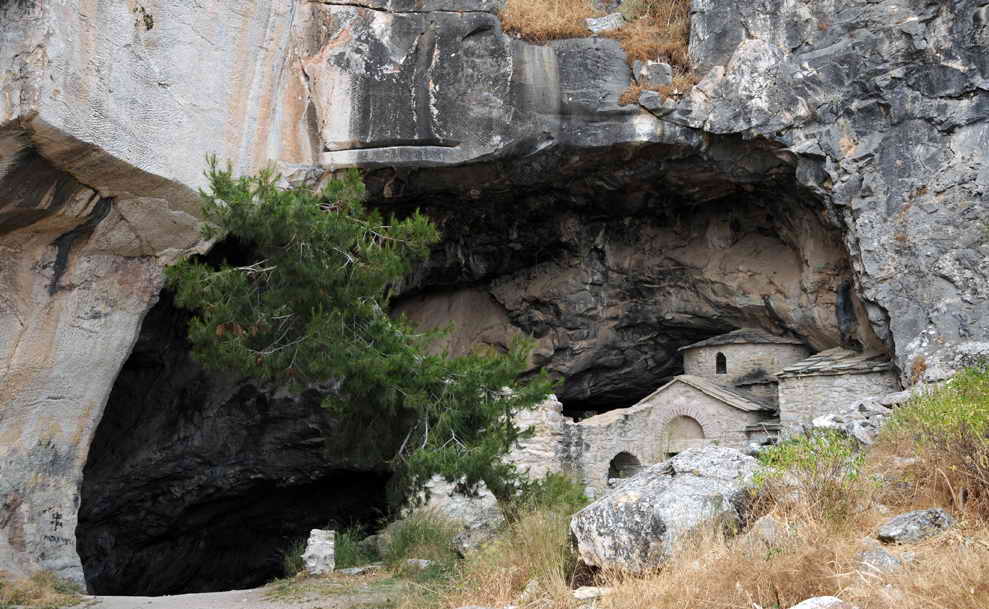
Davelis’ legend grew in dimension when he found shelter in a cave on Penteli Mountain, considered to have been haunted, as a hideout. The cave is part of a subterranean complex linked to many other caves. It has been associated with supernatural phenomena. In ancient Greece, it was a place of worship of the god Pan and was associated with a cult of Nymphs. In the Middle Ages, Christian hermits used the cave as their home and built a church at its entrance. Later, it was used by heretical monastic groups that split from the Orthodox Church.
Eventually, it was named the Davelis Cave. Urban legend has it that Davelis has hidden substantial treasures in its depths.
The Davelis folklore
By 1856, the gang was operating mainly in Athens. In a show of strength, the Davelis gang entered the suburban Menidi gendarme station and forced the gendarmes to surrender all their guns. The humiliating incident angered the Gendarmerie and a merciless hunt for Davelis was ordered. Davelis and his men went into hiding, while he corresponded with Duchess Bacoli, who offered him safe passage to Italy. Somehow the letters were intercepted by Davelis’ nemesis, his former partner, Yiannis Megas.
On July 12, 1856, a gendarmerie detachment, led by Yiannis Megas, located the gang near the village of Zemeno in Boeotia. A heavy engagement ensued. Davelis, seeing his overpowered comrades fall one after the other, challenged Megas to a duel to the death.
Megas, still vengeful, rushed to cut off Davelis’ head with his lance, but Davelis managed to attack and kill him first. A gendarme shot Davelis, fatally wounding him, while reportedly shouting, “Neither Davelis in the mountains, nor Megas in the palaces.” The gendarmes nailed Davelis’ head to a pole in Syntagma Square that they left on public view for several days thereafter.
This added to the legend of Davelis. For decades to follow, tidbits of the life and feats of the legendary bandit, whether true or imaginary, fueled the imagination of Greeks. Among the legends surrounding Davelis was one claiming that he often disguised himself to hang out at Athenian cafés to chat with patrons.
Another legend was that he was the lover of the French Duchess of Piacenza (Δούκισσα της Πλακεντίας in Greek) who had a mansion on Penteli Mountain. Supposedly, he visited her through an underground tunnel beneath the Davelis Cave.
The name Davelis has become engraved in the collective mind of Greeks. He was a larger-than-life bandit who was admired and feared at the same time, and the cave named after him will keep his name alive for generations to come.
See all the latest news from Greece and the world at Greekreporter.com. Contact our newsroom to report an update or send your story, photos and videos. Follow GR on Google News and subscribe here to our daily email!

