



A set of ancient stone tools found in northern Spain is giving fresh weight to the idea that North Africa shaped early human technology in Europe far earlier than many researchers thought. The study centers on stone tools from the Revilleja de Valparaíso site and argues that North Africa may have influenced the Iberian Peninsula about 700,000 years ago.
The study, published in Quaternary Science Reviews, was led by Francisco-Javier García-Vadillo of the Catalan Institute of Human Paleoecology and Social Evolution (IPHES) in Spain.
The team examined a quartzite tool assemblage from Revilleja de Valparaíso, a site near Hortigüela in Burgos. The tools were recovered from an alluvial deposit in a strategic river corridor between the Arlanza and Valparaíso rivers.
Researchers dated the deposit to about 696,000 years ago, with an uncertainty of 32,000 years. They used two independent methods, terrestrial cosmogenic nuclides and electron spin resonance on quartz, and then combined the results through Bayesian modeling.
Stone tools in North Africa gain an earlier European context
Researchers say Revilleja de Valparaíso is the first Large Flake Acheulean site in Western Europe with this kind of numerical date from that period. They argue that this pushes back the presence of this technological tradition in Iberia and challenges the view that such influence arrived much later.
The excavated assemblage is small, with 13 artifacts recovered in a stratigraphic context. Ten came from the lower gravel layer that was directly tied to the dating results. The pieces include flakes, cores, handaxes, picks, and a chopping tool.
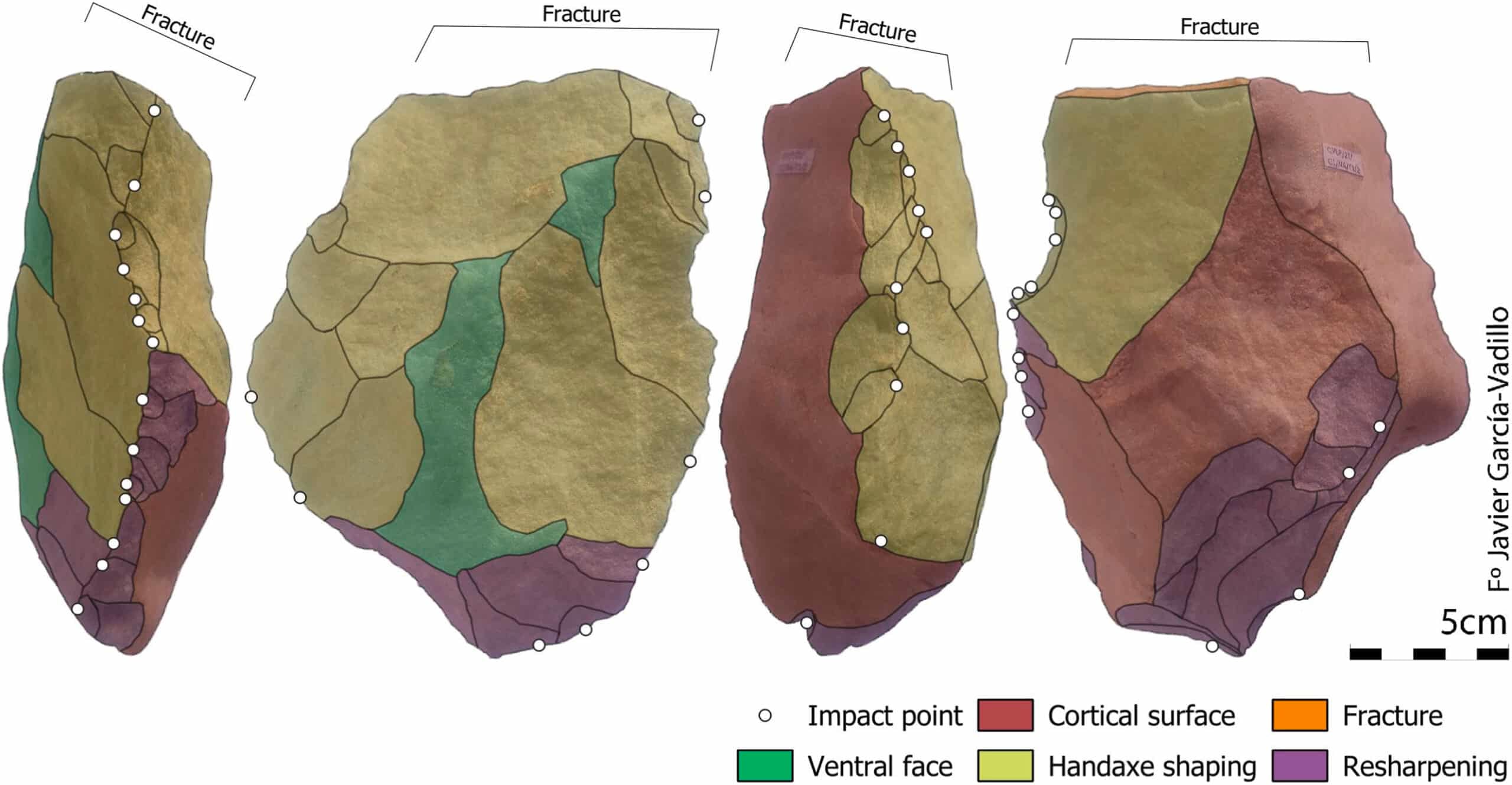
Most were made from local quartzite. Several of the large cutting tools were shaped on flakes, a key feature that researchers link to the Large Flake Acheulean tradition.
The study argues that these traits connect the Spanish site more closely to Acheulean traditions seen in North Africa than to early Acheulean sites north of the Pyrenees.
In particular, researchers point to the large flakes, the shaping of handaxes on flakes, and the range of large cutting tools. They say those features match technological patterns documented in North African assemblages.
Spanish site points to an earlier cross-Mediterranean tool tradition
The study also argues that Western Europe around 700,000 years ago did not host a single, uniform Acheulean culture. Instead, researchers describe a more complex picture.
They say one tradition developed north of the Pyrenees, while another, tied to the Large Flake Acheulean, reached Iberia from south of the Strait of Gibraltar.
Researchers say the findings place the roots of the Iberian Acheulean earlier than 500,000 years ago and suggest the Strait of Gibraltar was not a late or secondary route.
See all the latest news from Greece and the world at Greekreporter.com. Contact our newsroom to report an update or send your story, photos and videos. Follow GR on Google News and subscribe here to our daily email!

