



Archaeologists in Peru have uncovered a complex architectural structure linked to astronomical observation at the Áspero archaeological site.
The discovery was announced by Peru’s Ministry of Culture through the Caral Archaeological Zone. The site belongs to the Caral Civilization, one of the oldest known societies in the Americas, dating from about 3000 to 1800 BC.
Researchers say the structure was designed as a specialized space for observing the sky. The work was led by Peruvian archaeologist Ruth Shady Solís. Experts believe trained individuals used the site to track the movements of the Sun, Moon, and stars. These observations likely helped communities anticipate seasonal changes and manage coastal resources.
Elevated position supported observation

Excavations in Sector J1 revealed that the structure sits near the settlement’s main pyramidal complexes. From this point, both the coastline and the lower Supe Valley are visible. Researchers say this vantage point would have allowed systematic observation of environmental and celestial patterns.
This knowledge was critical for the fishing population. Predicting tides and seasonal shifts would have improved planning and ensured more reliable access to marine resources. It may also have supported exchange with nearby agricultural communities.
Construction phases show changing functions
Archaeologists identified four construction phases, showing how the structure evolved. In its earliest stage, the building likely served as a public ceremonial space.
Later, builders added an oval platform measuring about 3.18 meters (10.4 feet) in diameter and 63 centimeters (2.1 feet) in height. A vertical stone, known as a huanca, stood at its center. Such stones are widely associated with ritual practices in Andean cultures.
During a later phase, the structure was expanded into a double-stepped platform. The lower level measured about 9.40 meters (≈30.8 feet) in diameter and one meter (≈3.3 feet) high, while the upper platform measured 4.80 meters (≈15.7 feet).
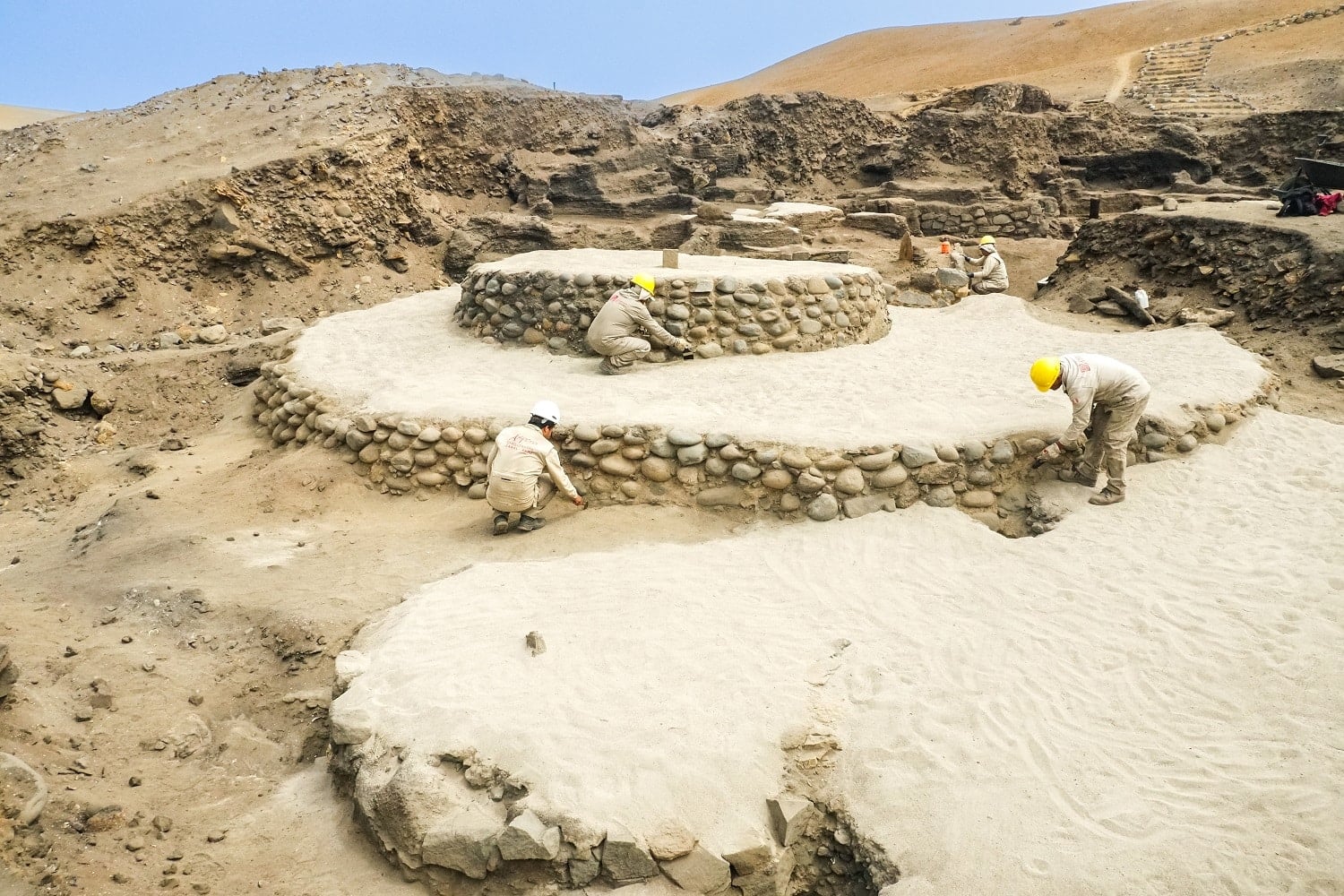
At its center, archaeologists found a rectangular stone and a nearby ceremonial hearth. These features suggest intensified ritual activity linked to observation of natural cycles.
In its final stage, the structure was covered and converted into residential spaces. Researchers say this shift reflects broader social changes and a decline in its specialized role.
Key port and center of knowledge
The Áspero settlement lies about 700 meters (0.43 miles) from the Pacific Ocean and covers roughly 18.8 hectares (≈46.5 acres). It includes 25 architectural complexes, indicating a well-organized society built on marine resources and regional exchange.
Findings at the site confirm that Áspero was not only a fishing center but also a place where scientific and ritual knowledge developed. The discovery adds to ongoing research into early Andean astronomy and highlights how ancient communities used observation to understand and adapt to their environment.
Further studies, including radiocarbon dating and architectural analysis, are underway to refine the site’s chronology and better understand its role within the Caral network.
See all the latest news from Greece and the world at Greekreporter.com. Contact our newsroom to report an update or send your story, photos and videos. Follow GR on Google News and subscribe here to our daily email!

