



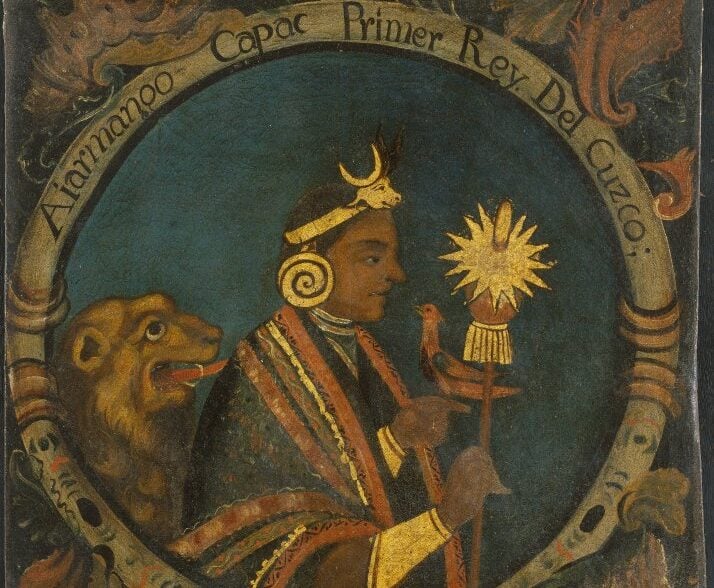
One of history’s most fascinating experiments in communism was carried out by the Inca Empire, a sprawling civilization across the harsh Andes that thrived without a single coin changing hands.
To modern eyes, the Inca running a completely cashless society might seem like a socialist utopia—almost too ideal or too strange to be true. It’s easy to retroactively label it “Inca communism.” Yet the reality was far more complex than 20th-century political theories suggest. The state ensured that no one went hungry and that everyone had shelter, but this wasn’t a grassroots workers’ revolution. It was a fiercely rigid, theocratic system that controlled people’s lives from birth to death.
Who actually owned the land in the Inca Empire?
Understanding land ownership in the Andes requires putting aside Western ideas of property and individual rights because the Inca system of communism governed not just resources but people’s very relationship to the land. The emperor, the Sapa Inca, was considered a living god—the literal son of the sun—and therefore technically owned every rock, river, and mountain across the empire.
In practice, land could not be bought or sold. The state divided territory into three main categories: the state’s share, to support the government and military; the Religion’s share, to maintain priests and temples; and the Community’s share, allocated to local groups known as “ayllus.”
Families never received formal deeds. Instead, they were granted the right to work a specific plot, sized according to the number of mouths they needed to feed—an arrangement resembling communism in principle. Yet in reality, the system emphasized collective stewardship rather than outright ownership, tightly controlled by a paternalistic government. While it echoed certain socialist ideals, the primary goal was to reinforce the emperor’s absolute power. Even today, echoes of this system remain. Communal land rights continue to shape indigenous politics and identity in Peru and Bolivia.

A proto-communist society without cash?
One of the most remarkable aspects of the Inca’s proto-communist system was how they managed millions of people without currency. Everyday citizens exchanged basic goods at local gatherings called “katus,” while the state maintained a strict monopoly over luxury items and long-distance trade.
Consider gold and silver. When the Spanish arrived, they ravaged the continent in pursuit of these metals, yet for the Inca, precious metals held no economic value. They were simply the “sweat of the sun” and “tears of the moon,” used only to embellish temples and signal the status of the elite. By removing the profit motive entirely, the Inca effectively prevented the rise of a wealthy merchant class that could challenge imperial authority.
This stands in stark contrast to today’s materialistic, hyper-capitalist world. While modern societies worry over stock market fluctuations and cryptocurrency crashes, the Inca demonstrated that a highly complex civilization could function efficiently by distributing physical resources, entirely ignoring the accumulation of abstract wealth.

Sweating for the state: The mit’a system’s role in Inca communism
So how do you collect taxes when no one has a bank account or even money? For the Incas, the solution was straightforward: you taxed their sweat. The empire relied on a mandatory labor draft called the mit’a, which became the true engine of the state. Ordinary citizens labored tirelessly, carving thousands of miles of roads through sheer mountain cliffs and constructing the steep agricultural terraces that still amaze visitors today.
But it was not a one-sided arrangement. In return for this grueling work, the state operated a vast welfare system. Giant stone silos, called qullqas, were scattered across the empire, stocked with freeze-dried potatoes, corn, and other staples. If drought struck, or if someone became too old or ill to work, the state ensured they were fed.
It was a strict social contract. People gave the state total obedience and backbreaking labor, and in exchange, the state guaranteed survival. That mindset—“all for the state”—did not disappear with the empire’s fall. It left a lasting mark on South American culture, where the expectation of a strong, protective government continues to influence politics and society.
Ultimately, Tahuantinsuyu (the Inca Empire) was not an egalitarian paradise or a fully realized communist society. It was a meticulously organized command economy, one that prioritized collective survival over individual freedom.
Standing among the sun-baked ruins of Machu Picchu, it’s striking to consider: today, we have unprecedented technology, yet poverty and inequality persist. The Inca managed to provide for everyone without relying on capitalism. Perhaps the greatest lesson from the Andes is that while perfect equality may be impossible, eliminating poverty is largely a matter of political will and administrative capability.
See all the latest news from Greece and the world at Greekreporter.com. Contact our newsroom to report an update or send your story, photos and videos. Follow GR on Google News and subscribe here to our daily email!

