



A fairly recent theory about the truth behind Atlantis is that it can be identified with a peculiar natural formation known as the Eye of the Sahara. This is a circular formation in Mauritania, northwest Africa. According to some theorists, the Eye of the Sahara is a perfect match for Plato’s legendary description of Atlantis. Is this really the case?
How the Eye of the Sahara Supposedly Fits Atlantis
Let us begin by analyzing the supposed match between the Eye of the Sahara and Atlantis. The Eye, also known as the Richat Structure, is a formation of several concentric circular depressions and ridges in the desert.
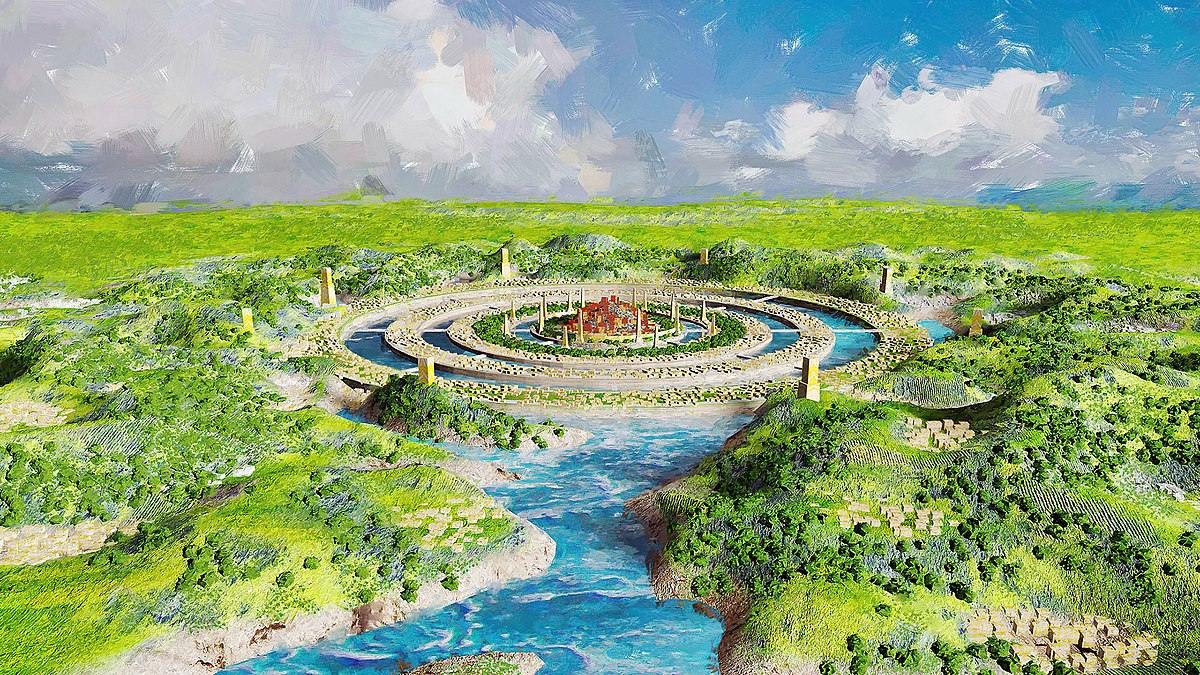
This is similar to the legendary description of Atlantis. According to Plato’s Critias, the capital of Atlantis was a central island surrounded by three alternating rings of land and water. At the Eye of the Sahara, the central area of land is surrounded by three large ridges with depressions in between them.
Of course, this area is completely dry today. However, if it were at sea level, then water would fill these depressions. The result would look very similar to Plato’s description of Atlantis.
Furthermore, the size also seems to match up well. Plato gives the citadel of Atlantis a diameter of approximately 11 miles. In line with this, proponents of this theory state that the Richat Structure has a diameter of about 13 miles, which is a fairly close match.
Evidence that the Eye of the Sahara was formerly at sea level
A major aspect of this theory is that the Eye of the Sahara was formerly at sea level. This is crucial. Otherwise, how could the Eye of the Sahara have been Atlantis, which was famously an island?
Some theorists argue that the northwest portion of Africa has gradually risen over the past 11,000 years. They argue that it was at sea level in c. 9600 BCE when Plato seems to place the account of Atlantis.
The supposed evidence for this is that satellite imagery reveals substantial amounts of salt within the Richat Structure’s rings. This, so the theory goes, proves that salt water formerly filled those rings.
In addition, satellite imagery appears to show that the sand surrounding the Richat Structure was swept across the land in what looks like evidence of a massive tsunami. This would have devastated any settlement that formerly existed on the Eye of the Sahara, just like what supposedly happened with Atlantis.
Problems with the evidence
Although this theory has gained considerable popularity in recent years, scientists and historians have widely rejected it. Why is this? Despite the confident claims of the theory, it does not stand up to scrutiny.
One issue is that some of the evidence is mutually contradictory. For example, consider the argument about the size and layout of the Eye of the Sahara. It does indeed have three distinct ridges. However, if we include the third ridge, then the structure as a whole is substantially larger than 13 miles in diameter.
On the other hand, if we take the diameter of 13 miles, then we need to exclude the third ridge. Hence, this would not be a perfect match for Plato’s description. We cannot hold to both arguments at the same time. They are mutually exclusive.
Contradictions of the sea-level argument
We find similar issues when we examine the supposed evidence that the Eye of the Sahara was formerly at sea level, like Atlantis. One argument is that the salt in the depressions proves that it used to be at sea level (in reality, it does not). Yet, another argument is that the appearance of the sand in the surrounding area proves that an enormous tsunami swept across the land.
Both things cannot be true at the same time. If this structure had been at sea level, then the surrounding land would have already been underwater and thus the tsunami would not have swept the sand anywhere.
On the other hand, if we accept the supposed evidence for a tsunami sweeping across the land, then the Eye of the Sahara cannot have been at sea level when this occurred and thus it cannot have been Atlantis. Once again, these arguments are mutually exclusive.
Other issues with the Eye of the Sahara as Atlantis
As well as these arguments being mutually exclusive, there are various other issues with this theory. For example, Plato directly says that Atlantis was greater than Libya and Asia combined. The Eye of the Sahara, being in North Africa, was within what the Greeks knew as Libya. This alone is enough to discount the Eye of the Sahara as the real Atlantis.
Furthermore, one major piece of supposed evidence for this theory is that Herodotus allegedly wrote of a place called ‘Atlantes’ in this era. This claim is entirely incorrect. The ‘Atlantes’ mentioned by Herodotus was not a place, but a people.
They had this name under living next to Mount Atlas, which is emphatically nowhere near the Eye of the Sahara. Additionally, the mythological Titan named Atlas did not become associated with that mountain range in North Africa until the sixth century BCE at the earliest.
Even with the best will in the world, this would have been many centuries after the legendary war between the Atlanteans and the Greeks. Thus, this does not offer any plausible argument for the Eye of the Sahara being connected to the name of Atlas in that early period.
See all the latest news from Greece and the world at Greekreporter.com. Contact our newsroom to report an update or send your story, photos and videos. Follow GR on Google News and subscribe here to our daily email!

