



The epic clash between Julius Caesar and Pompey the Great marks a turning point that reveals how the Roman Republic slowly but steadily transformed into an empire.
Before these two monumental figures found themselves on a collision course, Caesar, Pompey, and Marcus Licinius Crassus worked together in what history remembers as the First Triumvirate. This unlikely yet powerful and unofficial political alliance, formed in 60 BC, was explicitly designed to bypass the authority of the Roman Senate and, quite frankly, to turbocharge the political power and personal ambitions of its members.
Pompey, the elder statesman among them, had already earned his title “Magnus” thanks to a series of extraordinary military victories. He was the commander who cleared the Mediterranean of pirates and conquered vast territories in the East, turning the Roman Republic into a dominant power of its time. His astonishing triumphs on the battlefield made him a living legend among the Romans.
Caesar, by contrast, was the rising political star—a brilliant orator who captivated audiences and used his charisma to propel himself to the consulship. His combination of relentless ambition and genuine popular appeal made him a force to be reckoned with in Roman politics.
As for Crassus, he was the financial powerhouse of the group—one of the wealthiest men in Rome—providing the crucial economic backing for the trio’s grand political aspirations within the Republic’s hierarchy.
Yet, within this seemingly unbreakable alliance lay the seeds of its own destruction, as often happens with opportunistic political pacts. Though their combined strength was formidable, their individual ambitions were far too great to coexist indefinitely, especially within a republican system already rife with personal rivalries. The political arena of Rome was simply too small for two towering figures like Caesar and Pompey. Inevitably, one would have to yield—and that clash would become one of the most monumental conflicts in the history of the Roman Republic.
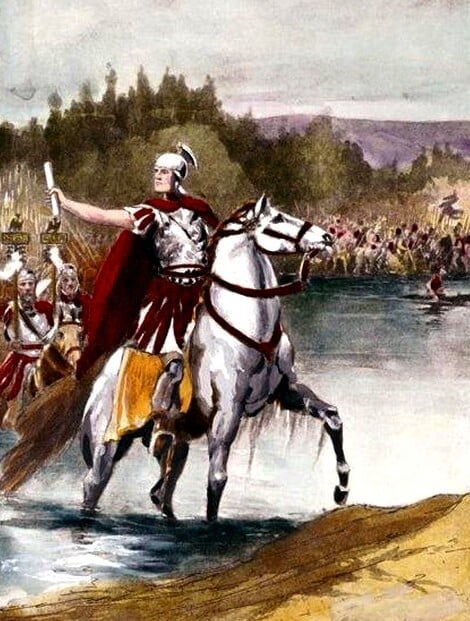
The Rubicon was crossed: Caesar against Pompey
The long-anticipated unraveling of the First Triumvirate truly began with the death of Crassus in 53 BC and, perhaps even more crucially, the loss of Julia.
Julia was Caesar’s daughter and Pompey’s wife. This familial bond had served as a fragile bridge between the two powerful men, restraining their egos from clashing outright. With Julia’s death, however, that bridge collapsed—leaving nothing to hold them back from open conflict.
As Caesar’s military campaign in Gaul neared its end, his astonishing success and the immense wealth and prestige he gained made him an existential threat to the conservative Senate and, by extension, to Pompey’s political future.
The Senate, dominated by staunch republicans, viewed Caesar as a dangerous revolutionary whose insatiable ambition and pursuit of glory endangered the very foundations of the Roman Republic. In an effort to curb his rising power, they ordered him to disband his legions and return to Rome as a mere private citizen—no longer as the Republic’s most celebrated military hero.
By this time, Pompey found himself torn between loyalty to his former ally and loyalty to the Republic’s political traditions. In the end, he sided with the Senate, likely driven by fear—fear of Caesar’s growing popularity and the very real possibility that his own influence would fade before the magnetic appeal of Caesar’s leadership.
Then came the moment that changed Roman history forever. In January 49 BC, Julius Caesar made his fateful decision to cross the Rubicon River, declaring with chilling finality, “Alea iacta est”—“The die is cast.” This single act of audacious defiance hurled Rome into a civil war that would reshape the Republic’s destiny. The crossing of the Rubicon became not only the point of no return for Caesar but also one of the most consequential moments in the entire history of the Roman Republic.
Pharsalus: Caesar and Pompey’s final act
The inevitable confrontation between Julius Caesar and Pompey the Great reached its climax at Pharsalus—in Thessaly, Greece, near today’s town of Farsala—in 48 BC. Although Pompey commanded far more soldiers than Caesar’s smaller but battle-hardened legions, the outcome was decisive. Pompey suffered a crushing defeat that revealed to the world who the true military genius was.
Pompey’s strategy relied on wearing down Caesar’s veterans through attrition, hoping to exhaust them into submission. But he gravely underestimated their resilience. Caesar’s loyal men, seasoned by years of relentless campaigning, proved simply too disciplined, too experienced, and too determined to die.
Defeated and disheartened, Pompey fled to Egypt, seeking refuge with the young Pharaoh Ptolemy XIII. In a cruel twist of fate, he was betrayed and assassinated upon his arrival—a brutal and ignominious end for a man once hailed as the savior of Rome. His death not only symbolized personal tragedy but also marked, in the eyes of many historians, the definitive end of the Roman Republic’s long struggle against autocratic rule.
Caesar’s victory at Pharsalus and Pompey’s tragic death in Egypt reshaped the entire course of Western history. The triumph cleared the path for the rise of the Roman Empire, ushering in centuries of imperial dominance across the Mediterranean world and far beyond.
See all the latest news from Greece and the world at Greekreporter.com. Contact our newsroom to report an update or send your story, photos and videos. Follow GR on Google News and subscribe here to our daily email!

