



High on the plains of ancient Persia, near what is now Shiraz, stands the memory of a city once called Parsa, known to the Greeks as Persepolis, the “City of the Persians.” Its foundations were laid in the late sixth century BC by Darius I, the visionary ruler of the Achaemenid Empire.
Darius selected a remote site at the foot of the Zagros Mountains, far from the older capitals of Susa, Ecbatana, and Babylon. This choice was both symbolic and strategic. Persepolis was never intended to serve merely as an administrative hub; rather, it was envisioned as a ceremonial center—a sacred reflection of the empire, its authority, and divine order.
The name and the myth
Construction began around 518 BC, and over decades it evolved into one of the grandest architectural achievements of the ancient world. Darius and his successors, Xerxes and Artaxerxes I, expanded it relentlessly. They constructed terraces and erected palaces and halls of stone which shimmered under the Iranian sun. It became the beating heart of Persian royal ritual, the place where New Year festivals celebrated cosmic renewal, the submission of nations, and the eternal favor of God Ahura Mazda.
The name Persepolis is deeply connected with both myth and language. To the Greeks, it was “the city of Perseus,” the legendary founder of the Persian race. According to Greek mythology, Perseus fathered a son, Perses, whose descendants were believed to have become the Persians, following the hero’s slaying of Medusa. In its native Old Persian, however, the city’s name was Parsa, meaning “the city of the Persians.” Though simpler in etymology, the name reflects a deep sense of national identity.
The Zoroastrian cosmos and the sacred city
To truly understand Persepolis, one must look past the stone and empire. The city reflected a moral and spiritual world shaped by Zoroastrian belief. Darius and his successors ruled under the banner of Ahura Mazda, the supreme god of truth and light. Their inscriptions echo this devotion. Darius often declared that his victories came “by the will of Ahura Mazda.” The city’s architecture embodied that faith, with its symmetry and order mirroring the cosmic duality between truth (asha) and falsehood (druj).
Persepolis stood as a physical reflection of Zoroastrian cosmology. The elevated terrace symbolized the separation between the sacred and the profane. The stairways that led to the Apadana, the great audience hall, for instance, evoked the ascent of the soul toward divine order. Light flooded the spaces, playing upon the carved figures of gods, kings, and delegations. The city thus became a world within a world—a place where divine justice met royal authority.
Zoroastrians saw in Persepolis the model of a righteous kingdom and the earthly mirror of asha. Though the sacred fire temples of the faith were found elsewhere, the spirit of Persepolis resonated with the cosmic light of their religion. It represented the ideal balance between creation and power, as well as between the ruler and the moral law.
Architecture of power and harmony
Persepolis rose upon a massive artificial terrace more than 450 meters (1,476 feet) long and 300 meters (984 feet) wide. Builders used limestone quarried from the nearby mountains and cedar wood brought from Lebanon. The construction required extraordinary coordination, with artisans and laborers, including Persians, Medes, Babylonians, Egyptians, and Greeks, from across the empire. Each group contributed their craft, resulting in a city that embodied imperial diversity.
The Apadana, Darius’s audience hall, stood as the heart of this architectural vision. Its vast columned hall could hold thousands of people. Reliefs on its stairways depicted processions of tribute bearers from subject nations, each shown with dignity and distinct costume. This was not mere propaganda but a visual expression of harmony among nations under one divine order.
Nearby stood the Hall of a Hundred Columns, built by Xerxes. Its scale rivaled the Apadana and symbolized the endurance of royal might. The Gate of All Nations, with its colossal winged bulls, welcomed envoys from every corner of the empire. Each building stood upon a platform of perfect geometry, arranged according to principles of symmetry and light. The architects of Persepolis sought not just grandeur but balance, echoing the ethical harmony central to Persian and Zoroastrian thought.
Gold, silver, lapis lazuli, and ivory adorned the halls. The city’s treasures were legendary, yet Persepolis’ most precious gift was not wealth but meaning. Additionally, every relief and inscription carried a vision of unity. Persepolis was a living sermon in stone—a reminder that an empire could embody justice when guided by divine wisdom.

The fire of Alexander and the end of a world
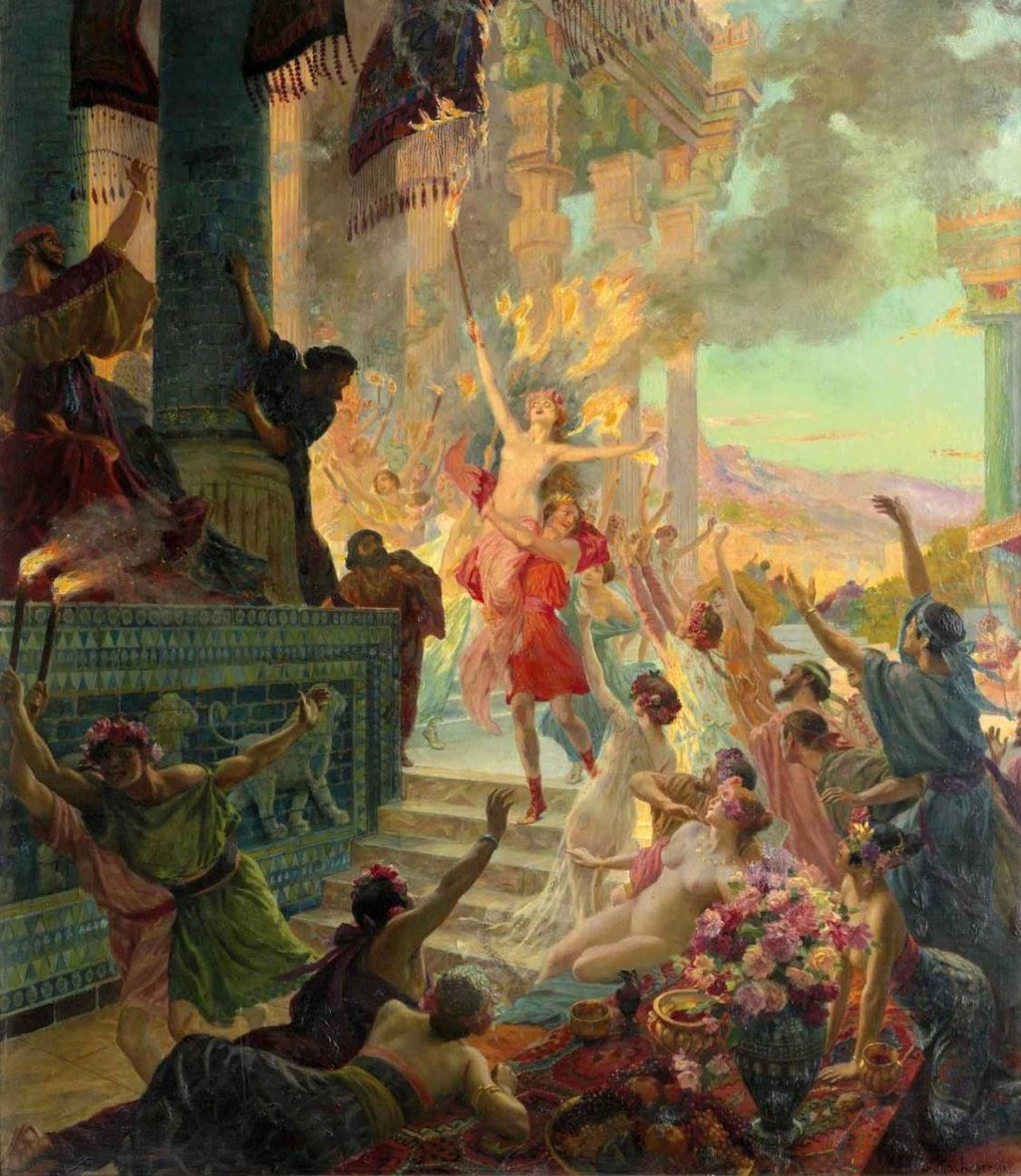
In 330 BC, the order of Persepolis met its tragic undoing. After defeating Darius III, Alexander of Macedon marched into the Persian heartland. Moreover, he entered Persepolis and allowed his soldiers to plunder it. The city that had stood as a symbol of light met the fury of fire. Ancient sources provide varying accounts on Alexander’s reasons for burning the city.
Diodorus Siculus says the act was deliberate revenge, a response to Xerxes’ burning of Athens a century and a half earlier. He also describes it as a drunken impulse, urged on by Thais, an Athenian courtesan who urged Alexander to avenge Greece’s past humiliation. Yet Plutarch suggests that Alexander regretted the destruction, realizing he had erased a monument to human greatness.
Regardless of his motive, the fire consumed more than marble and gold. It destroyed a vision of kingship bound to divine justice. Moreover, the city fell into silence, and its terraces turned to ash. Yet, even in ruin, Persepolis endured as a symbol of the fragility of power and the immortality of memory.
Today, the ruins of Persepolis still rise from the Iranian plain like the bones of a god. Its columns stand beneath the same sky that once glowed with sacred fire. Within their broken grandeur lies a message that transcends centuries: Darius built Persepolis, the city, not for fleeting glory but for an enduring reflection of order, truth, and unity.
The city’s destruction marked the end of an era, yet the idea of Persepolis survived. It shaped later Persian dynasties and inspired poets who saw in its stones the echo of divine wisdom.
See all the latest news from Greece and the world at Greekreporter.com. Contact our newsroom to report an update or send your story, photos and videos. Follow GR on Google News and subscribe here to our daily email!

