



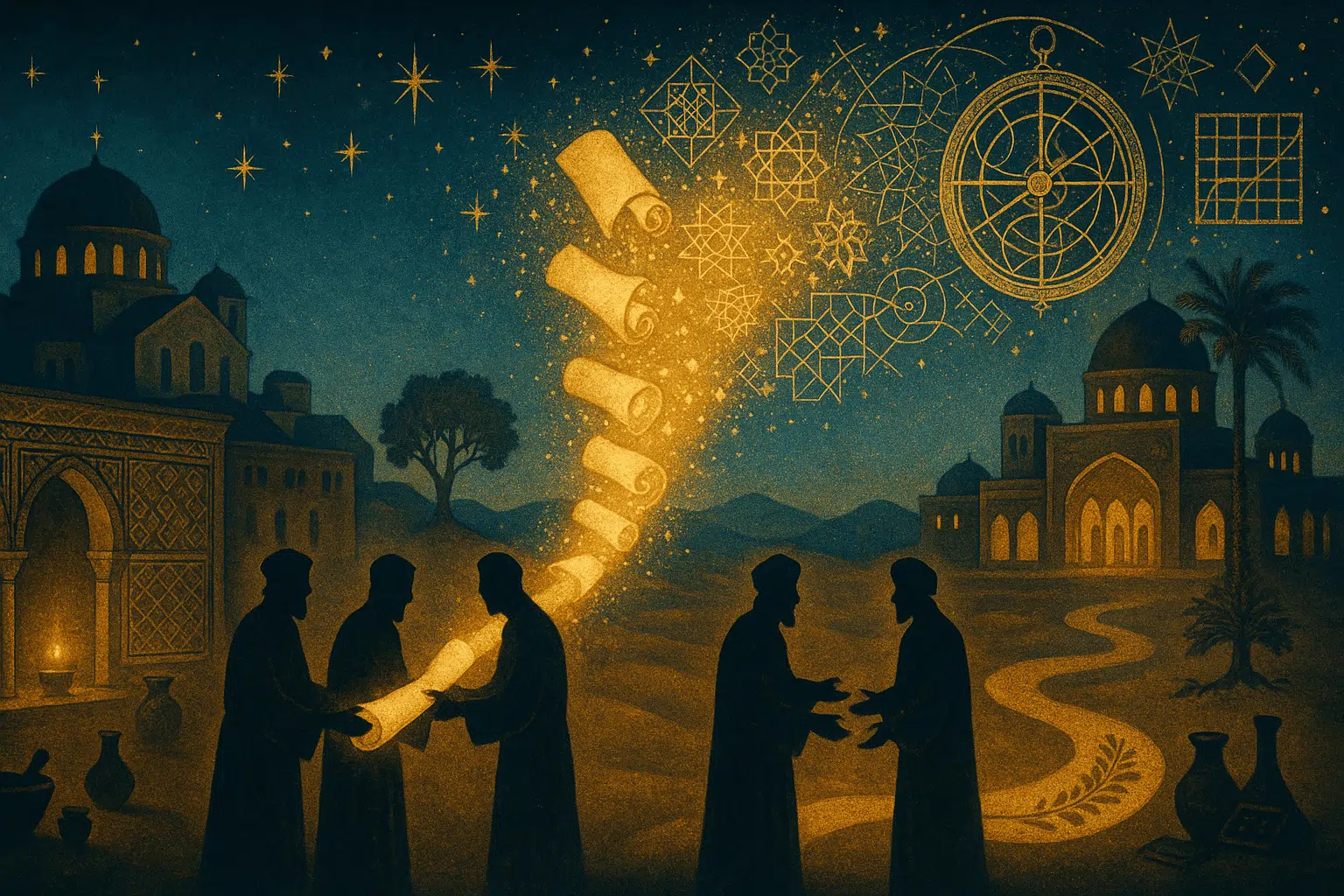
During the Islamic Golden Age, engagement with Greek thought inspired extraordinary scientific, philosophical, and medical advancements from the 8th to the 14th century. This phenomenal flourishing of a rising civilization took place due to a series of factors and events, one of which is closely linked to the Byzantine Empire and the legacy of classical knowledge.
Behind the Islamic Golden Age lies a far older story rooted in Ancient Greece. Strangely enough, we largely have the Byzantine Empire to thank for ensuring those Greek ideas were still around to inspire the scholars of Baghdad centuries later—the same empire that was the number one enemy of the rising Islamic empires of the East.
The rise of the Islamic Golden Age is a historical paradox that continues to intrigue scholars, particularly in its debt to Greek thought. While much of Western Europe was losing touch with classical traditions in the early Middle Ages, the Eastern Roman Empire—later known as Byzantium—quietly preserved them.
Monks and scholars safeguarded centuries-old scrolls across the empire, copying, studying, teaching, and expanding upon them. In doing so, they ensured that the vast body of knowledge inherited from antiquity endured, providing later generations with essential tools to interpret not only the ancient world but the human experience as a whole.
How the Byzantines helped the Islamic Golden Age develop through their preservation of Greek thought
In cities such as Constantinople, ancient Greek texts by Aristotle, Galen, Hippocrates, and other vital figures of the ancient Greek and Roman past were copied and commented on long after they had vanished from libraries in the West. Monasteries slowly but steadily became centers of learning, where the laborious task of preserving these texts quietly continued for centuries.
For the Byzantines, Greek philosophy and science retained their importance. Rather than viewing them as relics of the past, they actively engaged with these traditions—debating their ideas, teaching them alongside Christian theology, and keeping them alive through continual reinterpretation and critique.
What the Byzantines could not have foreseen was that their centuries of scholarly work would one day flow into the Arabic-speaking world. This transmission was not the result of conquest or mere chance, as is often assumed, but of a deliberate process of translation from Greek and Latin into Arabic—a task frequently carried out by Syriac-speaking Christian scholars who were fluent in both linguistic traditions. Without this crucial linguistic bridge linking Europe and the Middle East, the intellectual legacy of Ancient Greece might have never reached the House of Wisdom in Baghdad.
The House of Wisdom, or Bayt al-Hikma in Arabic, became the cornerstone of this remarkable cultural exchange between the Byzantine world and Islamic societies. Founded in Baghdad in the early 9th century, it served as a royal academy, library, and translation institute under the patronage of the Abbasid caliphs.
Scholars from diverse faiths and backgrounds, including Muslims, Christians, and Jews, worked side by side to translate Greek, Persian, and Indian texts into Arabic. Their efforts not only preserved the ideas of antiquity but also transformed them, laying the groundwork for new discoveries in mathematics, astronomy, medicine, and philosophy.
The House of Wisdom was a major intellectual hub where Islamic scholars thrived, producing new scientific and philosophical ideas inspired by ancient Greek philosophers and thought as well as the intellectual traditions of Persia and India. It played a pivotal role in the Islamic Golden Age.

How Baghdad became the epicenter of the Islamic Golden Age
The Abbasid Caliphate thrived under caliphs such as Harun al-Rashid and al-Ma’mun, leaders who transformed Baghdad into a hub of serious intellectual power. The House of Wisdom wasn’t a library as many falsely believe—it was the epicenter of knowledge, a living and breathing institution where knowledge was passed on, expanded upon, and spread across the Middle East. Leaders and wealthy individuals there wished to learn how the world worked, and they were willing to fund the right people who could get them the answers they craved.
Greek manuscripts on logic, medicine, mathematics, astronomy, and philosophy were translated and expanded upon. Scholars such as al-Farabi and Ibn Sina studied individuals like Aristotle, then engaged with, critiqued, and incorporated his ideas into Islamic theology and legal theory, effectively making Ancient Greece a significant factor that shaped the evolution of Islamic faith and logic.
Medicine also underwent a transformation during the Islamic Golden Age, as the theories of Galen and Hippocrates were tested, refined, and expanded in hospitals throughout the Islamic world. In mathematics, scholars such as al-Khwarizmi built on Greek geometry and introduced algebra, helping to shape the foundations of modern mathematics as we know it today.
It is therefore accurate to say that when Europe “rediscovered” Aristotle and other towering figures of ancient Greece in the 12th century, this knowledge did not come directly from Greece alone. Instead, it arrived via Arabic translations and the scholarship of thinkers from Baghdad and across the Middle East. Translated first from Greek into Arabic and then into Latin, these works returned to Europe enriched, carrying layers of Islamic interpretation and critique that were fully integrated into Western European thought.

Thinkers such as Avicenna and Averroes became essential reading in European universities. Avicenna, a Persian philosopher and physician, authored The Canon of Medicine, which profoundly influenced European medical practice, while Averroes, a Muslim Andalusian scholar, was renowned for his commentaries on Aristotle.
Their insights shaped medieval thought just as much as the original Greeks. The so-called “Renaissance” was effectively a “secondhand inheritance,” refined and built upon within a cultural context quite different from that of the Christian West.
This illustrates that history is rarely a neat, linear narrative, as we often imagine. Civilizations do not exist in isolation; they borrow, build upon, preserve, and remix the knowledge of those who preceded them.
See all the latest news from Greece and the world at Greekreporter.com. Contact our newsroom to report an update or send your story, photos and videos. Follow GR on Google News and subscribe here to our daily email!

