



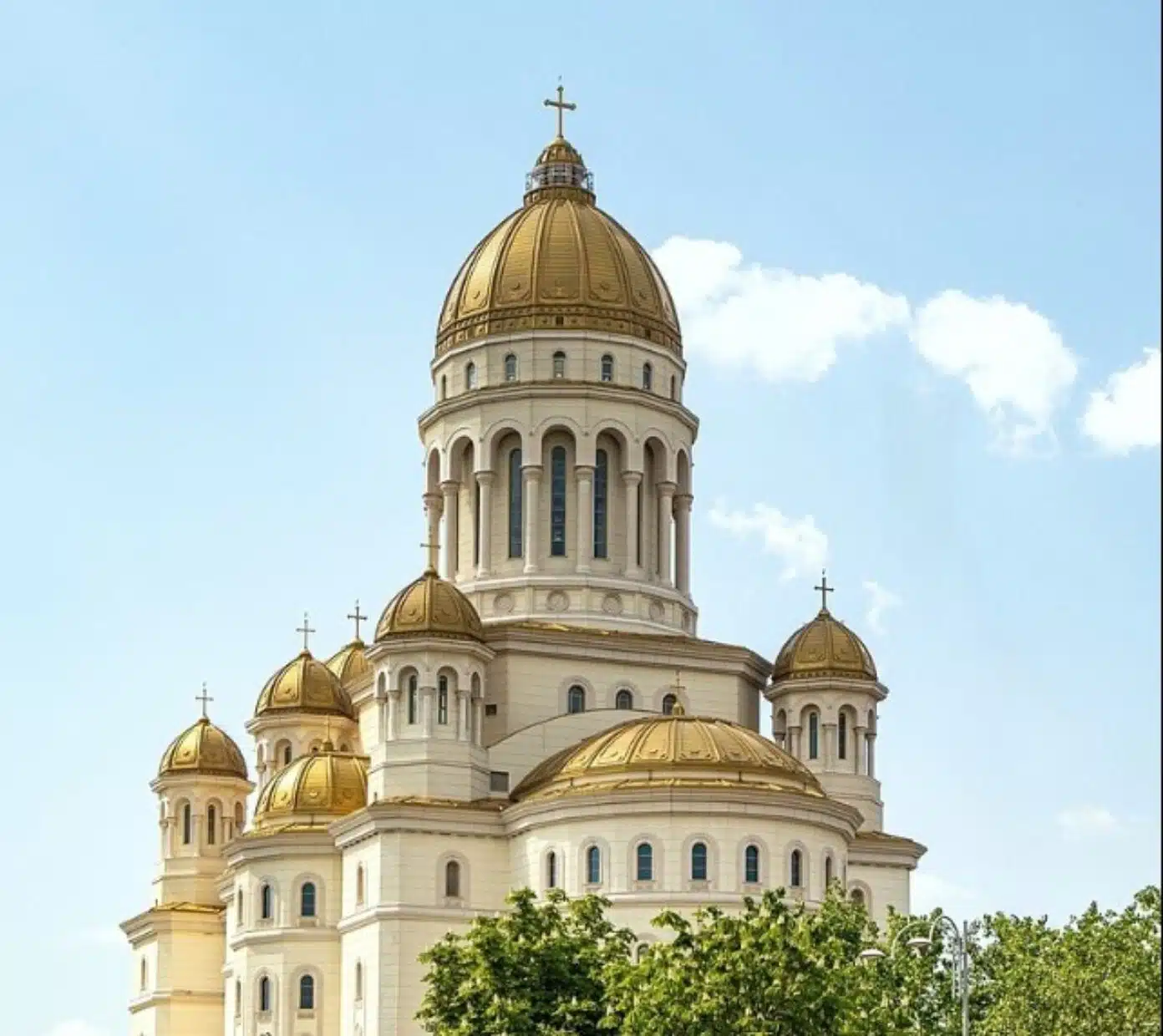
The largest Orthodox church in the world has been built in Bucharest, Romania and will officially open its doors to the public in October.
The People’s Salvation Cathedral, at a height of over 130 meters (426.5 ft), will become the future seat of the Romanian Orthodox Church and the tallest Orthodox structure in the entire world.
It will be consecrated in a historic ceremony led by His All-Holiness Ecumenical Patriarch Bartholomew I of Constantinople and His Beatitude Patriarch Daniel of Romania on October 26.
The church is some 13 meters (42.5 ft) taller than the second-placed St. Peter and Paul Cathedral in Russia’s St. Petersburg, and the largest Orthodox structure by floor space. Situated behind the Palace of Parliament, this will make it 50 meters (164 ft) taller than the Palace and will help to make the cathedral an iconic landmark in the city.
It has the largest collection of church mosaics in the world (interior decoration), with about 18,000 square meters (193,750 sq ft), including the mosaic of the altar at about 3,000 square meters (32,292 sq ft). The mosaic contains glass tesserae from Venice and Carrara stone from Pietrasanta, Italy.
The building will be able to welcome around six thousand worshipers and a church choir of one thousand. It will have four elevators and will also feature a 25-ton bell which could be heard at a distance of over 20 kilometers (almost 12.5 miles).

Patriarch Bartholomew consecrated the world’s largest Orthodox Church
The cathedral was consecrated on November 25, 2018 by the Ecumenical Patriarch of Constantinople Bartholomew, Patriarch Daniel of Romania and Metropolitan Chrysostomos of Patras from the Greek Orthodox Church. On the same day as the consecration, the very first church service of the cathedral took place and was led by both Patriarch Bartholomew and Patriarch Daniel.
A reported 200 million euros ($216 million) have been spent on the project thus far, with most of the money coming from public funds and around a quarter from donations.
Supporters of the mega project point out its potential role as a tourism attraction and a site for future pilgrimages by Orthodox faithful from across the globe, in addition to its spiritual purpose as a church tending to the needs of its faithful in what remains a deeply religious country.
Per the Pew Research Center, the population of Romania was about 86 percent Orthodox Christian in 2017. The Center also found Romania to be the most religiously devout among 34 surveyed countries in Europe, with 50 percent of the population stating that religion played a significant role in their lives. They also claimed to attend religious services at least once a month.

Critics slam “pharaonic” project
Critics have called the construction “pharaonic” and comparable to the megalomania of Ceausescu, the last communist leader of Romania.
Architectural historian Valentin Mandache is scathing about the cathedral project, telling Radio Free Europe recently that the landmark was an eyesore akin to communist-era constructions that lacked “any kind of aesthetics.” The Romanian claimed the building is an example of his country’s “corruption, excess populism, preference for strongmen and dictatorships, and, essentially, cultural backwardness.”
Gelu Domenica, a sociology professor at the University of Bucharest, noted that while the project was under construction, many Romanians were still living on about three euros a day, and some neighborhoods in the capital lacked functional running water. He concluded: “It seems that the authorities are more interested in investing in our well-being in heaven rather than here on Earth.”
MP Rina Sernia also criticized the project, arguing that the heavy reliance on public funds violated the principle of separation between Church and State—a concern with weight, given Romania’s officially secular status. He added that the construction should have been financed primarily through church resources and charitable donations rather than state funding.
Despite the significant cost, some believe the People’s Salvation Cathedral represents a distinctive Romanian identity, a symbol that connects to a vital part of their cultural heritage. It stands out against the backdrop of a skyline dominated by reminders of the country’s authoritarian past.
Watch the following video by Mega Projects:
See all the latest news from Greece and the world at Greekreporter.com. Contact our newsroom to report an update or send your story, photos and videos. Follow GR on Google News and subscribe here to our daily email!

