



Most people think of ancient Greece and immediately picture philosophers debating under olive trees. However, this image is incomplete without considering the ancient Greek inventions that transformed daily life and the nature of ancient warfare. The Greeks were indeed brilliant engineers and scientists who created technology that would not look out of place in a modern workshop. The tragedy is that most of their innovations have been lost in time.
Ancient Greek inventions that should not have existed
The Greeks were building what we would essentially call the robots of their time: sophisticated mechanical devices that could move, perform tasks, and even entertain audiences.
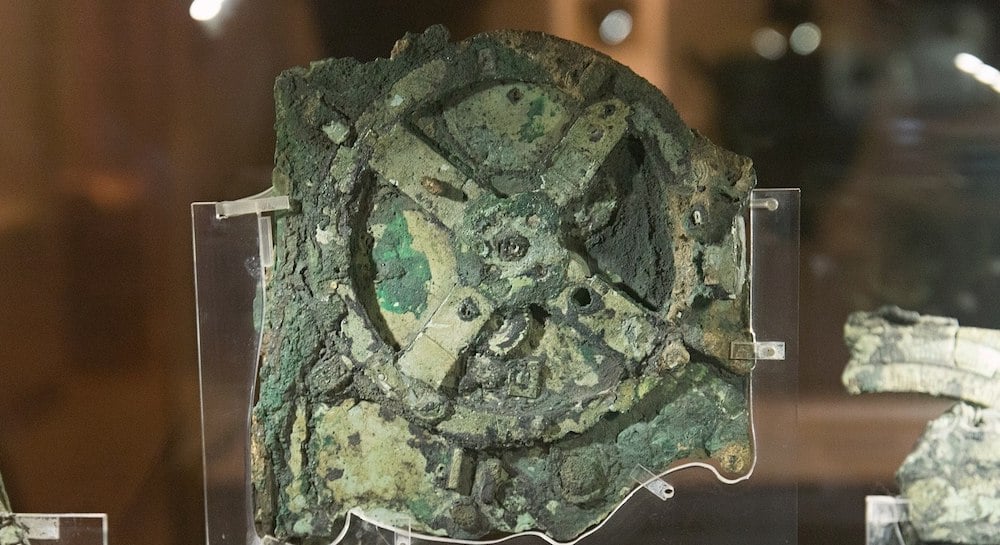
Many people have heard about Heron’s steam engine prototype, but that is just scratching the surface. The real protagonist of all these innovations was the Antikythera Mechanism, a bronze computer pulled from a Roman shipwreck, which was so complex that, when first discovered, archaeologists did not know what to make of it.
The Antikythera Mechanism consists of dozens of interlocking gears that could predict eclipses, track planetary movements, and calculate the schedules of the Olympic Games. The precision required to build such a device is staggering. Then there are the different types of automata described by ancient writers: mechanical birds that sang, statues that poured wine, and doors that opened automatically when a fire was lit on an altar.
Some historians dismiss these as myths, but the engineering principles behind them—using air pressure, water flow, and counterweights—were definitely within the capabilities of the ancient Greek world. What keeps enthusiasts going is imagining what else the Greeks may have built that has been lost to time. As bronze was valuable, many devices were likely melted down for raw materials, while others simply rusted away in forgotten storerooms, waiting to be discovered.
Physics before physics was cool: The ancient Greeks and their inventions
While we are all used to paying our respects to Galileo and Newton (and rightfully so), we should not forget that the ancient Greeks asked the same fundamental questions about how the universe works, only centuries earlier.
Democritus thought up the atomic theory around 400 BC. He proposed that everything is composed of tiny, indivisible particles without any of our modern equipment or mathematical frameworks. His ideas were so far ahead of their time that they were largely ignored until the 1800s. They were forgotten or ridiculed for more than two millennia!
Even more impressive was Strato of Lampsacus, who actually conducted experiments. He questioned Aristotle’s ideas about motion and discovered that falling objects accelerate. This is the type of insight that made Galileo famous over a thousand years later. Strato was doing real experimental science when most people thought the best way to understand nature was through pure reasoning.
The problem was that these revolutionary ideas were overshadowed by more popular philosophical schools of the time. Aristotle’s physics, which seems primitive to us now, dominated Western thought for over a millennium partly because it aligned with common sense and ordinary human experience and partly because it fit with the period’s mainstream religious doctrine.

Why was this all lost to time?
So what happened to all the incredible knowledge of the ancient Greeks? Surely humanity could have built upon it much earlier than the 19th and 20th centuries. Why did Europe essentially have to rediscover these concepts during the Renaissance, leaving itself in the dark for centuries?
The answer is not simple, but several factors came together to create a perfect storm of lost knowledge. Political instability was a major reason. When your city-state is being conquered every few decades, preserving ancient texts is not exactly a priority.
Then the rise of Rome shifted focus towards practical engineering rather than theoretical science. The Romans were skilled at building roads and aqueducts, but they were not as interested in understanding the underlying principles as the Greeks were.
Religious changes likewise played a role. Early Christianity was not necessarily anti-science, but it did prioritize different types of knowledge. It placed faith above understanding and belief above questioning—so why spend time studying planetary motions when you could be contemplating the divine?
The destruction of libraries was also a devastating reality of the post-Greek world era. We all know the story of Alexandria, but countless smaller collections were lost to fires, wars, and neglect. In an era prior to the printing press, losing a few key manuscripts could wipe out entire fields of study, leaving future generations in the darkness, trying to re-imagine and reinvent concepts and notions that once existed.
However, perhaps most importantly, the Greeks themselves did not always see the practical value of their discoveries. Some of their most brilliant insights remained theoretical exercises rather than technologies that were developed and passed down through generations, thus undermining their own progress.
Looking back at ancient Greece, we can clearly see that innovation is not a straight line. We like to think of scientific progress as cumulative, with each generation building upon the last, but that’s not always how it works. Sometimes brilliant ideas get lost and have to be rediscovered centuries later.
It also makes people wonder what we might be overlooking today. If ancient Greek engineers could build astronomical computers and create such mind-blowing inventions (for the time) using nothing but bronze gears, what other unimaginable feats might we be capable of?
The Greeks asked the right questions about the natural world long before we had the tools to answer them definitively. Their curiosity about how things work, their willingness to challenge what was widely believed to be true, and their drive to build things that had never been built before defined the world we live in today.
Related: Ancient Greek Genius Archytas Built a Flying Machine 2,400 Years Before Drones
See all the latest news from Greece and the world at Greekreporter.com. Contact our newsroom to report an update or send your story, photos and videos. Follow GR on Google News and subscribe here to our daily email!

