



Ancient Greece is often romanticized for its open acceptance of homosexuality and same-sex relationships. Yet, the truth is more complex.
Greek societies held diverse views on same-sex attraction, and laws varied from city to city. Clear distinctions were made between relationships based on mutual respect and those seen as morally corrupt. This distinction is critical in understanding the difference between celebrated homoerotic love and the condemned figure of the kinaidos.
The Athenian and Spartan laws against kinaidoi
In Athens, the statesman Solon (c. 638–558 BC) introduced reforms that shaped the city’s legal framework for centuries. Among his measures was legislation aimed at protecting the dignity of citizens and the moral health of the polis. One provision targeted the kinaidoi—men accused of effeminacy (ways of behaving traditionally associated with women), sexual excess, and the abuse of passive sexual roles for pleasure or gain.
According to Aeschines, the Athenians did not condemn a kinaidos simply for being attracted to men. They despised him for lacking moderation, self-control, and the virtues expected of a citizen and for hurting himself in his pursuit of pleasure. The city could strip a kinaidos of political rights, ban him from public speaking, and even punish him for corrupting youth. Athenian law drew a moral boundary: it honored love between men but treated lust-driven excess as a vice.
Sparta followed a similar principle, though in a stricter military context. Lycurgus, the legendary lawgiver, valued discipline above all else. Spartan law encouraged deep emotional bonds between male warriors. These ties, often idealized, were seen as strengthening loyalty in battle. Yet, overt sexual acts, particularly those associated with indulgence rather than self-restraint, faced disapproval. The Spartan model tolerated affection and love but condemned behavior that undermined martial discipline or male virtue.
Homoeroticism versus kinaidoi: Cities where sexual homoeroticism was legal
To the Greeks, homoeroticism meant something quite different from our modern concept of homosexuality. It referred to an emotional and often intellectual bond between an older man (erastes) and a younger man (eromenos). This bond could involve mentorship, poetry, and shared ideals. Love was praised when it was disciplined, honorable, and directed toward the moral betterment of the youth.
The kinaidos stood in contrast to this ideal. He represented a man ruled by pleasure rather than reason. To the Greeks, such a figure lacked sophrosyne—self-control—and became a danger to the moral fabric of the city. This explains why laws often targeted the kinaidoi, while relationships rooted in mutual respect and restraint were celebrated.
While Athens and Sparta maintained restrictions, other Greek city-states embraced a more permissive stance. The most well-known example is Thebes. The city celebrated the Sacred Band, an elite military unit composed of 150 pairs of male lovers. The Thebans believed warriors bound by love would fight more fiercely and stand more steadfast in battle. In this context, they accepted physical intimacy and saw it as a way of enhancing military unity.
However, some modern scholars count roughly eleven surviving ancient references to the Sacred Band and note that only half of those explicitly describe it as composed of male lovers, which complicates the certainty of the traditional account.
In addition, Elis, located in the Peloponnese, also stands out for its tolerance. Laws there permitted sexual relationships between adult men and younger partners, provided they were consensual and formed within a socially acceptable mentorship bond. In Megara, there was likewise an open acceptance of sexual intimacy between male citizens, without the legal restrictions of Athens, however. Meanwhile these cities represent a different strand of Greek thought—one where same-sex attraction, even in its sexual form, could coexist with civic virtue.
Plato on the elevating nature of love
Plato provides perhaps the most renowned philosophical treatment of homoerotic love. In works like the The Symposium and Phaedrus, he describes love between two men as capable of lifting the soul toward the contemplation of the divine and the pursuit of truth. For Plato, the highest form of love was not carnal but spiritual. It was a union of similar souls striving together toward virtue.
Plato draws a clear line between noble love and base desire. He condemns relationships driven purely by lust, aligning in this way with the Athenian disdain for the kinaidos. He idealized a partnership in which partners controlled their passion and cultivated mutual respect to promote moral improvement. This love, for Plato, was the path to arete—excellence.
Plutarch, the Platonist philosopher, who wrote centuries later, echoed Plato’s distinction. In his Erotikos, he praises the disciplined love between men that fosters courage, wisdom, and loyalty and rejects what he sees as the degraded sensuality of the kinaidoi and other hedonists. For Plutarch, as for Plato, the worth of a relationship lay in its capacity to inspire virtue, not in the satisfaction of bodily desires.

Panhedonists and the figure of Alcibiades: Socrates as the ideal
Not all famous Greeks followed the path of restraint, however. Alcibiades, the brilliant but controversial Athenian general and statesman, embodied the archetype of the panhedonist—one who pursued every pleasure available. Alcibiades sought love and admiration wherever he could find them, without the discipline valued by philosophers. His life provides a vivid contrast to the ideals of Plato and Plutarch.
In Plato’s Symposium, Alcibiades appears drunk, interrupting the discussion of love to offer a passionate tribute to Socrates. He admits his attraction to the philosopher but also reveals his inability to match Socrates’ self-control. Alcibiades represents the tension in Greek culture between admiration for beauty and the danger of unrestrained indulgence.
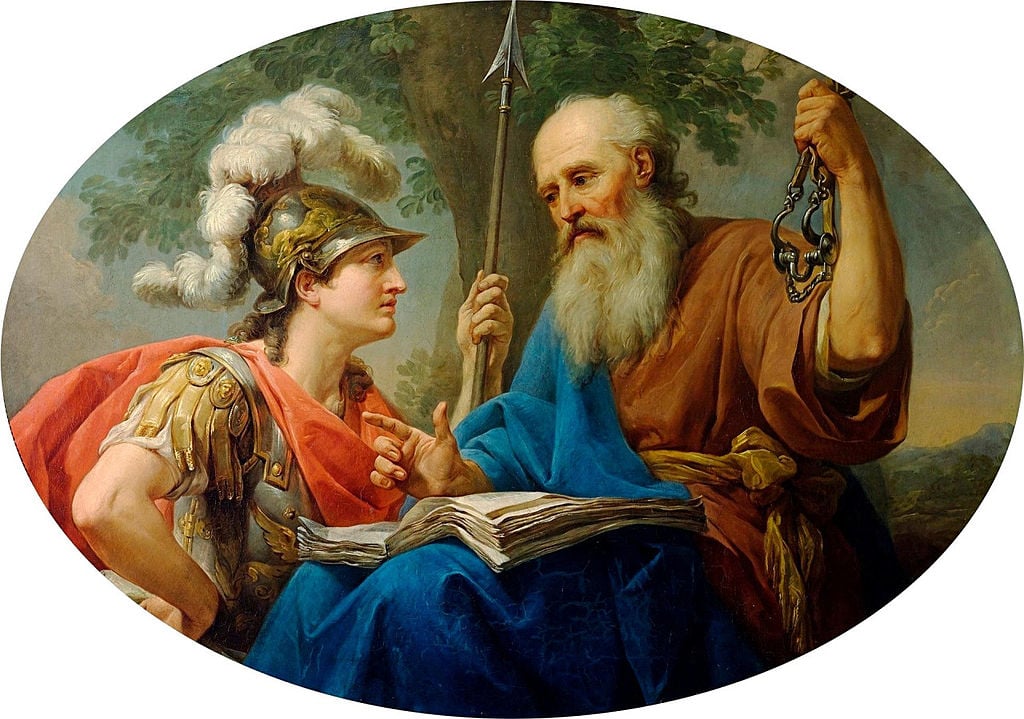
If Alcibiades symbolized indulgence, Socrates embodied the philosophical ideal. He valued the soul over the body and resisted the temptations of physical desire. At the same time, in his relationships with younger men, Socrates focused on intellectual and moral development. Furthermore, he guided them toward virtue through dialogue and example rather than through physical intimacy.
Socrates’ self-restraint set him apart. In The Symposium, he resists Alcibiades’ advances, choosing instead to continue their philosophical discussions. To Plato, Socrates was living proof that love could inspire without corrupting. He stood as the perfect erastes—a lover who sought the good of his beloved’s soul rather than the pleasures of the flesh.
Love, law, and the Greek legacy
The varied laws and customs of Greek city-states reveal a civilization wrestling with questions of desire, virtue, and the public good. Athens and Sparta drew boundaries, condemning the kinaidoi while honoring disciplined love. However, Thebes, Elis, and Megara, along with Crete and other cities of ancient Greece, were of a different view, integrating sexual homosexuality into civic life. Philosophers such as Plato and Plutarch elevated love between men into a moral and even spiritual pursuit while warning against the dangers of unrestrained passion.
These distinctions show that the attitude of ancient Greece toward homosexuality followed no single model. The celebration of beauty was balanced with caution about excess. Moreover, love was harnessed as a force for virtue while being restrained from becoming a source of moral decay.
The legacy of this complexity endures. Additionally, it challenges modern assumptions about the past and invites us to consider how cultures shape the boundaries between desire, law, and moral ideals. In ancient Greece, homosexuality—that is, love between men—could be noble, dangerous, or both, depending on how it was expressed.
@enriqueanartelazo Next time a friend says “Ancient Greece invented homosexuality” ever again, send them this 👀 #lgbtqhistory #queerhistory #lesbianhistory #misinformation
See all the latest news from Greece and the world at Greekreporter.com. Contact our newsroom to report an update or send your story, photos and videos. Follow GR on Google News and subscribe here to our daily email!

