



Modern textbooks and museum labels often assert that women were entirely absent from ancient Greek theater, portraying it as an exclusively male domain. According to this view, men performed all roles—including female ones—using masks and stylized voices to represent women.
This narrative, repeated in academic discourse and popular dramatizations alike, presents a seemingly uniform portrait of ancient performance culture. Yet a closer examination of the evidence, coupled with a more nuanced understanding of historical context, reveals a more complex picture—one that suggests the likely, if not probable, participation of women in certain theatrical and musical roles, especially in tragedy and religious drama.

The standard narrative: men on stage
Most classical scholarship since the 19th century has upheld a rigid assumption: that women never performed on the professional stage in Classical Athens. This view was championed by influential Anglophone scholars such as John and William Langhorne who emphasized the supposedly civic and masculine nature of the Dionysian theater, reinforcing the idea that women’s roles in Greek society were seen as passive or confined to the domestic sphere and largely excluded form public life.
These scholars pointed to the absence of female names in the dramatic records of the City Dionysia and Lenaia festivals as evidence of a male monopoly on stagecraft. However, this silence is not evidence of absence. Rather, it reflects the limitations of surviving documentation and the influence of modern, patriarchal assumptions embedded in the academic tradition.
Public participation of women in ancient Greek theater
Evidence that women and children were active participants in the theatrical culture of ancient Greece comes from Plato, who, in his critique of rhetoric, indirectly confirms the diverse audience of the theater. In Gorgias (circa 380 BC), Socrates engages Callicles in a dialogue during which he argues that poetry and theatrical performances were forms of public speech aimed at a broad “crowd”—explicitly including children, women, slaves, and free men alike.
Socrates remarks that such mass appeal, rather than being admirable, often results in flattery and pandering. His observation underscores that theatrical performances were not exclusive, male-dominated civic events, but rather widely accessible spectacles that attracted diverse audiences across social and gender boundaries.
Furthermore, in Aristophanes’ comedy Frogs (405 BC), the playwright mocks the tragedian Euripides by having the older tragedian Aeschylus claim that women who watched his plays performed on stage were driven “crazy” with emotion and enthusiasm. This portrayal suggests that women not only attended theatrical performances but were deeply engaged by them, offering further evidence against the modern stereotype of an exclusively male theater audience in Classical Athens.
According to the biographer Plutarch, Lysimachus, a contemporary king and rival, mockingly remarked that he had never before witnessed a harlot take on a major tragic role—referring to Lamia, Demetrius’ famous lover, who was known for her performances in tragedy. Demetrius, however, staunchly defended her, boldly asserting that Lamia’s chastity surpassed even that of Penelope, the paragon of marital fidelity.
This anecdote not only attests to the presence of women in significant theatrical roles but also reflects the complex social perceptions surrounding female performers in antiquity. It further challenges the rigid assumption that ancient Greek theater was an exclusively male domain, especially in the context of the Hellenistic and Roman periods.
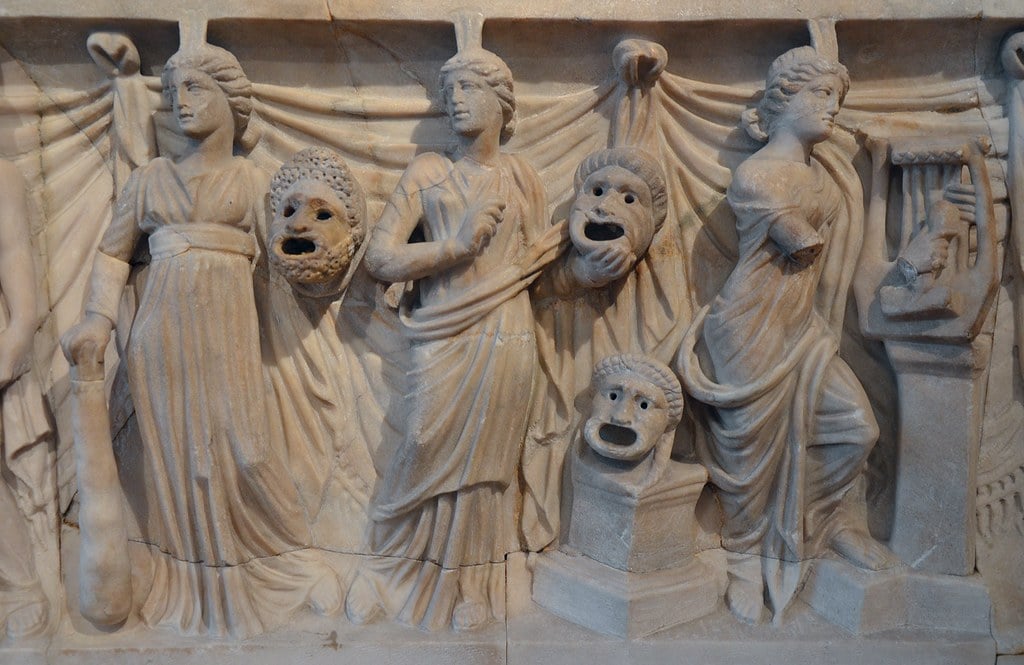
Women performers in ancient Greek and Roman theater: Beyond Athens
The presence of women in ancient theater becomes even clearer when we look beyond classical Athens and into the broader Hellenistic and Roman periods. The figure of Myrtio, a well-known mima (mime actress), illustrates that women did perform on stage, albeit occasionally in genres considered less prestigious or “vulgar” by certain elites.
Athenaeus the rhetor recounts Myrtio’s career, highlighting her as a professional female performer whose roles often involved dance, music, and dramatic mime. Similarly, other women like Dionysia, Licinia Eucharis are recorded in Roman-era documents and inscriptions as celebrated actresses and dancers who commanded high fees, earned public acclaim, and achieved star status.
Cicero the Roman rhetor famously noted that the dancer Dionysia earned 200,000 sestertii, an enormous sum. This suggests not only the celebrity but also social visibility of female performers in theatrical and ritual contexts. Such examples challenge the narrow view that women were entirely absent from the stage. They demonstrate a long-standing tradition of female artistic participation in Greek and Roman drama—especially in religious festivals such as the Dionysia.

Religion and the role of women
Comedy, particularly that of Aristophanes, employed parody and exaggeration. In this context, male actors in female roles might serve the comic purpose, but tragedy required more authenticity. The powerful emotional arcs of figures such as Antigone, Iphigenia, or Medea demanded subtle expression and sincere affect. These characters were central to the moral and dramatic logic of their plays.
Would all-male casting have done justice to these roles? Possibly not, but the Greeks were keenly sensitive to the aesthetic and emotional integrity of performance. It is difficult to imagine that no director or dramatist ever experimented with a woman in a female tragic role—especially since the performers aimed to make these performances sacred and cathartic.
Women played active and vital roles in religious life across the Greek world. They served as priestesses, led ritual dances, and participated in mystery cults. Dionysian worship, in particular, featured the Maenads, ecstatic female devotees who embodied the emotional extremes also inherent in Greek tragedy.
If women could participate in the worship of Dionysus, why not in the dramatized retelling of his myths? Theater was not only entertainment—it was part of a civic-religious ritual. The separation of the sacred and secular was not as stark in ancient Greece as it is today. This makes it unlikely that women were entirely excluded from stagecraft throughout the classical period.

Historiographical distortion
The 19th-century academic bias against women in the ancient world casts a long shadow. Philologists and historians of the era were from societies that restricted women’s public roles. They often projected their assumptions onto ancient Greece. The image of an all-male theater ensemble served a convenient narrative: it reinforced the idea of the Athenian polis as a masculine sphere of logos, reason, and political discourse—one in which women were silent and invisible.
However, ancient texts tell a different story. In tragedy, women do not merely appear—they dominate. The Oresteia, Medea, Antigone, and Alcestis place female agency at the center of dramatic action. These characters are not background figures but the moral core of the drama. Their prominence suggests that audiences—and possibly performers—valued female presence not just as subjects of pity or fear, but as moral interlocutors.
While definitive evidence of women acting in 5th-century Athenian tragedy remains scarce, the cumulative weight of philosophical and dramatic evidence points toward a more inclusive theatrical world than traditional scholarship has allowed. Even if male actors dominated the Athenian stage, this does not mean women were absent from ancient Greek theater as a whole——or that their participation was never attempted in Athens itself.
See all the latest news from Greece and the world at Greekreporter.com. Contact our newsroom to report an update or send your story, photos and videos. Follow GR on Google News and subscribe here to our daily email!

