



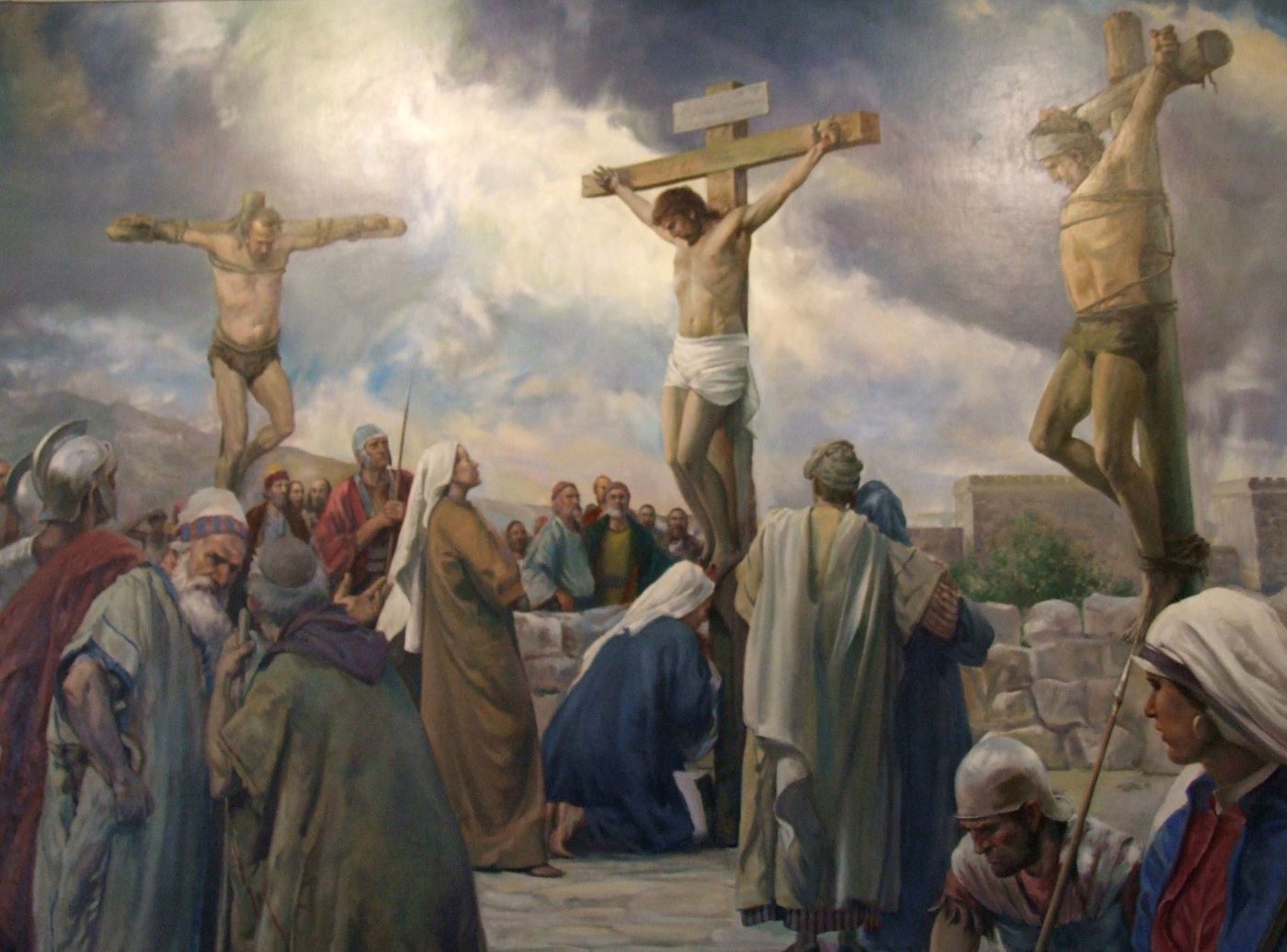
The Holy Week that leads to Easter Sunday is the holiest of weeks for Christianity, symbolizing the passion, death and Resurrection of Jesus Christ.
For Orthodox Greeks it is the most revered period of the year as they fast for forty days, go to confession, and attend long church liturgies in the Holy Week that culminates in the Resurrection and the joy of Easter Sunday.
During Holy Week the liturgies intensify and run for hours and hours. Also called Passion Week, the gospels read in church retell the Passion of Christ, the painful days that led Him to the Cross and then to Resurrection.
Palm Sunday
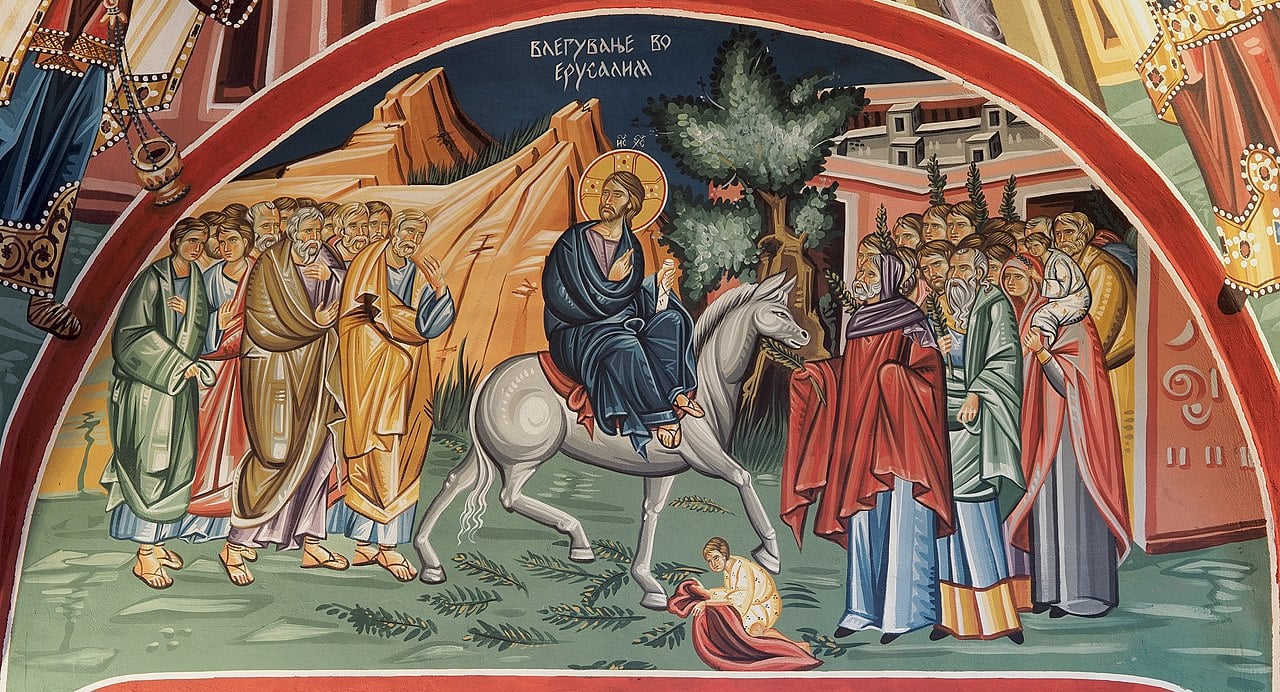
Palm Sunday is the beginning of the Holy Week of the Greek Orthodox Church and starts with a liturgy commemorating Jesus’ entrance in Jerusalem amidst the joyful cheering of people carrying branches of palm trees to welcome Him.
Having anticipated His arrival and having heard of the miracle of Lazarus the previous day, the people went out to meet the Lord and welcomed Him with displays of honor and shouts of praise. On this day, the faithful receive and worship Christ in this same manner, acknowledging Him as King and Lord.
The evening liturgy begins with the Hymn of the Bridegroom: “Behold the Bridegroom comes in the midst of the night . . . beware, therefore, O my soul, lest thou be borne down in sleep . . . and lest thou be shut out from the Kingdom.”
Holy Monday

Holy Monday in the Greek Orthodox Church commemorates the blessed and noble Joseph and the fig tree which was cursed by the Lord and withered.
On this day, the Church calls the faithful to remember the story of the Patriarch Joseph, the so-called Pangalos, and the parable of the barren fig tree. Both of these events are connected to the theme of faith, obedience to the will of God, and the need for spiritual fruitfulness.
Joseph the Pangalos is an Old Testament figure who prefigures Christ himself. He was sold by his brothers as a slave in Egypt, but he remained righteous, pure, and faithful to God, despite the harsh trials and injustices he suffered. His story reminds us of the value of patience, self-control, and trust in God’s providence, and is an example of spiritual endurance and virtue.
When Jesus entered Jerusalem amidst exultation from the gathered crowd, He became hungry. And seeing a lone fig tree by the road, He came to it, and found nothing on it except leaves; and He said to it, “No longer shall there ever be any fruit from you.” And at once the fig tree withered. And seeing this, the disciples marveled, saying, “How did the fig tree wither at once?” (Matthew 21:18-20)
The fig tree withering is a parable, as Jesus is warning Christians that after their conversion they should bear fruits worthy of their redemption.
Holy Tuesday, the Hymn of Kassiani, and the Ten Virgins
Her hymn, called the Doxastikon on the Aposticha of the Bridegroom for Orthros, but better known as the Hymn of the Sinful Woman, is sung every Tuesday evening during Holy Week as the apex of the service on that day.
On Holy Wednesday the faithful receive communion
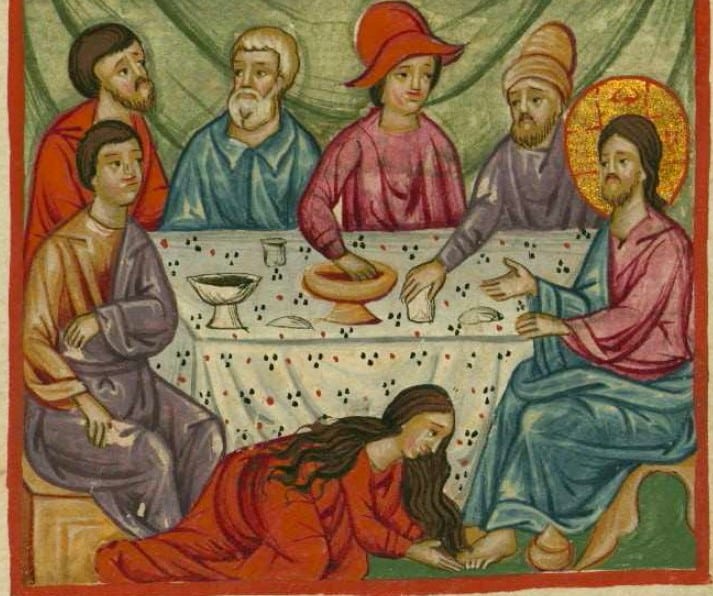
On Holy Wednesday there is The Liturgy of the Presanctified Gifts. This very ancient Liturgy is a Vespers service. It is also the day when Mary Magdalene – the repentant sinner who became a devoted follower -anointed Jesus’ feet with with oil.
In the evening, the sacred ceremony of the Mysterion of the Holy Unction takes place. It is the evening of repentance, confession, and the remission of sins by the Lord, preparing the faithful to receive Holy Communion, usually the next day.
Holy Thursday liturgies are the most heartbreaking of Greek Easter as Jesus Christ is betrayed and is led to his death at the end of the day. It is the day of the Last Supper, when He celebrated Passover with His disciples.
Holy Thursday and the betrayal
(video of Good Thursday liturgy at Mount Athos)
On Holy Thursday morning, the liturgy celebrates four Events: the washing of the disciples’ feet, the institution of the Holy Eucharist, the Marvelous Prayer, and the betrayal.
Holy Thursday is the commemoration of the Last Supper of Jesus Christ, when he would fulfill His role as the Christian victim of the Passover for all to be saved by His final sacrifice.
The Last Supper was the final meal Jesus shared with his Disciples in Jerusalem and during this Passover meal,
Jesus took bread, said the blessing, broke it, and giving it to his disciples said, “Take and eat; this is my body.” Then he took a cup, gave thanks, and gave it to them, saying, “Drink from it, all of you, for this is my blood of the covenant, which will be shed on behalf of many for the forgiveness of sins. I tell you, from now on I shall not drink this fruit of the vine until the day when I drink it with you new in the kingdom of my Father.” (Matthew 26: 26-29)
It is believed those who eat of Christ’s flesh and blood shall have eternal life.
Christ also establishes the special priesthood for his disciples, which is distinct from the “priesthood of all believers.” Christ washed the feet of his Disciples, who would become the first priests.
He also established the sacrament of Holy Communion prior to his arrest and crucifixion. Jesus celebrated the dinner as a Passover feast.
Holy Thursday is the most mournful day of the Greek Orthodox Holy Week as the day when Jesus Christ has died on the Cross and His Mother, the Virgin Mary is crying for Her loss.
On Holy Friday Christianity mourns at the Epitaphios
Good Friday is a day of absolute mourning for all of Christianity, of absolute rest and fasting, the day on which the climax of the Divine Drama takes place. At the Ninth Hour of the day, “It is finished” is said. Jesus’ divine soul descends into Hades. The “Protevangelium,” the first joyful promise of God to the fallen Forefathers, begins to be fulfilled.
Until shortly before 11 am, the liturgy of the Great Hours is celebrated, where Greek Orthodox women mourn and weep for Christ, while others bow down and pay homage to the crucified Christ. From dawn on the same day, the Epitaph is prepared and is celebrated all night in most churches in Greece. At noon on the same day, Christ is taken down and placed in the Epitaph, where His procession will take place in the evening.
In the evening, the faithful devoutly attend the Morning Service of Holy Saturday and the Epitaph Service, while the Encomiums are sung in three stops: “Life in the grave,” “Worthy is He,” and “All generations.” Then, late in the evening, the Epitaph procession takes place, while the bells ring mournfully throughout the day.
The Holy Friday liturgy is mourning for the painful Passion of Christ. To take away our sins, Christ willingly endured all kinds of torture, and finally the Cross and Death, purging all our sins with His death.
In the evening there is the Procession of the Epitaphios—representing the coffin of Christ—in each parish. The Epitaphios has been decorated with spring flowers, mostly white, red and purple.

Holy Saturday is the last day of Holy Week and Great Lent. The burial of the Lord took place on Holy Saturday. On the Sabbath, after the chief priests and Pharisees had gathered before Pontius Pilate, they begged him to secure the tomb of Jesus for three days because, as they said, “we suspect that His disciples, after stealing His buried body by night, will then proclaim to the people as true the Resurrection that that deceiver foretold while He was still alive; and then the last deception will be worse than the first.”
They said this to Pontius Pilate and after getting his permission, they left and sealed the tomb, placing a military guard there for safety.
On Holy Saturday psalms are read and Resurrection hymns are sung, telling of Christ’s descent into Hades: “Today Hades cried out groaning,” the psalm says.
The hymns speak of the conquering of death and the day’s celebration is called “First Resurrection.” Most of the readings of this day are from the Old Testament on the prophecies and promise of the conquering of death as Easter Sunday approaches.
Easter Sunday-Christ is Risen

Finally, right at the stroke of midnight, there is the moment that all Greeks around the world eagerly anticipate: The Resurrection ceremony with the joyous proclamation of “Christos Anesti!” (Christ is risen!).
It is a night of joy, the end of the Greek Orthodox Holy Week after forty days of mourning as Orthodox Christians honor the Son of God who died for our sins and was then resurrected from the dead to show us the path to eternal life in faith.
Easter Sunday dawns and celebrations begin. Greeks light the charcoal fire to roast whole lambs on the spit, break the red eggs wishing each other a Great Easter, and wait to sit at the Easter table with family and friends.
After the forty days of Lent as the Greek Orthodox Church dictates , great quantities of food and drink are consumed, welcoming the Spring that has been reborn along with the Resurrection of Christ.
See all the latest news from Greece and the world at Greekreporter.com. Contact our newsroom to report an update or send your story, photos and videos. Follow GR on Google News and subscribe here to our daily email!

