



Leucippus, the ancient Greek philosopher and father of atomic theory, astonishingly formulated the concept of the great cosmogenic explosion, now known as the Big Bang. Among other things, he stated: “Everything is infinite and changes into each other.”
Leucippus: A forerunner to the Big Bang theory
The origins of cosmological thought stretch back thousands of years, with ancient philosophers speculating about the nature of the universe. Among them was Leucippus, the 5th-century BCE Greek thinker and founder of atomism. He proposed ideas that bear a striking resemblance to modern cosmological models—particularly the Big Bang theory. He perceived the universe as formed through the chaotic motion and crash of atomic particles. This appears as an earlier idea similar to contemporary scientific understanding of cosmic evolution.
The atomic universe of Leucippus
Leucippus, along with his student Democritus, developed the first known theory of atomism. He argued that the universe consists of particles (atoms) moving through the void. In a fragment attributed to him, Leucippus describes a universe in which atoms, initially in random motion, gradually unite into larger structures due to their natural tendencies. Heavier particles settled and formed the foundation of earthly bodies, while lighter ones moved outward and shaped the heavens.
This description closely parallels modern concepts of a primordial cosmic state. In this state, matter was once scattered chaotically before uniting into galaxies, stars and planets.
This is the ancient text of Leucippus as preserved by the early Christian father Eusebius of Caesaria in his work ”Praeparatio evangelica:”
“The present cosmos, in its scattered form, was shaped in this way: the bodies of atoms, without intention and having random motion, moving continuously and rapidly,
gathered in one place in great numbers, and thus having diversity of shapes and sizes. The larger and heavier particles gathered at the center, while the smaller, more mobile, smoother, and slipperier ones moved outward and assembled to form the celestial bodies. But when the striking force that lifted them upward ceased, and they were no longer driven toward the heavens, they were prevented from descending further, and they were compressed towards locations that could accommodate them. Thus, the surrounding mass of bodies was scattered and intertwined, and in this interweaving, the heavens were born. And from the same nature, the atoms, being diverse . . . formed the nature of the stars.”

The cosmic birth through collision and compression of atoms
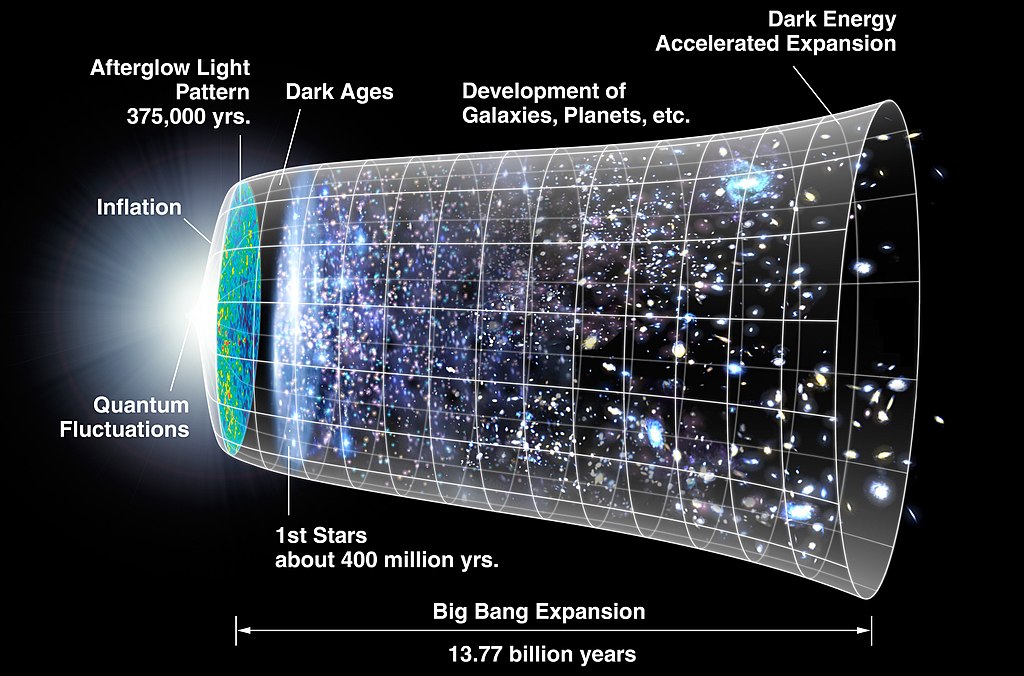
Leucippus’ view implies that the ordered universe arose from an initial state of disorder. This idea finds echoes in the Big Bang model. He suggests that atoms collided and accumulated in a swirling vortex, eventually forming distinct cosmic structures. Modern physics describes an initial explosion. This explosion led to the gradual formation of matter through gravitational forces and interactions between fundamental particles.
This notion of cosmic evolution aligns with the works of modern physicists. These include the Belgian theoretical physicist Georges Lemaître, who first proposed the Big Bang theory. Also the English cosmologist Stephen Hawking, who explored the early universe’s quantum fluctuations. Moreover, the American cosmologist Alan Guth’s inflationary model expands upon the idea of an initially chaotic universe that underwent rapid expansion before cooling into structured matter.
A visionary ahead of his time
Leucippus’ ideas lacked the mathematical rigor and empirical validation of modern scientific theories. However, he grasped the universe’s formation with astonishing foresight. His concept of a spontaneous, physical origin of the cosmos—devoid of divine intervention—laid the groundwork for later scientific inquiry. The notion that the cosmos was not static but rather emerged from an initial chaotic state anticipated the discoveries of centuries to come.
Leucippus’ insights, though speculative, demonstrate how ancient Greek philosophy planted the seeds for later scientific revolutions. His theory of a self-organizing cosmos, driven by atomic interactions, is a distant intellectual ancestor of the Big Bang model. This makes him one of history’s most visionary thinkers in the field of cosmology.
See all the latest news from Greece and the world at Greekreporter.com. Contact our newsroom to report an update or send your story, photos and videos. Follow GR on Google News and subscribe here to our daily email!

