



It may sound unbelievable but a Greek-Canadian scientist is stating that the Ancient Greeks may have reached America years before the Spanish Seafarer Columbus did.
Researcher of Aegean Scripts, Dr. Minas Tsikritsis, in the text by Plutarch “On the Apparent Face in the Orb of the Moon,” in paragraphs 941A-942, claims that he has identified and demonstrated through computer programs the restoration of a forgotten historical reality, which had until now eluded many researchers.
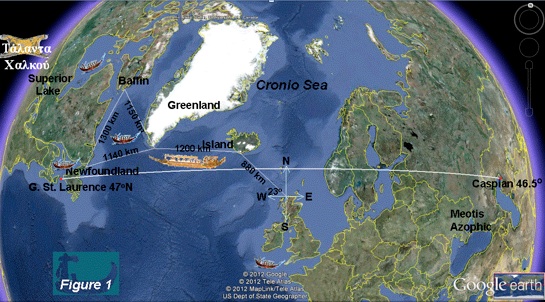
In the study, he indicates that the prehistoric Greeks knew that “west of the three islands and northwest of Britain” there was a “great” continent. Two years ago, another academia, Professor I. Mariolakos, identified the great continent, surrounding the great Ocean, as today’s North America.
Dr. Tsikritsis states that, “even before the time of Christopher Columbus, there was a communication which began during the Minoan era and continued until the Hellenistic times. The purpose of these travels during the Bronze Age was related to trade and the transportation of pure copper from Lake Superior of Canada.”
According to his findings it seems that after the first Minoan merchants, the Mycenaeans continued the journey, and, as reported by Plutarch, they sent Hercules to revitalize the presence of the Greek element, which had been diminished by the continuous miscegenation with the locals. Later, during the Iron Age, the interest in the region declined and until the Hellenistic time, it remained only as a conventional ceremonial tradition. So every thirty years some ships were sent to the areas that followed the worship of Cronus in order to renew the priest personnel.
The ancient text by Plutarch states that the dialogue coordinator, Lambrias, asks Sylla the Carthagean to narrate once more a story that he had heard from the servants of the temple of Cronus in Carthage. The story was originally told by a foreigner who was visiting the temple and came from the great continent.
According to Tsikritsis, who analyzed the data with the aid of a special computer program, “the information that is mentioned in the text confirms the description of a journey in 86 AD from Canada to Carthage.” The findings are summarized as follows by Tsikritsis:
1. The revealing journey determines correctly the distance from Britain to the island of Ogygia, with a boat that sails with oars for five days (880 km).
2. It mentions a great continental land in the area of which there were three islands (Greenland, Baffin Island, Newfoundland) that had the same distance, on the northwest of Britain (Fig.1).
3. It specifies that on the same latitude, we find the entrance to the Gulf of St. Laurence and the Caspian Sea, a fact that we notice if we expand a straight line (Fig.1).
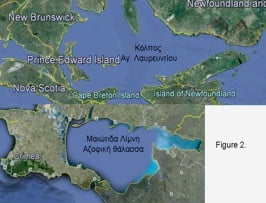 4. It states correctly that the Gulf of Saint Lawrence is a little bigger than Lake Maeotis, present day Sea of Azov (Fig. 2). It mentions that the Gulf Coast was inhabited by Greeks since the very old times and after the expedition of the Mycenaean Hercules, possibly during the 15th century BC, the Greek element was revitalized after it reached a near-extinct point due to the constant miscegenation with the locals. (It is obvious that Hercules was not accompanied only by Iolaus, but it was rather an expedition of hundreds of Greeks that changed demographically the area of the Gulf of Saint Lawrence, which they inhabited).
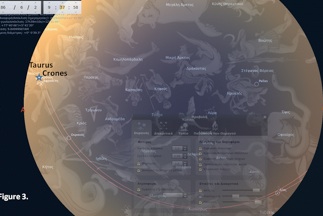
5. It determines a period of 30 years after which the journey started: when planet Cronus rose in accordance with Taurus. Astronomical evidence confirms that in the north latitude 47ο, during the 1st century AD, that period coincided with the end of May 86 AD.
 6. When the journey home began, they stayed for three months on the island of Greenland in the north (60ο Ν), where the sun sets only for one hour during the summer solstice, between 9/6 and 9/7. This definition confirms that the island of Greenland must be identified with the underworld, where Cronus had been buried in a cave and was being kept there by Zeus.
7. The reason for these long journeys during the Bronze Age is documented by the pure copper, which was found in large quantities in the region around Lake Superior and the island Royale, both located in Canada. From this area, about 50,000 tons of copper were mined between 2400 BC and 1200 BC.
8. During the time of Plutarch, as he states himself, they did not carry copper but golden cups and urns, inside which they kept the provisions for the journey.
 9. Finally, it is known that in the ancient times the Oracles were centers where they kept chronicles of geographical knowledge, and as a result they gave advice about the future colonization. Therefore, it is acceptable that since Plutarch was a priest in the Oracle of Delphi after 86 AD, he had this knowledge.
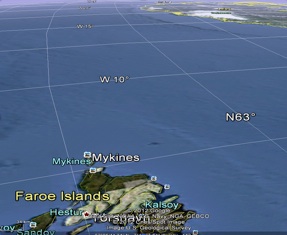
10. It seems that the journey home was made from the north; starting from Canada they went to Greenland (island of Cronus), then they reached Iceland and finally Britain. A confirmation of this route is the station-island which still bears the name Mykines, the most west island of the Faroes.
Finally, the research by Tsikritsis claims that a journey was made from Canada to Carthage in 86AD, and that the Minoans and other Ancient Greeks had reached North America before Colombus.
What do you think? Could that be possible? Let us know in our comments section below.
See all the latest news from Greece and the world at Greekreporter.com. Contact our newsroom to report an update or send your story, photos and videos. Follow GR on Google News and subscribe here to our daily email!

