
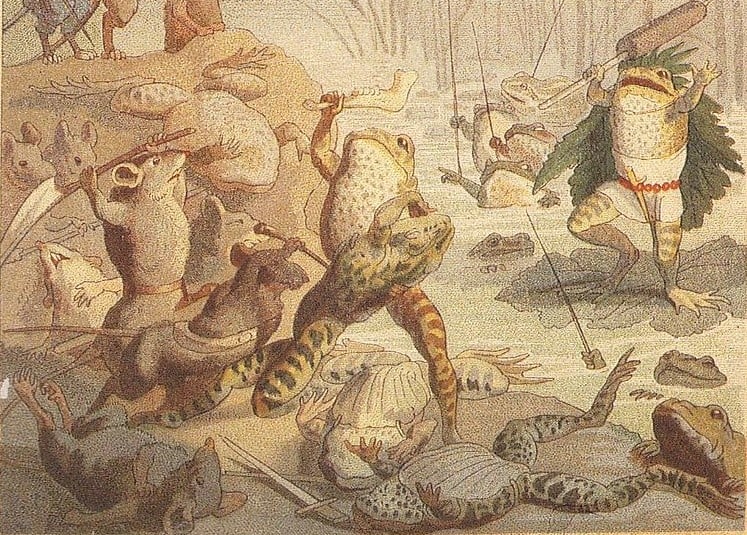
The Batrachomyomachia (“The Battle of Frogs and Mice”) is the only surviving complete ancient Greek epic parody, a humorous adaptation of Homer’s Iliad. Scholars place its composition sometime between the 6th and 4th centuries BC, or possibly later. The poem’s content suggests it is a later work or one that has undergone subsequent editing.
“Batrachomyomachia” (Greek: Βατραχομυομαχία) is a compound Greek word composed of three elements: “frog” (βάτραχος), “mouse” (μῦς), and “battle” (μάχη).
Hellenistic sources attribute the authorship of the Batrachomyomachia to Homer, as its subject matter appears to reflect his style and themes. Later sources, however, credit Pigres of Halicarnassus, who lived in the early 5th century BC. Since the epic was already known to Plutarch, scholars generally place it within the Classical period.
According to linguistic studies, the poem was composed in Ionia during the 3rd or 2nd century BC. A minority of scholars argue that the Batrachomyomachia was written much later during the Roman era possibly by Lucian, the Hellenized Syrian satirist who wrote A True Story, a parody of incredible travel tales often considered the earliest example of science fiction (2nd century AD).
However, there is insufficient evidence to assign the Batrachomyomachia to a specific historical context. Whether or not an oral tradition of epic parody existed prior to the Athenian period, it seems likely that established conventions of performance and composition influenced its creation and delivery.
The great battle between the frogs and mice
One day, the mouse prince Psicharpax climbed onto King Frog Physignathus’ back to cross a pond. When a water snake suddenly appeared, Physignathus panicked and dived into the water, forgetting about Psicharpax clinging to him. Unable to swim, the unfortunate mouse drowned.
From the bank, another mouse witnessed the tragedy and rushed to inform the others of their prince’s death. Enraged that the frog king allowed their leader to drown, the mice sent a messenger to the frogs to declare war. The frogs, in turn, blamed their king, who denied any wrongdoing.
Zeus, observing that war was imminent, proposed that the gods take sides and specifically asked Athena to aid the mice. Athena refused, explaining that both sides had wronged her and that it would be wiser for the gods to remain neutral and simply watch.
When the two tribes clashed in battle, the mice initially prevailed over the frogs. The gods of Olympus convened once more, and Hera urged Zeus to intervene to stop the bloodshed. Zeus then sent a swarm of crabs to rescue the frogs from annihilation. The armored crabs drove back the mice, and the war finally came to an end.
The ancient Greek parody of Homer’s Iliad
Close readings of the ancient Greek parody reveal clear resemblances in language and themes to Homer, particularly the Iliad. The poem depicts a war between two armies from separate regions, includes princes and kings, portrays a noble reason for the mice to fight, features graphic battle scenes, and centers on a king held responsible for misfortune.
As in the Iliad, the parody incorporates genealogies of the protagonists, grandiose speeches, heroic deeds, a divine council, and intervention by the Greek gods. There is even a direct reference to Homer: the frog’s father is named Peleus, as was Achilles’ father.
The poem consists of 303 verses in typical epic style, and its plot centers on the friendship between the frog prince, Physignathus (“Puffing-Jaw”), and the mouse king, Psicharpax (“Crumb-Thief”). Although the work is clearly intended as a humorous parody, it has attracted significant scholarly research and analysis.
The names of the characters are especially comical. Among the mice are Artepibulus (meaning “he who lies in wait for bread”), Artophagus (“the Bread-Eater”), Lichomyle (meaning “the licker of mill-stones”), Lichopinax (“the Dish-Licker”), Meridarpax (“the Portion-Snatcher”), Pternoglyphus (“the Heel-Licker”), Tyroglyphus (“the Cheese-Licker”), and several others.
The frogs also have humorous names, including Borborocoites (“Sleeper in the Mud”), Craugasides (“the Hoarse-Croaker”), Hydrocharis (meaning “he who delights in the water”), Limnisius (meaning “of the lake”), Limnocharis (meaning “he who delights in the lake”), Pelobates (“the Mud-Walker”), and Prassophagus (“the Leek-Eater”), among others.
Scholar analysis and origin
There are inconsistencies in storytelling, such as the reappearance of combatants who had previously been killed in battle. Some earlier scholars attributed this to Homer’s carelessness—an argument now largely discarded—while others argue that the Batrachomyomachia was intended as a form of serious literary criticism.
St. John’s College, Oxford, Professor Dr. Matthew Hosty adds another dimension to the poem’s analysis. He observes that the work includes a theme of resurrection, as the mouse prince, Psicharpax, who drowned, later reappears and fights in battle. Similarly, the mouse warrior, Leichenor, and the frog warrior, Prasseius, both die in combat but subsequently return alive and unharmed.
Other scholars interpret the poem as written purely for entertainment. The work is highly comedic at times, and some argue that it draws on Aesop’s animal fables. The poem blends multiple elements, including animal fable, parodic animal epic, the language of tragedy and comedy, traditional epic poetry, and myth.
Dr. Lawrence Bliquez of the University of Washington maintains that the Batrachomyomachia was intended primarily as comic relief from the seriousness of Homeric epics. Regarding its origin, he suggests it was composed in Athens, possibly for the Greater Panathenaea festival.
Most scholars agree that poems like the Batrachomyomachia likely had a performance tradition although there is consensus that this particular poem does not derive directly from such a context.
A second example of this epic parody style is the Galeomyomachia, meaning “War of the Weasel and the Mice.” Similar in style to the Batrachomyomachia, it belongs to the Classical period, though its date and authorship remain uncertain, and only fragments of the poem survive.