



Ancient gold earrings found in burials around the northern Black Sea offer new evidence that Greek fashion remained popular well into Roman times. A study of their stones, chains and miniature vessel-shaped pendants suggests that designs from the Hellenistic period continued to influence jewelry made for wealthy women as the Roman period took hold.
The research, published in the journal Archaeology and Early History of Ukraine, examines jewelry from two Sarmatian graves and ancient Greek cities along the Black Sea coast. Most examples date to the first century A.D. Despite differences in appearance, they share a distinctive design: a large jeweled setting with small amphora-shaped pendants and hanging gold chains.
Archaeologist Evgenia Velychko, of the National Museum of the History of Ukraine, found that the similarities extend beyond decoration. Older ornaments appear to have remained in use, while jewelers adapted familiar designs for new customers.
Ancient gold earrings show Greek fashion’s lasting appeal
One of the most elaborate pairs came from Nohaychik Barrow in Crimea, excavated in 1974. The earrings combine emeralds, striped agate, carnelian and glass in intricate gold settings. Each is slightly more than 2 inches long. Missing beads and altered fastenings suggest the jewelry was damaged and repaired in ancient times.
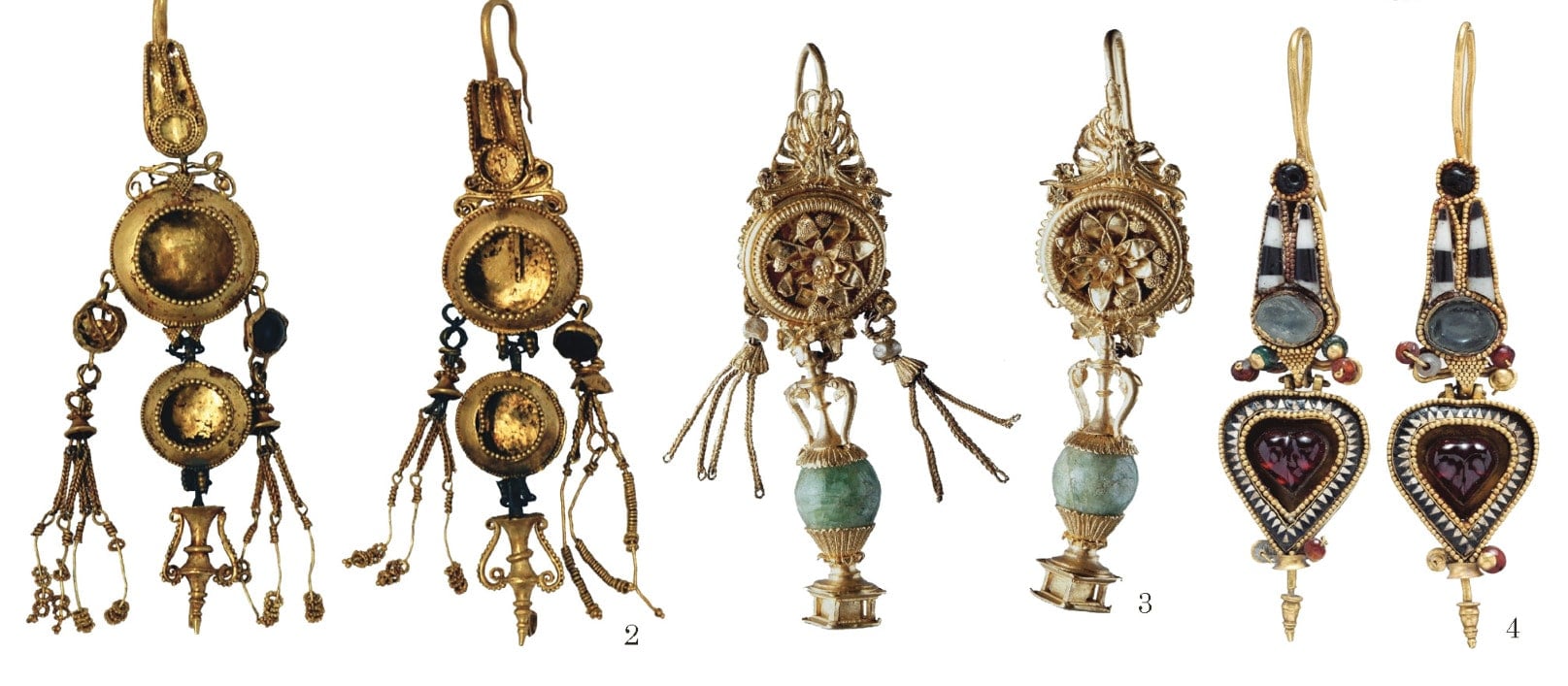
Another pair, recovered from Sokolova Mohyla in southern Ukraine, features garnets, dangling chains and miniature amphoras carved from rock crystal. Both sets came from women’s burials containing other valuable possessions, including gold ornaments. Imported vessels date the Sokolova burial to the later first century A.D.
Dating the Nohaychik burial remains contentious. The earrings themselves are thought to have been made in the late second or first century B.C. Some researchers place the grave in the first century B.C., while others date it to the first or early second century A.D. That disagreement affects how long the earrings might have been worn.
Black Sea jewelry retained earlier designs
Other finds help trace the style’s endurance. Earrings from cemeteries at Panticapaeum, near modern Kerch, feature similar decorative settings and hanging chains. A further example from Olbia is known through records of a burial opened in 1891, although the jewelry is now lost.
Velychko also compared the pieces with Hellenistic earrings from Egypt in the British Museum. Similarities in their construction suggest that the northern Black Sea designs belonged to a wider tradition rather than an isolated local fashion.
The study identifies the Nohaychik earrings as imports with features associated with the southeastern Mediterranean. Later versions may have been produced closer to the Black Sea. Velychko wrote that local elites valued “vivid ornamentation and expressive details,” helping explain why older Greek-influenced designs survived into Roman times.
See all the latest news from Greece and the world at Greekreporter.com. Contact our newsroom to report an update or send your story, photos and videos. Follow GR on Google News and subscribe here to our daily email!

