



Ancient Greek art is famous for its attention to the human body. Sculptors idealized proportion, poets praised shining eyes, flowing hair and powerful limbs, and athletes competed naked before crowds. But one feature appears often enough in ancient literature to raise an unusual question: did the ancient Greeks place special importance on beautiful feet and ankles?
The surviving evidence suggests that they did notice them as part of physical attractiveness. Yet calling this a widespread “foot fetish” would go beyond what the sources can prove. What the texts do show is that well-shaped ankles, graceful movement and even the appearance of the feet could contribute to an ancient Greek ideal of beauty.
One of the clearest pieces of evidence comes from Homer. In the Iliad, women are repeatedly described with the adjective kallisphyros, meaning “beautiful-ankled.” In Book 14, for example, Danaë—the mother of Perseus—is called Danaēs kallisphyrou, or “beautiful-ankled Danaë.” The same adjective occurs elsewhere in Homer for women and goddesses, and the ancient Greek lexicographical tradition defines it straightforwardly as “with beautiful ankles.”
This matters because Homeric epithets are not simply random descriptions. Characters are repeatedly identified through memorable physical qualities: Hera is “white-armed,” Athena is “bright-eyed,” and Achilles is famously “swift-footed.” Calling a woman “beautiful-ankled” therefore places the ankle among the physical features through which attractiveness and identity could be expressed.
More evidence of ancient Greeks focusing on beauty of the feet
The idea was not limited to the Iliad. The Homeric Hymn to Demeter opens by describing Persephone as Demeter’s “trim-ankled” daughter. The description appears again later in the poem as Demeter searches for her missing child. The recurrence suggests that a refined or delicate ankle had become an established poetic marker of feminine beauty in archaic Greek literature.
The emphasis may sound surprising to modern readers, but clothing offers some context. Greek women were normally represented in long garments that covered much of the body, while walking and dancing could draw attention to the lower legs, ankles and feet. An ankle, like a hand or face, could therefore function as a small but conspicuous detail. In poetry, that visible feature could symbolize broader bodily elegance.
Another important piece of evidence comes from Sappho, the celebrated lyric poet from the island of Lesbos.
In Fragment 16, Sappho remembers the absent Anactoria and contrasts her with the spectacular sight of Lydian chariots and armed soldiers. What the poet would rather see is Anactoria’s “lovely” or desire-arousing step and the radiance of her face. In Gregory Nagy’s translation, Sappho longs to see her “taking a dancing step that arouses passionate love.” Another translation renders the passage as “the lovely way she walks.”
The passage does not praise Anactoria’s feet directly, but it does something equally revealing: it turns the way she walks into an object of erotic attention. Her gait is placed alongside her face as something the speaker longs to see. Beauty, in other words, was not necessarily static. The attractiveness of the body could be expressed through movement, posture and the manner in which a person stepped.
Later Greek erotic poetry makes the aesthetic importance of feet even more explicit.
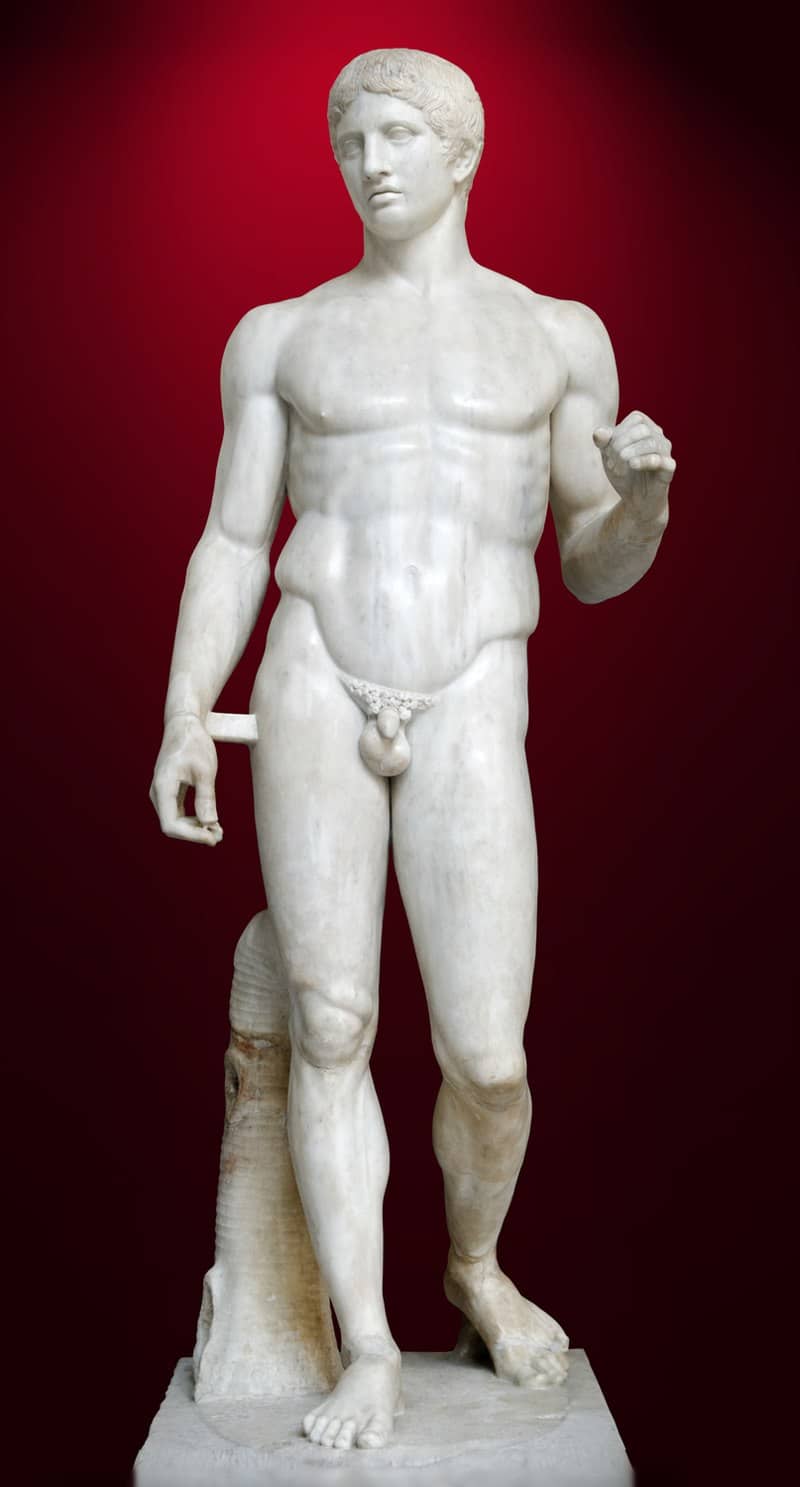
An anonymous epigram preserved in Book 12 of the Greek Anthology praises a young man named Pyrrhus. The poet describes his physical form as faultless, praises his eyes and says that grace blossoms upon his chest. Then comes a humorous exception: the gods did not give Pyrrhus that same “grace” in his feet.
The solution, according to the poet, is footwear. A boot will conceal the unfortunate foot while contributing beauty of its own. The joke is significant because it only works if the appearance of a person’s feet could actually matter. Pyrrhus is effectively assessed from head to toe, and his feet are the one feature that fails to match the beauty of the rest of his body.
The example is particularly valuable because it concerns a man. Admiration of ankles in early epic is usually associated with women and goddesses, but this later erotic poem shows that male feet could also be subjected to aesthetic judgment.
Ancient Greek poetry could even use unattractive ankles as an insult. Material preserved under the name of the seventh-century BC poet Archilochus includes a derogatory reference to a woman as “fat-ankled,” again indicating that ankle shape could carry aesthetic meaning.
Still, caution is necessary.
There is no evidence that ancient Greeks as a whole were unusually obsessed with feet, and repeated praise of ankles does not prove the existence of a widespread sexual fetish in the modern psychological sense. Ancient poetry relied heavily on inherited formulas, exaggeration and idealized descriptions, while the surviving literature represents only a fraction of Greek society across many centuries.
The evidence supports a subtler conclusion.
Ancient Greek ideas of beauty could be remarkably detailed. Attractiveness might reside in the eyes, hair, skin, chest and limbs, but also in the ankles, feet and even the manner in which somebody walked. For the ancient Greeks, beauty was not necessarily concentrated in the face. It could be perceived across the entire body and sometimes, apparently, all the way down to the feet.
See all the latest news from Greece and the world at Greekreporter.com. Contact our newsroom to report an update or send your story, photos and videos. Follow GR on Google News and subscribe here to our daily email!

