



When scientists of the International Commission on Stratigraphy describe the Hadean Eon, the earliest age of our planet, what strikes us is how familiar this chaos feels when compared to Greek mythology. The ICS, a global body of geologists, defines Earth’s official geologic time scale, including the Hadean Eon. The name itself was adopted directly from the Greek god of the underworld, Hades.
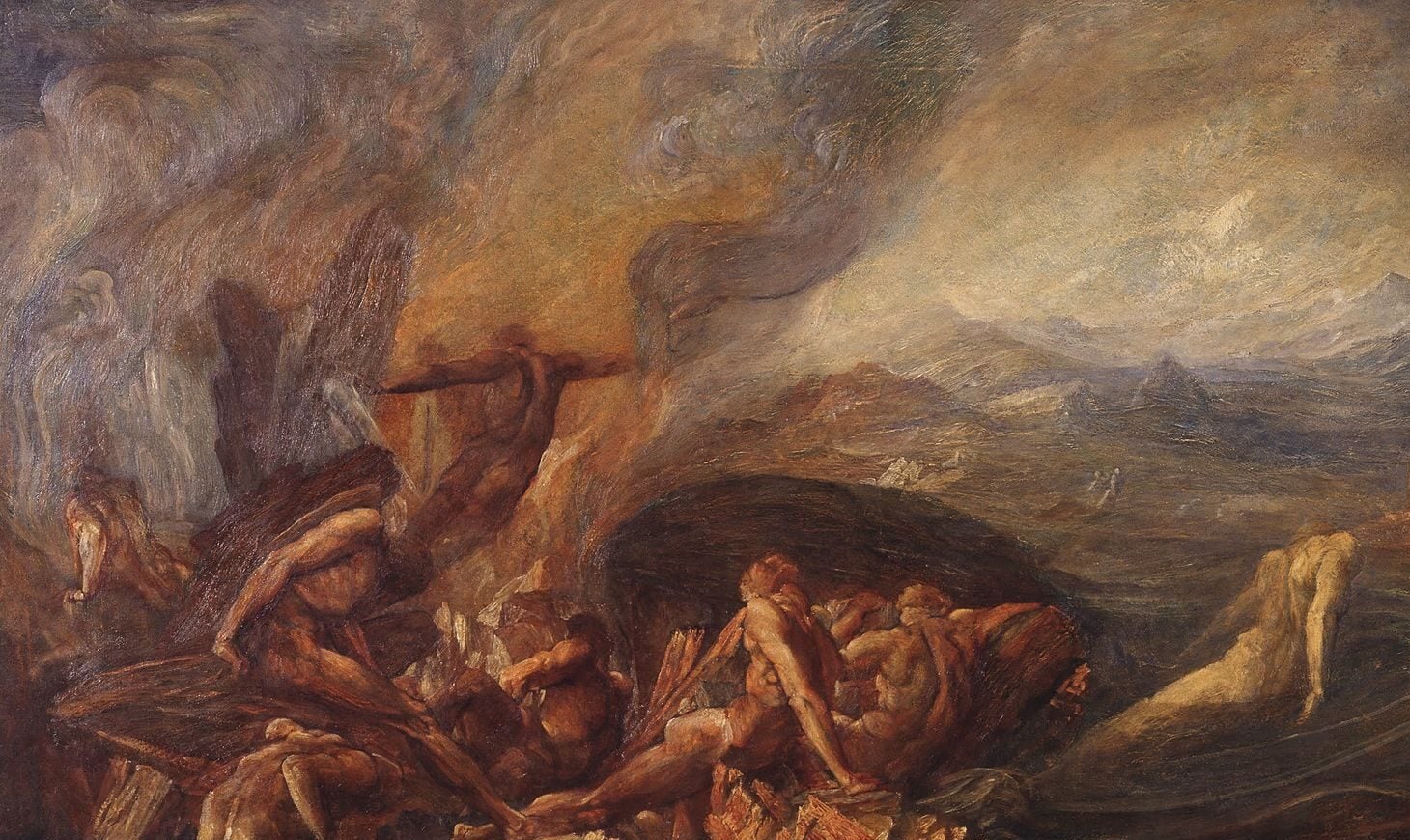
Hades ruled the underworld, a place of fire and shadow, and the newborn Earth truly belonged to such a realm. Four and a half billion years ago, our planet glowed with molten rock. Volcanoes erupted endlessly, and the sky choked with steam and poisonous gases. Oceans tried to form but vanished again under crushing heat. Asteroids struck the Earth with devastating force, reshaping its surface repeatedly. This was not a world for life; it was a world of chaos.
The Titans and the violent birth of the world
Hesiod, in his Theogony, described that the first beings to rise from the void were neither gentle now small but violent and colossal. Gaia gave birth to Uranus, the sky, and together they produced the Titans—forces embodying raw nature. Oceanus carried the world-river, Hyperion brought the sun, and Kronos even devoured his own children. At this stage, the universe was unstable and destructive. Only after the Titanomachy, when Zeus imposed order, could the world begin to resemble the cosmos we know today.
The parallel is remarkable. Modern science describes magma oceans and asteroid storms, while Greek mythology recounts the reign of the Titans. Both tell of a time when the Earth shook under forces too wild to sustain life. Both describe an age that had to end before a stable order could emerge.
Greek philosophy, too, fits within this picture. Empedocles, the philosopher of Acragas, writing in the fifth century BC, imagined that the early Earth brought forth countless strange beings. He spoke of creatures with mismatched limbs, animals with two faces, or hybrids of human and beast. Most of these forms perished because they lacked harmony. Only the balanced shapes endured. Empedocles, with poetic vision, anticipated what modern science now calls selection. Life must pass through the trial of chaos before it can endure.
This view was not isolated. Heraclitus, the philosopher of change, claimed that strife is the father of all things. For him, conflict lay at the heart of creation. Fire and water, day and night, life and death — the world existed through tension. The Hadean Eon could almost serve as geological proof of his philosophy. Fire battled with water. Land rose only to sink again. Life waited in the wings until the storm settled.
The Chaldean tradition and the anthropomorphic Greek gods
Other ancient traditions echo this same theme. The Chaldeans, whose myths reached the Greeks, spoke of an early age when monstrous beings filled the Earth. According to the Byzantine chronicler George Syncellus, they described men with wings, bulls with human heads, and fish with human faces. A goddess of chaos, Omorca, ruled until she was defeated and divided, her body forming the ordered world. Although foreign in detail, the story shares the same rhythm: before order came chaos, and before the cosmos came destruction.
The Greeks, however, gave this chaos a uniquely human face. The Titans were not distant abstractions. They carried the passions and flaws of mortals, only magnified to cosmic scale. Kronos devoured his children in fear of losing power. Oceanus flowed endlessly, bound by no shore. These figures remind us that Chaos is not just natural but also moral. It is the excess of desire, the refusal to yield, and the domination of raw strength. Zeus’s victory in the Titanomachy is more than a cosmic event. It marks the triumph of measure, law, and reason over uncontrolled power.
This is why the name “Hadean” suits that first eon so well. The Earth then was a place where fire and darkness reigned, a realm of forces too strong for fragile life. Like the underworld, it was necessary but terrifying. From that crucible, however, new possibilities emerged. Oceans cooled, atmospheres stabilized, and the raw elements prepared the ground for life.
Chaos, cosmos, and the enduring Titans
Modern science prides itself on breaking from myth. Yet when we step back, we see that our stories are not so different. Science speaks of impact events and molten crusts. Poets spoke of Titans and giants, and both describe a world in turmoil. Both recognize that creation begins not with peace but with strife.
The language changes, but the structure of thought endures. Hesiod tells us that Zeus must overthrow Kronos before order can reign. Geology tells us that Earth must survive cataclysms before life can begin. Empedocles tells us that only harmonious forms endure. Biology tells us that natural selection shapes survival. These echoes remind us that myth and science belong to the same human impulse: the search for meaning in the chaos of beginnings.
The Hadean Eon (what the Greeks called Chaos) lasted hundreds of millions of years, but in a sense, it never ended. The Earth still trembles with volcanoes, quakes, and storms. The Titans remain, buried beneath layers of order, but never fully gone. Every eruption, every quake, and every hurricane recalls their strength. The Olympians won, but their rule rests on fragile foundations.
For the Greeks, to remember the Titans was to remember that chaos always threatens to return, and for us, to study the Hadean Eon is to face the same truth. Creation demands struggle. Order is precious because it rises from turmoil. The Earth carries within it both Zeus and Kronos, both cosmos and chaos. Our myths and our science tell the same story, each in its own tongue: before life, there was fire. Before harmony, there was strife. Before the world, there were Titans.
See all the latest news from Greece and the world at Greekreporter.com. Contact our newsroom to report an update or send your story, photos and videos. Follow GR on Google News and subscribe here to our daily email!

