



Archaeologists excavating the Zvyaginsky II burial ground in Russia’s Nizhny Novgorod Region have uncovered what may be the earliest known Murom burials on the right bank of the Oka River.
The discoveries offer rare insight into the origins of the Murom culture, one of the least understood early medieval peoples of the Volga-Oka region, and suggest the community settled the area earlier than previously believed.
Excavation uncovers dozens of burials and rare horse graves
During the fourth excavation season, a joint team from the Institute of Archaeology of the Russian Academy of Sciences and the Nizhny Novgorod Museum-Reserve examined about 1,000 square meters of the cemetery. Archaeologists uncovered 43 graves, including 37 inhumation burials, one cremation burial, and the remains of six horses.
Among the most unusual finds was a grave containing two horses buried together. Over several years of excavation, Zvyaginsky II has become one of the best-studied Murom cemeteries, allowing archaeologists to trace changes in the culture across several centuries.
Unlike earlier seasons, which focused on the decline of the Murom people, this year’s excavation explored the culture’s earliest beginnings. The oldest section of the cemetery produced several unusual burials that shed new light on the community’s formative years.
Ceremonial headdress reveals status and shared traditions
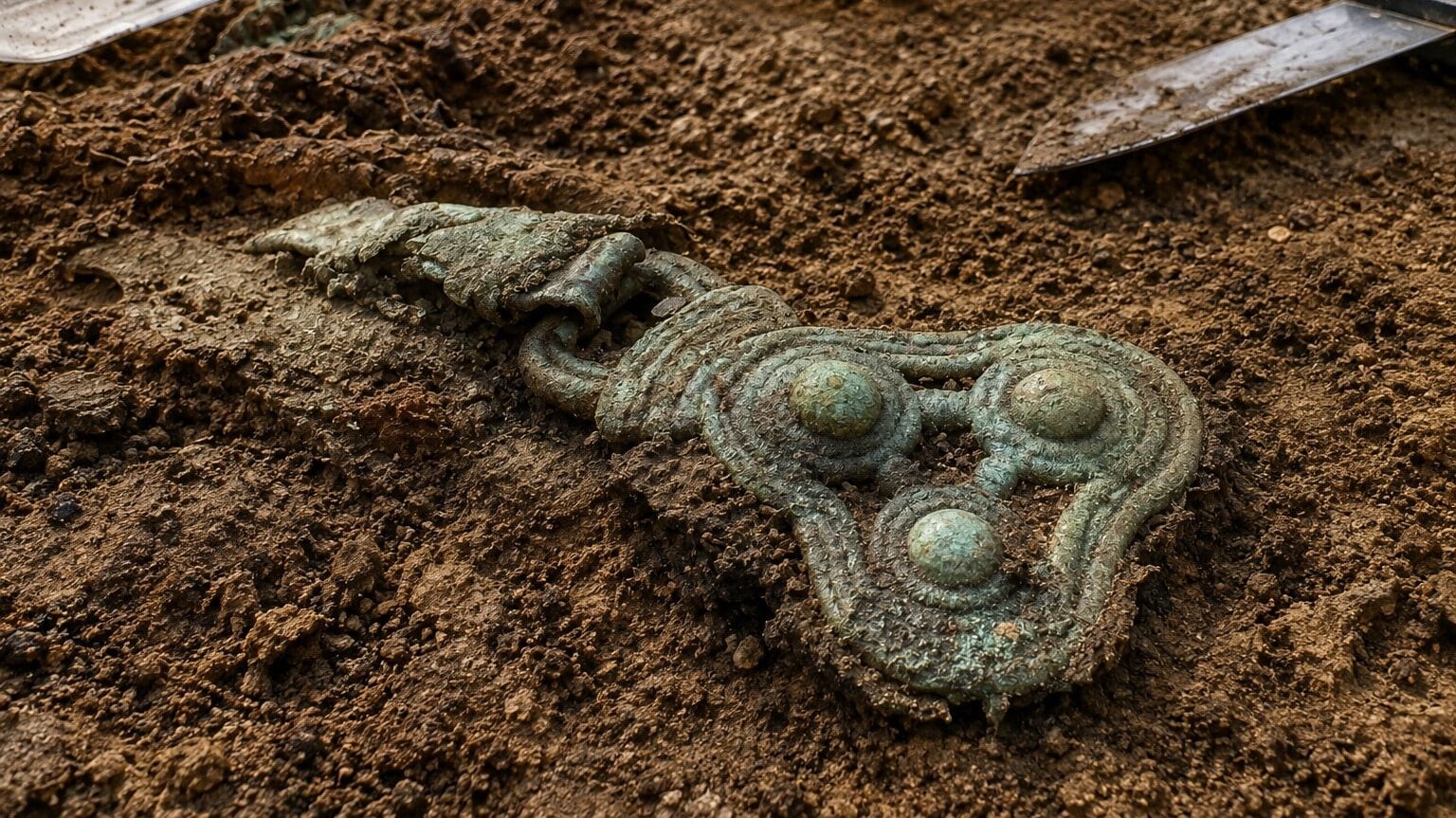
One of the most remarkable discoveries was the burial of a woman wearing an elaborate ceremonial headdress. Seven small cross-shaped brooches were arranged in a halo-like pattern around her skull, while a larger double-plate brooch rested behind her head. The smaller brooches had all been cast from the same mold, and none retained fastening pins, indicating they served as decorative ornaments rather than clothing fasteners.
Archaeologists in Russia have uncovered what may be the earliest known Murom burials on the right bank of the Oka River, revealing new clues about the origins of one of Eastern Europe's least understood early medieval cultures. pic.twitter.com/YDQgJlkk0q
— Tom Marvolo Riddle (@tom_riddle2025) August 7, 2026
Traces of tin and lead beads beneath the brooches suggest the ornaments had been sewn onto fabric. The headdress also included leather cords covered with bronze rings and a braided headband. The bronze rings measured only about two centimeters in diameter, making them much smaller than those found in later Murom burials from the eighth and ninth centuries.
Archaeologists believe the elaborate headdress marked high social status. Comparable examples are extremely rare. The last similar discovery was made nearly 80 years ago at another Murom cemetery. Related headdresses from nearby Bezvodninsky-Akhmylovsky burial grounds also point to shared cultural traditions across the lands between the Volga and Oka rivers.
Weapons and imported belts reflect cultural connections
Several male graves contained weapons, including axes, spears, arrowheads and darts, reflecting the presence of a warrior class. Archaeologists also uncovered openwork belt pendants and richly decorated belt sets.
Five so-called eastern belt sets have now been recovered from the site. Researchers believe these distinctive belts reached the Volga region through contacts with Central Asia, where similar designs appear in seventh- and eighth-century artwork.
One female burial also contained an eastern-style belt preserved around the pelvis, along with a winged clasp made from a tin-lead alloy that is usually associated with military equipment. Similar clasps have also been found in female Murom burials elsewhere, suggesting they may have carried both practical and symbolic importance.
Children’s graves push Murom settlement further back
Most burials date to the late seventh and early eighth centuries based on jewelry, glass beads, neck rings, and other grave goods. However, several children’s graves appear to be older. One child was buried with a necklace of solid red glass beads known only from the seventh century, while two others contained ornaments dating to the sixth or early seventh century.
Together, the discoveries provide some of the clearest evidence yet for how the Murom culture emerged before spreading across the lower Oka River valley, where it remained established for nearly 500 years.
By comparing the new finds with earlier excavations, archaeologists are beginning to reconstruct the cultural changes that shaped one of medieval Russia’s most enigmatic communities.
See all the latest news from Greece and the world at Greekreporter.com. Contact our newsroom to report an update or send your story, photos and videos. Follow GR on Google News and subscribe here to our daily email!

