



The shackled men found in a mass grave near ancient Athens were not foreign fighters or outside invaders, according to a new study. Instead, chemical evidence from their teeth shows they came from the same region where they were buried.
The burial site, known as the Esplanada, was discovered in 2016 at the Phaleron cemetery on the coast near Athens. It holds the remains of 79 adult men, laid out in three rows, many still bound at the wrists with metal restraints. Since the discovery, archaeologists and historians have debated who these men were and why they died together.
Some researchers have argued the burial reflects the rise of state power in early Athens, as the city began punishing crimes as a community rather than leaving justice to individuals. Others have suggested the deaths point to political chaos, at a time when Athens had no strong system in place to settle disputes peacefully.
Tooth chemistry reveals where ancient Athenians truly lived
To help answer that question, a team led by Julianne R. Stamer of Arizona State University’s Center for Bioarchaeological Research analyzed strontium isotopes from tooth enamel.
Strontium is absorbed into teeth from local food and water during childhood, leaving a chemical signature tied to where a person grew up. By comparing that signature to known local values, researchers can tell whether someone spent their early years near where they were later buried.
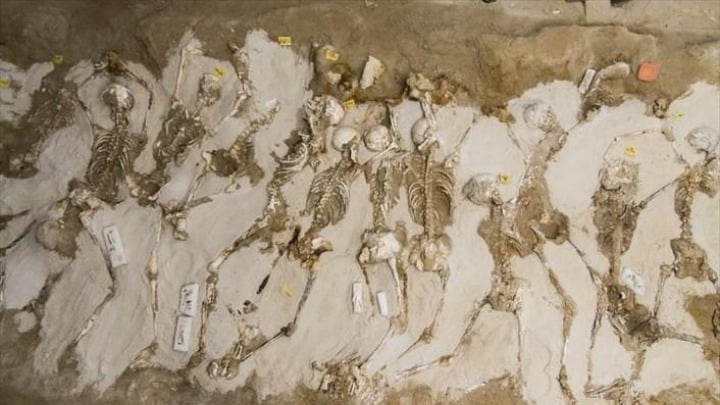
The team tested samples from 66 of the men in the Esplanada grave, along with 97 other individuals buried elsewhere at Phaleron. The results showed that nearly all of them, about 97 percent of the men in the mass grave, had local origins.
That figure closely matched the broader Phaleron population, where about 96 percent of those tested were also local.
Shackled men in the mass grave prove overwhelmingly local
The findings suggest the violence these men experienced came from within their own community rather than from an outside threat, the study concludes.
Stamer’s team worked alongside Matthew Simonton, a classicist at Princeton University, and Stella Chryssoulaki, an archaeologist with the Hellenic Ministry of Culture who helped lead excavations at the site.
The authors say the results support the idea that Attica, the region surrounding Athens, saw only limited migration during the Archaic period, even as trade and travel were increasing across the wider Aegean world.
The study appears in the Journal of Archaeological Science: Reports.
See all the latest news from Greece and the world at Greekreporter.com. Contact our newsroom to report an update or send your story, photos and videos. Follow GR on Google News and subscribe here to our daily email!

