



When a young olive tree first took root on a rocky hillside in eastern Crete more than 3,200 years ago, the Minoan civilization was entering its final centuries. Long before Classical Greece emerged and centuries before the Parthenon was built, the tree had already begun its remarkable journey through history. Today, the Ancient Olive Tree of Kavousi, estimated to be around 3,250 years old, is still alive and bears fruit.
Growing in the Lasithi region of eastern Crete, it is widely regarded as one of the world’s oldest living olive trees—a rare natural monument that connects the island’s modern landscape with one of Europe’s earliest civilizations. Unlike the ruins of palaces or ancient temples, the olive tree remains a living organism.
Season after season, it continues the same natural cycle it has followed for more than three millennia, long before modern visitors would travel to admire it. The ancient olive tree of Crete continues producing new leaves, blossoms, and olives to this day amidst a landscape where olive cultivation has shaped life since antiquity.
A tree rooted in the twilight of the Minoan World
Researchers estimate that the tree began growing sometime during the Late Minoan period, between approximately 1350 and 1100 BC. This was a transformative era for Crete. The great Minoan palaces that had dominated the island for centuries had already declined, yet communities continued to thrive while new political and cultural influences from mainland Mycenaean Greece gradually emerged.
Although no evidence suggests the tree was planted by the Minoans, its roots reach back to the final chapters of their civilization. Few living organisms anywhere in Europe can be confidently placed within such a distant historical timeframe. The tree’s extraordinary longevity makes it more than an ancient specimen. It offers a tangible reminder that the natural world often survives far longer than the civilizations that once flourished around it.
An ancient olive tree on Crete surrounded by a landscape rich in archaeology
The Ancient Olive Tree of Kavousi stands within one of Crete’s most significant archaeological landscapes. Nearby lies Azoria, an extensively excavated settlement overlooking the Gulf of Mirabello. Archaeological research has revealed an important urban center that flourished during the Early Iron Age, offering valuable insights into the communities that emerged after the collapse of the Bronze Age civilizations.
The wider Kavousi region preserves evidence of human activity stretching from the Bronze Age through the Classical period, illustrating the remarkable continuity of settlement in eastern Crete. Among the discoveries at Azoria is one of the best-preserved ancient olive-processing installations identified in the Aegean. Archaeologists uncovered a complete olive press equipped with a lever-and-weight mechanism, together with facilities used to crush olives, extract their oil, and separate it from water.
The installation demonstrates the sophistication of olive-oil production in ancient Crete and highlights the crop’s economic importance long before the Classical era. While there is no evidence that olives from the ancient olive tree itself were ever processed there, both the tree and the archaeological remains belong to the same cultural landscape of Crete—one where olive cultivation has been part of daily life for thousands of years.
Olive oil and the Minoan economy
Olive oil was among the most valuable resources produced by the Minoans. Archaeological excavations at the great palaces of Knossos, Phaistos, Malia, and Zakros have revealed vast storage magazines lined with enormous clay pithoi used to store agricultural products, including olive oil.
The commodity served numerous purposes. It was used in cooking, religious ceremonies, perfumes, cosmetics, lighting, and trade. Cretan olive oil was transported throughout the Eastern Mediterranean, becoming an essential component of the island’s economy. The importance of olive cultivation persisted after the Minoan period. Administrative records written in the Linear B script document the careful management of olive oil during the Late Bronze Age, reflecting its enduring economic value.
The Ancient Olive Tree of Kavousi is therefore not simply an exceptionally old tree. It survives within a landscape where olive cultivation has formed part of local life since prehistoric times, providing a living link to one of the Mediterranean’s oldest agricultural traditions.
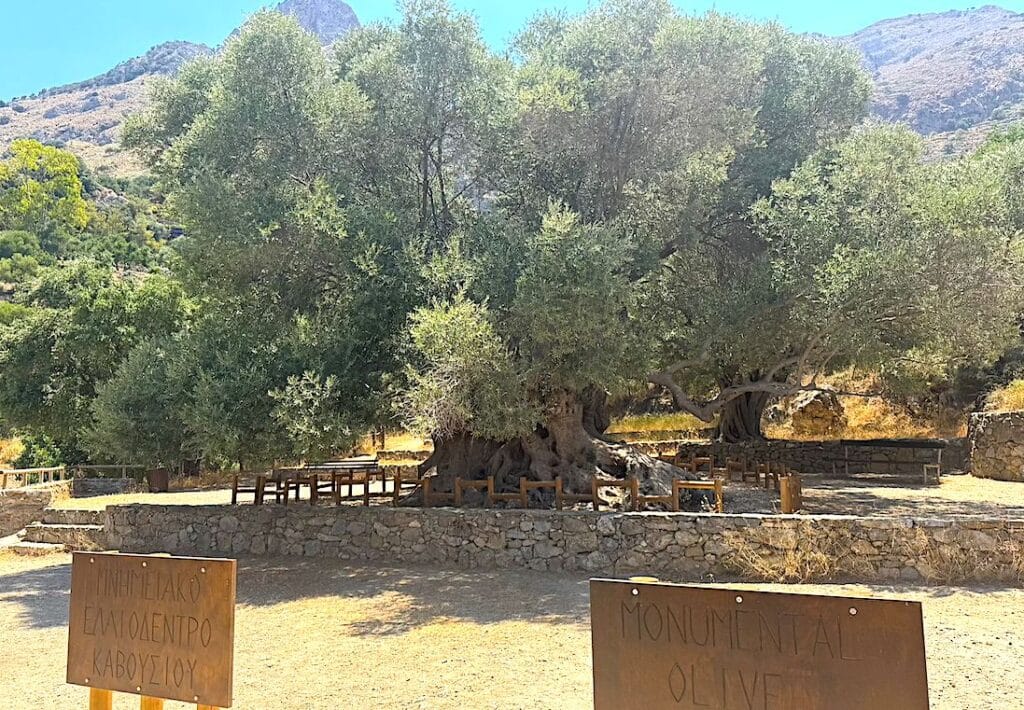
A living monument: The Ancient Olive Tree of Kavousi on Crete
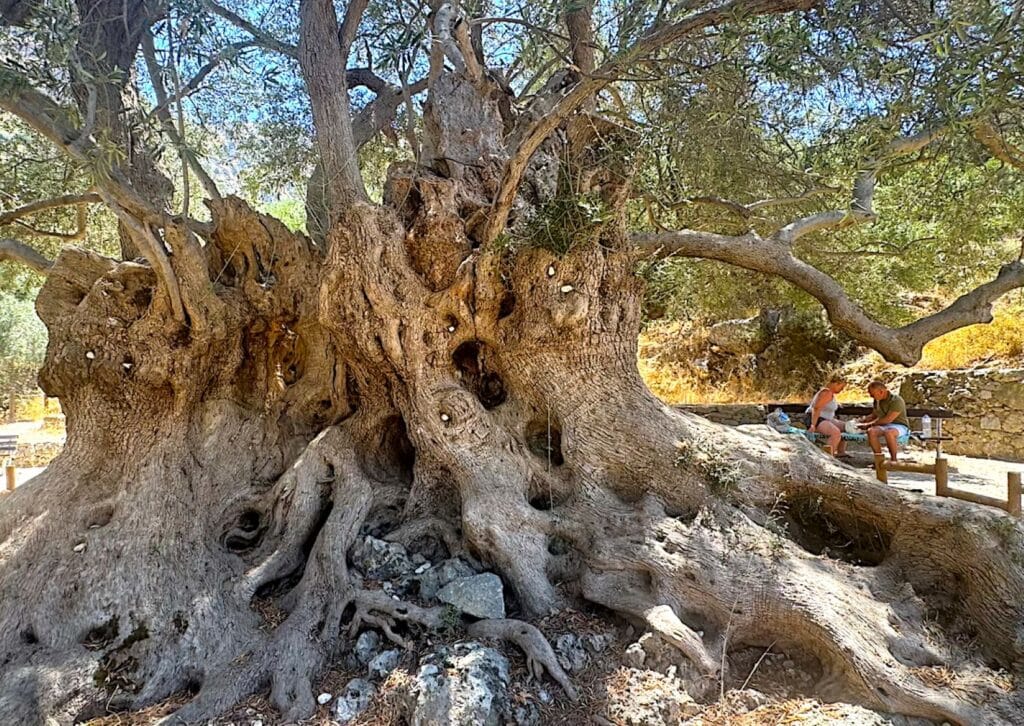
Ancient olive trees differ from many other long-lived species. Over centuries, their trunks gradually hollow, twist, and regenerate, making it difficult to determine their precise age through conventional tree-ring analysis. Instead, scientists combine morphological characteristics, historical evidence, and comparative studies to estimate their age.
The Kavousi tree belongs to the traditional Mastoidis olive variety, grafted onto wild olive rootstock. Known for its resilience and longevity, the variety has been cultivated in eastern Crete for generations and is particularly well adapted to the island’s dry climate.
Despite the passing of more than three millennia, the tree continues to produce olives. That simple fact may be its most remarkable characteristic. It is not a fossil preserved in stone or the remains of a vanished forest but a living, productive organism that still participates in the annual rhythm of the Cretan countryside.
Protected for future generations
Recognizing its exceptional ecological, historical, and cultural importance, Greek authorities designated the Ancient Olive Tree of Kavousi a Protected Natural Monument in 2019. The designation safeguards both the tree and the surrounding landscape, ensuring that one of Greece’s oldest living landmarks will be preserved for future generations.
Today, visitors who make the journey to the hillside above Kavousi encounter more than an impressive tree. They stand before a living survivor that has endured while kingdoms rose and fell, empires came and disappeared, and entire civilizations transformed the Mediterranean world.
Its massive sculpted trunk, shaped by thousands of years of continuous growth, bears silent witness to the passage of time. Yet perhaps the most extraordinary aspect of the tree is not its age but its vitality. Every growing season it reminds us that history is not preserved only in museums, temples, or archaeological sites. It might also flourish in the branches of a single olive tree.
For travelers seeking a deeper understanding of Crete, the Ancient Olive Tree of Kavousi offers an experience unlike any other, standing at the intersection of nature, archaeology, and history. It is a living monument that still bears fruit over three thousand years later long after the collapse of Minoan civilization.
See all the latest news from Greece and the world at Greekreporter.com. Contact our newsroom to report an update or send your story, photos and videos. Follow GR on Google News and subscribe here to our daily email!

