



For many people, capitalism conjures images of stock exchanges, multinational corporations, and global finance. Yet some of its most recognizable ingredients—private property, competitive markets, banking, entrepreneurship, and international trade—were already flourishing in Ancient Greece more than 2,400 years ago.
The agora of Athens bustled with merchants buying and selling goods from across the Mediterranean. Private bankers financed commercial ventures. Shipowners invested in risky overseas expeditions in search of profit. Wealthy citizens owned businesses, workshops, and mines, while courts enforced commercial contracts.
If all this sounds remarkably familiar, it raises an intriguing question: did capitalism flourish in Ancient Greece? Most historians answer with a qualified no.
The reason is that while the Greeks developed many of the building blocks of capitalism, they lived in a fundamentally different economic system—one shaped by agriculture, small-scale production, and philosophical ideas that often viewed unlimited wealth with suspicion.
The agora of Athens in Ancient Greece
The commercial heart of every Greek city-state was the agora, where farmers, artisans, merchants, and foreign traders met to exchange goods. A visitor to Classical Athens might find locally produced olive oil, wine, pottery, bronze weapons, textiles, and jewelry alongside imported grain from the Black Sea, Egyptian papyrus, Phoenician purple dye, and luxury goods from across the Eastern Mediterranean.
Prices responded to supply and demand, merchants competed with one another, and long-distance trade connected hundreds of Greek communities stretching from Spain to the shores of modern-day Ukraine. Recent archaeological research has even suggested that organized market economies in the Aegean may have existed centuries earlier than previously believed, extending back into the Bronze Age. By the Classical period, however, Athens had become one of the Mediterranean’s most dynamic commercial centers.
Entrepreneurs and investors

Ancient Greek merchants were entrepreneurs in every sense of the word. Merchant ships carried valuable cargoes across dangerous seas plagued by storms and pirates. Successful voyages could generate enormous profits, but failed expeditions could wipe out an investor’s entire fortune.
To manage these risks, wealthy Athenians often financed voyages undertaken by others. Investors supplied capital while merchants organized the expedition, sharing both profits and losses. This system encouraged commerce while spreading financial risk—a remarkably sophisticated approach for the ancient world.
Different regions also specialized in particular products. Corinth became famous for its pottery, Chios for its wine, and Attica for its olive oil and silver. This specialization increased efficiency and helped create thriving international trade networks across the Mediterranean.
Banking before modern banks—and “capitalism” in Ancient Greece?
Commerce on this scale required financial services. Private bankers, known as trapezitai, accepted deposits, safeguarded valuables, exchanged currencies, and issued loans. Because dozens of Greek city-states minted their own coins, money changers became indispensable to merchants conducting business far from home.
Perhaps their most innovative financial instrument was the maritime loan. Unlike ordinary loans, repayment depended upon the safe return of a trading voyage. If a ship was lost at sea, the lender frequently absorbed the loss. Higher interest rates reflected the greater risk involved, making these agreements surprisingly similar to modern risk-based commercial finance.
Private property wasn’t enough
Ancient Greece possessed many institutions that today are associated with capitalism. Private property was protected by law. Citizens owned farms, workshops, ships, and businesses. Commercial contracts could be enforced through the courts, and entrepreneurs sought profits through trade and investment. Yet these features alone do not define capitalism.
Modern capitalism depends on continual capital accumulation, large-scale private investment, industrial production, corporations, and wage labor as the dominant form of economic organization—bone of these existed in Ancient Greece. Production remained largely agricultural or artisanal. Workshops were typically small family businesses rather than factories. Business enterprises rarely survived beyond their founders, and there were no joint-stock companies or stock exchanges through which investors could own shares in growing enterprises. Economic growth occurred, but it was not driven by continuous reinvestment in expanding production, the defining characteristic of modern capitalist economies.
Aristotle’s critique of unlimited wealth
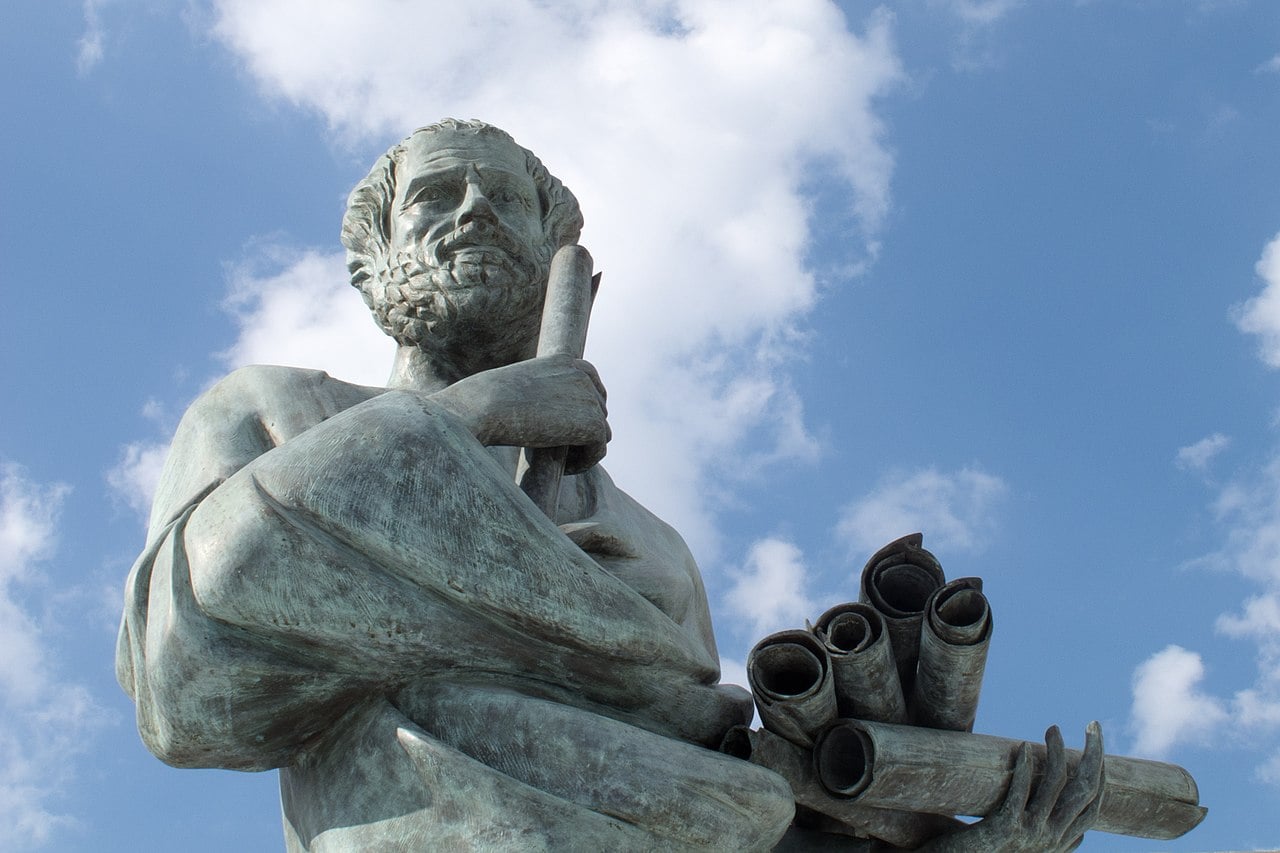
The clearest explanation why the claim that capitalism defined Ancient Greece has been rejected by many historians may come from Aristotle himself. In his Politics, Aristotle distinguished between oikonomia, the proper management of a household, and chrematistics, the pursuit of wealth simply to accumulate more wealth. He believed the first was natural and necessary, while the second deserved criticism:
“There are two sorts of wealth-getting…the former necessary and honorable, while that which consists in exchange is justly censured; for it is unnatural, and a mode by which men gain from one another.”
— Politics, Book I
Aristotle did not oppose commerce altogether. Markets were necessary because communities needed to exchange goods they could not produce themselves. His concern was in treating money as an end rather than a means. He reserved his strongest criticism for usury—the practice of making money from money itself:
“The most hated sort [of wealth-getting], and with the greatest reason, is usury…because money was intended to be used in exchange, but not to increase at interest.”
— Politics, Book I
Although Greek bankers routinely charged interest on commercial loans, Aristotle regarded the endless multiplication of wealth through financial transactions as contrary to nature. His philosophy reflected a broader Greek belief that economic activity should ultimately serve society and human flourishing rather than become life’s ultimate purpose. That idea appears even more clearly in the opening book of the Nicomachean Ethics:
“The life of money-making is one undertaken under compulsion, and wealth is evidently not the good we are seeking; for it is merely useful and for the sake of something else.”
For Aristotle, wealth had value only because it enabled people to live well. It was never meant to become the highest goal of human life.
Ancient Greece provided the foundations of capitalism—not capitalism itself
Although Ancient Greece was not capitalist, it profoundly shaped the commercial world that followed. The Greeks refined commercial law, expanded long-distance trade, protected private property, developed banking services, and encouraged entrepreneurship. These innovations influenced the Hellenistic kingdoms, the Roman Empire, and, many centuries later, the commercial revival of medieval and Renaissance Europe.
Capitalism itself would emerge much later, combining these older institutions with industrial production, corporations, wage labor, and continuous capital investment. The bustling agora of Athens was not Wall Street. Yet it demonstrated something equally remarkable: more than two millennia before modern capitalism, the ancient Greeks had already discovered the power of markets, enterprise, investment, and trade.
They did not invent capitalism, but they helped create many of the economic institutions upon which it would eventually be built.
See all the latest news from Greece and the world at Greekreporter.com. Contact our newsroom to report an update or send your story, photos and videos. Follow GR on Google News and subscribe here to our daily email!

