



The vast Roman Empire did not remain whole forever; by the late 3rd century AD, it had split into two separate parts: the Western Roman Empire and the Eastern Roman Empire. This division shaped the future of Europe and the Mediterranean for centuries.
The empire once ruled a vast territory stretching across Europe, North Africa, and the Middle East. At its height, it united diverse peoples under one system of government, law, and culture.
The unified Roman Empire
Rome started off as a small city-state in Central Italy. Over centuries, it grew into a republic and, later, an empire. By the 1st century AD, Rome controlled lands from Britain to Egypt. The empire thrived due to its strong army, efficient administration, and well-developed infrastructure like roads and aqueducts. The Latin language and Roman law spread widely, and Rome itself was the political and cultural capital, symbolizing unity and power.
However, ruling such a vast and diverse empire became increasingly difficult. Its sheer vastness resulted in slow communication and governance. Different regions faced distinct challenges, from economic strains to external invasions, and by the 3rd century AD, Rome consistently struggled with political instability, military threats, and economic decline.
Causes of the division
Emperor Diocletian, who ruled from 284 to 305 AD, recognized the empire’s troubles. To better manage it, he introduced a system known as the Tetrarchy, which divided power among four rulers: two senior emperors (Augusti) and two junior emperors (Caesars). Each governed a different part of the empire. Although temporary, this system laid the groundwork for a more permanent division.
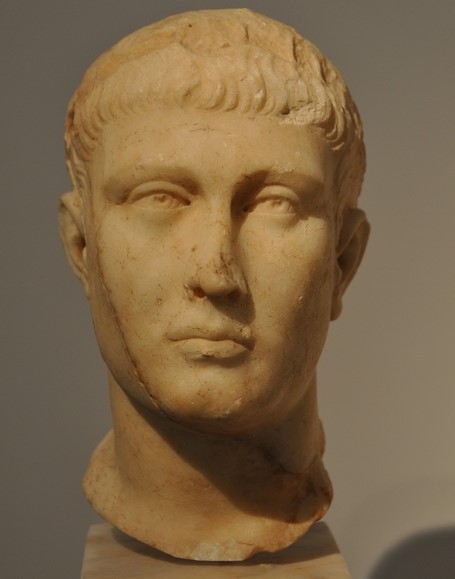
One of the Caesars was Constantius Chlorus, who ruled the Western provinces and helped stabilize them during a chaotic period in time. His son, Constantine, later rose to power after Diocletian’s abdication. Constantine continued many of Diocletian’s reforms but shifted the empire’s focus by founding Constantinople as a new eastern capital.
This move reinforced the growing importance of the Eastern provinces. Diocletian had already moved the imperial court to the East, establishing Nicomedia (modern-day Turkey) as a key capital. The Eastern provinces, rich in cities like Alexandria, Antioch, and Constantinople, possessed significant wealth and resources. Meanwhile, the Western provinces, including Italy, Gaul, and Spain, struggled with invasions and economic decline.

Credit: Jerzy Strzelecki, Wikimedia Commons, CC BY-SA 3.0.
The formal split under Theodosius I
The empire split formally after Emperor Theodosius I died in 395 AD. Theodosius ruled the entire empire but decided to divide it between his two sons. His son Arcadius inherited the East, and Honorius took the West. From this point, the Eastern and Western Roman Empires functioned as separate political entities.
The Western Empire retained Rome as its symbolic capital, though the court often moved to cities like Ravenna. It faced growing pressures as Germanic tribes such as the Visigoths, Vandals, and Ostrogoths invaded and settled on Roman lands. Economic troubles worsened as agriculture declined, trade routes shrank, and cities depopulated.
The Eastern Empire, centered around Constantinople (formerly Byzantium), fared better. Constantinople’s location provided a strong defensive position and control over trade routes between Europe and Asia. The Eastern Empire maintained a stable bureaucracy and strong military, repelling invasions from Persians, Huns, and later Arabs.
Differences between the two empires
Once united, the Eastern and Western Roman Empires evolved quite differently in culture, language, and governance. The roots of this divide can be traced back to earlier rulers such as Constantius Chlorus, who governed the Western provinces, and his son Constantine the Great, who later became the first Christian emperor and founded Constantinople as the new capital in the East.
Latin remained the dominant language in the West, serving as the official tongue for administration and law, while the Eastern Empire increasingly embraced Greek, especially among the educated elite and in religious contexts. Both empires adopted Christianity after Constantine legalized the faith in the early 4th century, but their religious practices and church structures gradually diverged. This divergence laid the foundation for the eventual split between the Roman Catholic Church in the West and the Eastern Orthodox Church.
In governance, the East developed a sophisticated bureaucracy centered on a powerful emperor who upheld imperial traditions and court rituals inherited from both the Hellenistic and Roman worlds. The West, in contrast, depended more on local military leaders and experienced frequent changes in leadership, reflecting its political instability. Economically, the Eastern Empire flourished with prosperous cities, thriving trade networks, and fertile agriculture, while the Western Empire faced continual invasions, territorial losses, and economic decline.

The fall of the Western Roman empire
The Western Empire struggled throughout the 5th century. Germanic tribes sacked Rome several times, most notably in 410 AD by the Visigoths. Despite efforts to defend its borders, the Western Empire weakened steadily. By 476 AD, the last Western emperor, Romulus Augustulus, was deposed by the Germanic chieftain Odoacer. This event marks the traditional date for the fall of the Western Roman Empire.
After the fall, Western Europe fragmented into numerous kingdoms ruled by Germanic peoples. Roman institutions and urban life declined, and the region entered what historians often refer to as the “Dark Ages.” However, the legacy of Rome lived on in law, language, and the Christian Church.

The survival and transformation of the Eastern Roman Empire
Unlike the West, the Eastern Roman Empire, known later as the Byzantine Empire, survived for nearly another thousand years, preserving many aspects of Roman law, culture, and governance. Byzantine emperors viewed themselves as Roman rulers, maintaining the title Imperator Romanorum (Emperor of the Romans).
Constantinople became a wealthy and powerful city, with monumental architecture such as the Hagia Sophia and impressive walls defending the city. The Byzantine Empire also became a center of Orthodox Christianity and Greek culture.
The Byzantines faced numerous challenges, including wars with Persians, Arabs, Crusaders, and eventually the Ottoman Turks. In 1453, Constantinople fell to the Ottomans, marking the end of the Roman imperial tradition.

Legacy of the Eastern and Western Roman Empires
The division between the Eastern and Western Roman Empires did not end with politics and borders. It deeply shaped religious life as well. After Emperor Constantine legalized Christianity, both empires embraced the faith, but differences soon emerged.
The Western Empire developed what became the Roman Catholic Church, centered in Rome and led by the Pope. The East formed the Eastern Orthodox Church, with its spiritual center in Constantinople and a more decentralized leadership of patriarchs.
Over centuries, disagreements over doctrine, language, liturgical practices, and authority led to the Great Schism of 1054, formally splitting Christianity into these two branches. This religious division persists to this day, reflecting the ancient political and cultural split of the Roman world that has influenced faith, tradition, and identity across Europe and beyond.
See all the latest news from Greece and the world at Greekreporter.com. Contact our newsroom to report an update or send your story, photos and videos. Follow GR on Google News and subscribe here to our daily email!

