



The Roman Empire produced emperors—Augustus, the founder, and Trajan, the builder, among others—who were celebrated for their achievements, but every golden age also had some of the worst Roman emperors whose reigns stained the empire with fear, vanity, violence, and collapse.
Specifically, there are nine emperors often remembered not for their victories but the chaos, cruelty, and misjudgment that marked their time in power. From delusions of godhood to reckless wars and political purges, each left scars that outlived their reigns.
Tiberius (14-37 AD)
Following Augustus, Tiberius began with stability and discipline. He expanded the empire’s frontiers and preserved financial order. But as he aged, he withdrew from public life, retreating to the island of Capri.
From afar, he governed through letters and trusted allies like Sejanus, who oversaw widespread purges and treason trials. According to ancient sources like Tacitus and Suetonius, during his time of retreat, the empire was marred by cruelty and moral decay, though these claims have also been debated. Tiberius reportedly tortured prisoners and executed perceived enemies based on little evidence.
He died in AD 37, leaving behind a stable treasury but deeply mistrustful senate. His successor, Caligula, would steer the empire into chaos once again.
Caligula (37-41 AD)

Gaius Caesar, better known as Caligula, rose to power amid optimism, but only months into his reign, he fell gravely ill. According to historians, his behavior shifted drastically afterwards. He ordered the execution of political rivals and even close family members and demanded he be worshipped as a living god, dressing in divine robes and installing statues of himself in temples.
His rule grew bizarre, and he once led an army to the coast and commanded soldiers to attack the sea—allegedly to conquer the god Neptune (the god Poseidon for the Greeks). Moreover, he taxed heavily to fund feasts, games, and personal projects, and mocked senators by forcing them into humiliating roles. In a symbolic act of contempt, he planned to name his horse Incitatus, a consul.
By AD 41, even his bodyguards had had enough. A Praetorian conspiracy ended Caligula’s life. His uncle, Claudius, was declared emperor in the aftermath.
Nero (54-68 AD)

Nero became emperor at the young age of sixteen, succeeding his adoptive father, Claudius. Early hopes soon gave way to a reign marked by violence, extravagance, and paranoia. He ordered the murder of his mother, Agrippina the Younger, in AD 59. Five years later, fire engulfed much of Rome. While no proof linked Nero to the blaze, many believed he started it to clear space for a grand new palace. Instead of addressing public outrage, he blamed Christians, launching one of the first major persecutions.
Nero spent vast sums on art, games, and architecture, including the extravagant Domus Aurea. He performed music and drama in public, acts considered shameful for an emperor. As opposition mounted, Nero had his first wife, Claudia Octavia, banished on trumped‑up adultery charges and ultimately executed, while ordering the deaths of dozens of nobles.
After his second wife, Poppaea Sabina, died in 65 AD, he became enamored of a young freedman, Sporus—believing the boy bore an uncanny resemblance to Poppaea—had him castrated, gave him her name, and “married” him in a full imperial ceremony.
In AD 68, facing revolt in Gaul and betrayal by the Praetorian Guard, Nero died by suicide. His last words: “What an artist dies in me!” His death ended the Julio-Claudian dynasty and triggered a year-long civil war.
Domitian (81-96 AD)

Domitian succeeded his brother Titus and began with a promise. He revalued the currency, funded building projects such as the “Domus Flavia,” and strengthened Rome’s borders. However, power got the best of him, and he demanded that he be called dominus et deus—“lord and god.” He purged the Senate, staged mass executions, and relied heavily on informers to expose conspiracies, both real and imagined.
In one infamous episode, he held a feast in a pitch-black room where each guest was given a gravestone with their name on it. The message was clear: their lives rested in his hands. Assassinated in AD 96 by palace staff and possibly his own wife, Domitia, his name was erased from public records under a Senate order of damnatio memoriae, meaning “condemnation of memory,”a harsh punishment for the ancient Romans meant to erase a figure from public memory.
Commodus (180-192 AD)

Commodus, the son of Marcus Aurelius, inherited a stable empire but abandoned its traditions. He preferred showmanship to statecraft, appearing in the arena dressed as a gladiator. His fights were staged, but he demanded full credit—and full payment.
He renamed Rome after himself, restyled the calendar months in his honor, and posed as the demigod Hercules in countless statues. While he focused on image, governance fell to corrupt favorites like the praetorian prefect Cleander. By AD 192, conspiracies circulated. When poison failed, a wrestler strangled Commodus in his bath. His assassination ended the Nerva–Antonine dynasty and plunged Rome into another power struggle, remembered as the Year of the Five Emperors.
Diocletian (284-305 AD)
Diocletian took power amid a crisis and introduced bold reforms. In AD 293, he created the Tetrarchy, dividing the empire among four rulers to ease governance and defense. He issued the Edict on Maximum Prices in 301 AD to curb inflation, though enforcement failed. His tax reforms brought structure but not stability.
Diocletian died today 311AD. He rose through the ranks of the military to become cavalry commander to the Emperor Carus. Bust of Diocletian. pic.twitter.com/mNg4ixas9P
— Roman History (@romanhistory1) December 3, 2021
His darkest legacy began in 303 AD with the Great Persecution of Christians. Churches were destroyed, scriptures burned, and thousands imprisoned or killed. The effort to restore the traditional Roman religion only strengthened Christian resistance. In 305 AD, Diocletian shocked the empire by stepping down voluntarily, and he retired to a coastal palace in modern-day Croatia. Civil war soon followed.
Elagabalus (218–222 AD)

Crowned emperor at the young age of fourteen, Varius Avitus Bassianus adopted the name Elagabalus in honor of the Syrian sun deity. Prior to becoming emperor, he had served as a high priest for the particular sun god in Syria, and he tried to make the god supreme in Rome as well, building a temple on the Palatine Hill and parading sacred stones through the streets.
Court gossip focused on his marriages to men, silks in the throne room, and preference for youthful favorites over seasoned officials. Disgusted soldiers sided with his cousin, Alexander Severus. The guards killed Elagabalus and dumped his body in the Tiber in 222 AD.
Caracalla (198-217 AD)
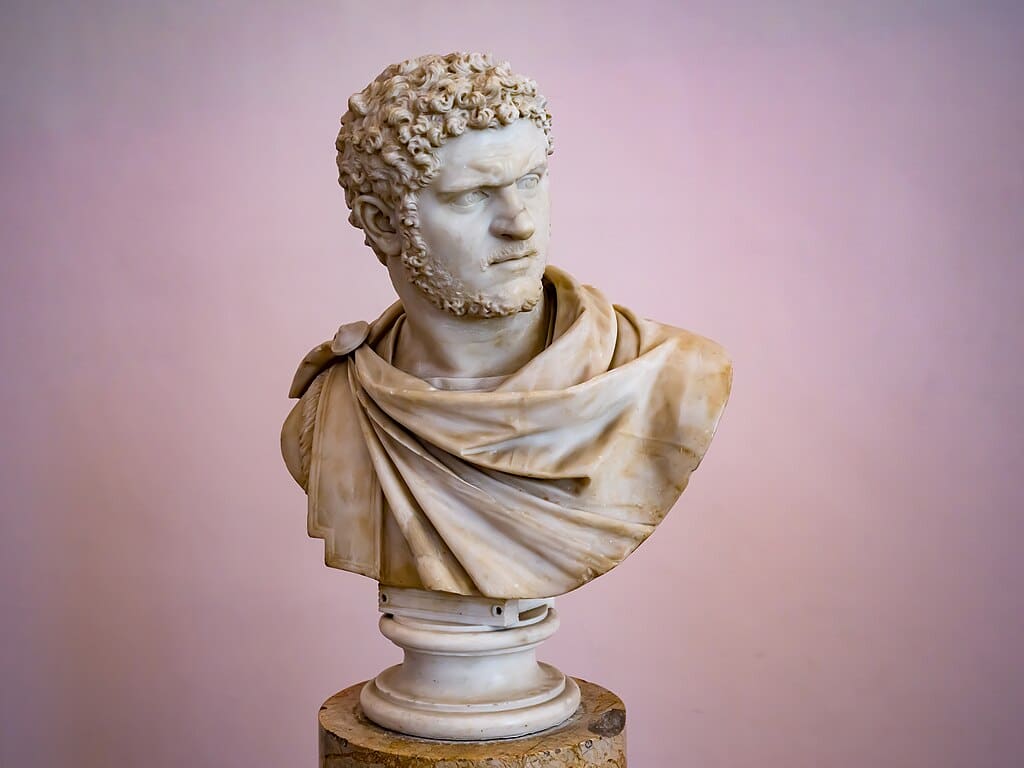
Caracalla began as co-emperor with his brother Geta after their father passed away in 211 AD. Within a year, Caracalla had Geta killed during a meeting with their mother. Thousands of Geta’s supporters were executed in the following purge as well. To expand his support, Caracalla issued the Constitutio Antoniniana in 212 AD, granting Roman citizenship to all free men in the empire, mainly to increase tax revenues.
Eager for military glory, he launched campaigns in Germania and Parthia and raised soldiers’ pay repeatedly to maintain loyalty, straining Rome’s finances. Meanwhile, his paranoia deepened, and purges continued. In 217 AD, while traveling near Carrhae, he was assassinated by a soldier—allegedly on the orders of his Praetorian prefect, Macrinus, who replaced him.
Honorius (395-423 AD)
Honorius was a child of the age of ten when he became emperor. Early leadership came from his general, Stilicho, but after Stilicho’s execution in 408 AD, the empire spiraled. Honorius moved the capital to Ravenna, seeking security in its marshes.
Today 395AD Honorius aged 10 becomes emperor in the west. He was the younger son of emperor Theodosius I and his first wife Aelia Flaccilla, and brother of Arcadius. pic.twitter.com/BipZNpaO6N
— Roman History (@romanhistory1) January 17, 2022
In 410 AD, the Visigoths sacked Rome under Alaric. Honorius remained in Ravenna, offering no visible response. As the empire fragmented, Britain and Gaul drifted from Roman control. It was in 418 AD, when he allowed the Visigoths to settle in Aquitaine—proof that Rome could no longer enforce its rule. Honorius died in 423 AD, leaving the Western Roman Empire fractured and fading.
Each of these Roman emperors came to power with hopes of greatness but allowed ambition, fear, or delusion to guide them. Their failures weakened Rome’s structure from within—politically, spiritually, and militarily.
Collectively, they remind us that empires fall not only from external invasions but from the very failures of those in whom we have entrusted leadership.
See all the latest news from Greece and the world at Greekreporter.com. Contact our newsroom to report an update or send your story, photos and videos. Follow GR on Google News and subscribe here to our daily email!

