



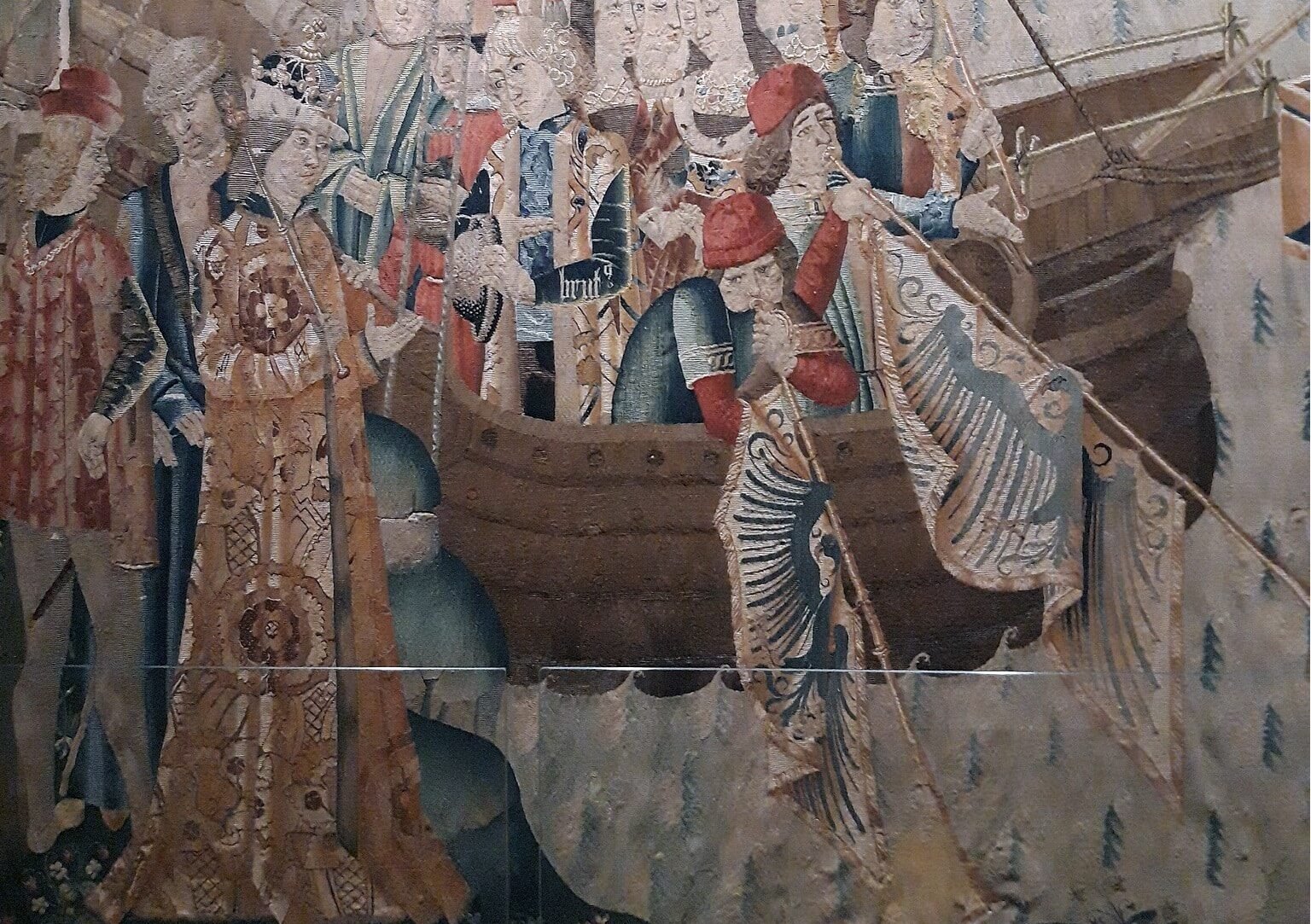
According to legend, Pandrasus, an ancient Greek king of Epirus, ruled over an enslaved community of Trojans sometime after the Trojan War. This legend tells the story of how King Pandrasus was defeated and how the Trojans escaped captivity. But what is the origin of this legend, and does it have any basis in historical facts?
What is the origin of the legend of Pandrasus?
Despite featuring a Greek king, this legend does not originate in ancient Greece. In fact, it comes from medieval Britain. The earliest reference to Pandrasus appears in the Historia Regum Britanniae, a manuscript written by Geoffrey of Monmouth around 1137.
The medieval Britons believed that they were descended from the Trojans. Hence, the Historia Regum Britanniae tells the story of the fall of Troy and how the Trojans fled to Italy afterwards. These claims essentially correlate with those of ancient Greek and Roman records.
One detail that does not clearly appear in ancient Greco-Roman legend is the claim that Aeneas had a descendant named Brutus, who went on to found Britain and became the ancestor of the Britons. This idea emerges in medieval British sources, including Geoffrey of Monmouth’s account.
It is within the context of this foundation story that the legend of King Pandrasus appears. He is portrayed as Brutus’s first adversary after leaving Italy and beginning the journey that would ultimately lead to the founding of Britain.
Pandrasus and the enslaved Trojans
Now that we understand the origin of this legend, what does it actually tell us? According to Geoffrey of Monmouth, when Brutus arrived in Greece after being exiled from Italy, he found enslaved Trojans. Specifically, they were from the family of Priam’s son Helenus. Geoffrey wrote:
“For, after the destruction of Troy, Pyrrhus, the son of Achilles, had brought hither in chains Helenus and many others; and to revenge on them the death of his father, had given command that they should be held in captivity.”
Thus, it was allegedly Pyrrhus, the son of Achilles, who had enslaved these Trojans after the Trojan War. However, by the time Brutus arrived, the king ruling over these enslaved Trojans was Pandrasus—several generations after the fall of Troy.
Geoffrey’s account explains that Pandrasus was holding the Trojans captive near the River Akalon, which is believed to be the River Acheron flowing through Epirus in northwest Greece.

How Brutus and the Trojans defeated Pandrasus
According to the legend in the Historia Regum Britanniae, Brutus voluntarily joined this enslaved community of Trojans under Pandrasus. Over the years, he gained the respect of the Trojans, eventually becoming their leader. They begged him to free them from their misery.
To do so, Brutus led the Trojans into the nearby woods and sent a formal letter to Pandrasus, requesting that they be permitted to reside there in freedom or leave the country entirely. In response, Pandrasus declared war on the Trojans.
This war was brief, as the Trojans used skillful strategy to quickly gain the upper hand. At one point, they lured the Greek army into the woods and then ambushed them. Brutus then led a nighttime assault on Pandrasus’ camp, slaughtering all his troops.
However, the Trojans did not kill Pandrasus. Instead, Brutus kept him alive to compel him to officially grant their freedom. The Trojans thus left Greece with considerable spoils taken from their former captors. In fact, Brutus even married Pandrasus’ daughter, a woman named Ignoge.
The true history of Pandrasus and the Trojans
Does this legend of Pandrasus and the Trojans have any basis in fact? Interestingly, the idea of a community of Trojans living in Epirus does have some supporting evidence. There are a number of ancient references that place a group of people called the Pelasgians in that very area. However, we know that the term “Pelasgians” was sometimes used as a synonym for the “Tyrrhenians,” or the Etruscans.
That these “Pelasgians” of Epirus were actually Tyrrhenians, or Etruscans, is supported by Hesiod. He claimed that Odysseus had a son who ruled over the Tyrrhenians, a son born from Circe. These Tyrrhenians in question are said to be those living “very far off in a recess of the holy islands.”
This description obviously does not match up with Italy, the known territory of the Etruscans. However, it does correlate with the region of Dodona in Epirus. This was considered a “far off” territory, as Homer’s Iliad attests, and it was adjacent to the sacred islands of Paxos and its neighbors.
Regarding Paxos, there is evidence that this was the home of Circe. Since Circe was the mother of Odysseus’ son who ruled over the Tyrrhenians, it can be assumed that he was likely active in the region. Hence, the evidence indicates that there apparently was a community of Etruscans, alternatively known as the Tyrrhenians or Pelasgians, living in Epirus in the region of the Acheron River.
Was Pandrasus a real king?
What is the relevance of this to the legend of Pandrasus and the Trojans? Significantly, there is substantial evidence that the Etruscans considered themselves to be the descendants of the Trojans. Some scholars even argue that this alleged origin could be historically accurate.
Unfortunately, we have no information on the kings of Epirus in the period in which the legend is set. Therefore, it is impossible to confirm or deny the existence of a Pandrasus ruling in this area during the period claimed by the legend.
According to literary evidence, it is possible that a community who considered themselves Trojan descendants existed in the area described by the legend. This may not prove the legend in its entirety, but it shows that the legend is largely consistent with the evidence at hand.
See all the latest news from Greece and the world at Greekreporter.com. Contact our newsroom to report an update or send your story, photos and videos. Follow GR on Google News and subscribe here to our daily email!

