



Dion of Syracuse, positioned at a rare intersection of philosophy and political action, became a disciple within Plato’s circle and absorbed the ideals of justice, order, and rational rule embodied in the concept of the philosopher-king. Yet he did not remain a thinker confined to quiet academic halls. Instead, he entered the turbulent world of Sicilian politics, where he sought to translate philosophical ideals into lived political reality.
His story unfolds between hope and collapse, education and exile, as well as theory and rebellion. Above all, it raises the difficult question of whether philosophy can truly govern power or if power inevitably corrupts philosophy.
A student shaped by the Academy
Dion grew up in Syracuse during a period of political instability. The city was ruled first by the tyrant Dionysius I of Syracuse and later by his son, Dionysius II of Syracuse. Power was concentrated in the hands of a single ruler, and court politics dominated public life.
At a young age, Dion came into contact with Plato and joined his intellectual circle. He quickly distinguished himself as an eager student, embracing Plato’s belief, as expressed in the Republic, that justice depends on knowledge and that rulers must understand the Good.
Plato taught that cities suffer when ambition replaces wisdom and argued that only philosophers are fit to govern. Dion absorbed these ideas deeply and came to believe that Syracuse could be transformed into a just city under philosophical leadership.
Plato’s hope of a philosopher-king and Dion
Plato did not remain distant from Syracuse. He traveled there three times, and during his second visit, he entered the court of Dionysius II of Syracuse. Dion encouraged this visit, viewing it as an opportunity to reform the ruler. Plato attempted to educate Dionysius II in philosophy, hoping to shape him into a philosopher-king. Dionysius initially showed interest, listening attentively, engaging in discussion, and expressing curiosity about philosophical ideas.
However, tensions soon emerged. Court advisers resisted Plato’s influence, fearing a shift in power away from established tyranny and viewing philosophical instruction as a threat to their position. As pressure mounted, Dionysius began to withdraw. He grew increasingly suspicious of Plato and his circle, and the experiment in philosophical education began to unravel.
Dion’s position at court became increasingly precarious. His close association with Plato made him a target of suspicion, and political rivals accused him of plotting against the tyrant. Eventually, Dionysius II turned against him, removing Dion from influence and forcing him into exile. This marked the collapse of the direct philosophical experiment in Syracuse.
Exile profoundly reshaped Dion’s outlook. He no longer believed that education alone could reform tyranny. Instead, he began to consider force as a necessary instrument of political change. Still, he did not abandon Plato’s ideals entirely. Rather, he reinterpreted them, believing that philosophy could justify action when rulers refused reason—a stance that Plato himself would have regarded with caution.
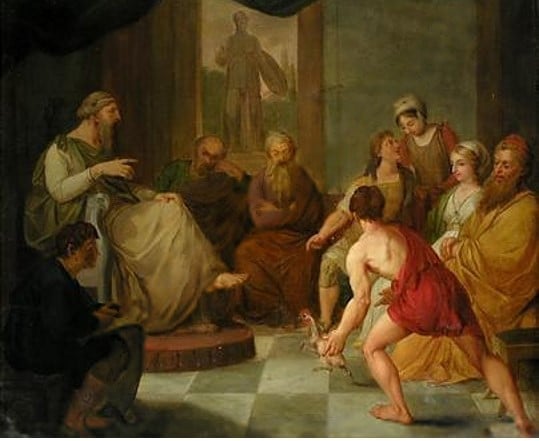
From philosophy to rebellion: Plato’s philosopher-king experiment
During his exile, Dion began planning his return. He gathered support quietly and built alliances among opponents of Dionysius II of Syracuse, while also recruiting a small force of mercenaries. He remained steadfast to his goal, aiming to liberate Syracuse so as to restore justice. However, he now pursued a military path rather than an educational one.
Plato returned to Sicily for a final time in an attempt to act as a mediator between Dion, who was organizing an armed return from exile, and Dionysius II, while also trying once more to guide the young ruler toward philosophy. This visit proved to be the most dangerous of all. Dionysius II refused to allow Plato to leave the city.
He confined Plato to the acropolis of Syracuse around 361 BC. There, Plato lived under the constant threat of imprisonment or execution. He was eventually released only through the intervention of the philosopher-statesman Archytas of Tarentum, who sent a ship to secure his escape back to Athens.
Dion, meanwhile, returned to Sicily with determination. He did not arrive with a large army but instead relied on surprise, timing, and support from within the city. Upon landing, he moved quickly against the regime. His forces entered Syracuse and challenged the tyrant’s control. The city shifted rapidly as factions changed sides. Dionysius II ultimately lost power and fled, while Dion entered Syracuse as a victor. He now controlled the very state he had once hoped to reform through philosophy alone.

The brief rule of a philosopher-warrior
Dion’s victory marked a moment of transformation. Syracuse was no longer under the immediate authority of Dionysius II of Syracuse. Instead, Dion himself held power and was confronted with the demands of governance. He attempted to introduce reforms inspired by Platonic ideas, aiming to reduce corruption and restore civic order while stabilizing the political system.
However, ruling proved far more difficult than overthrowing a tyrant. Rival factions remained active within the city. Some continued to support the former regime, while others distrusted Dion’s authority altogether. Tensions thus escalated quickly. His reliance on military force generated fear among citizens, while his philosophical ideals appeared increasingly detached from the practical realities of political control.
Dion’s rule remained unstable, and even his closest allies began to diverge in their expectations. Some demanded harsher authoritarian measures, while others pushed for more democratic reforms. Among those closest to him was Callippus of Syracuse, who ultimately turned against him. Callippus orchestrated Dion’s assassination, bringing his brief political experiment to a violent end.
Plato’s legacy and political reality
Dion’s life had a profound impact on Plato. The events in Syracuse exposed the limits of philosophical intervention in practical politics. Plato had attempted to shape a ruler through education, yet the experiment ultimately failed. At the same time, Dion’s rebellion demonstrated something equally significant: philosophical ideas can inspire political action. Even when imperfectly applied, those ideas can still influence the course of history.
The ideal of the philosopher-king remained powerful, but Dion’s experience also revealed its fragility. Wisdom alone does not guarantee mastery over political forces or the competing pressures of power.
Dion of Syracuse lived between two worlds. One was grounded in philosophy and reason, while the other was defined by war and political struggle. He began as a student of ideas and ended as a revolutionary leader. His trajectory illustrates how intellectual ideals can move from the classroom into the battlefield. Yet his story also underscores the persistent gap between theory and reality. Philosophy may inspire rulers, but it cannot easily restrain ambition, fear, or the dynamics of power.
Dion attempted to bridge that divide and succeeded only briefly before losing everything. His life remains a striking example of how ideas shape history—and how history, in turn, often resists ideas.
See all the latest news from Greece and the world at Greekreporter.com. Contact our newsroom to report an update or send your story, photos and videos. Follow GR on Google News and subscribe here to our daily email!

