



Among the defenders of Constantinople stood one of the most unexpected figures of the siege: an Ottoman prince named Orhan Çelebi. Every year on May 29, Greeks remember the Fall of Constantinople with grief, reflection, and historical memory. The final hours of the Byzantine Empire still echo deeply across Hellenism because the city represented far more than a capital. Constantinople embodied the continuation of Rome, the spiritual center of Orthodoxy, and the heart of medieval Greek civilization.
The final defense of the city therefore became more than a military struggle. It became a desperate stand for survival against overwhelming odds.
Emperor Constantine XI Palaiologos entered the walls knowing that death almost certainly awaited him. Yet he refused surrender. Alongside Greeks, Genoese, Venetians, and volunteers from many lands, the defenders of Constantinople prepared for one final battle against the Ottoman army of Mehmed II.
History often remembers Mehmed II as the conqueror of Constantinople. Far fewer people remember that another member of the Ottoman dynasty fought against him from inside the Byzantine walls.
Yet Orhan’s story reveals the complexity of the late medieval world and the strange alliances forged during the empire’s final days.
A prince born into dynastic chaos
Orhan Çelebi descended from Sultan Bayezid I through Süleyman Çelebi, one of Bayezid’s sons and one of the claimants during the Ottoman Interregnum. This chaotic civil war erupted after the Monghol emperor Timur defeated Bayezid at the Battle of Ankara in 1402.
Following the sultan’s collapse, several Ottoman princes fought for the throne simultaneously. The empire nearly fragmented entirely.
Süleyman Çelebi initially controlled the European territories of the empire and enjoyed Byzantine support. However, political rivalries and internal decline weakened his position steadily. After losing support and failing to maintain authority, he fled toward Byzantine territory and eventually died during his escape in 1411.
His son Orhan managed to reach Constantinople safely.
From that moment onward, the Byzantine emperor effectively became his protector and jailer at the same time.
Exile inside Constantinople
Orhan spent most of his life in Constantinople as both political hostage and honored exile. Because he possessed a legitimate dynastic claim, Ottoman sultans viewed him as a permanent danger.
The Byzantine court understood his strategic importance perfectly.
Under the Treaty of Gallipoli, the Ottoman government even financed Orhan’s upkeep through annual payments to the emperor. In exchange, Constantinople kept the prince under supervision and prevented him from rallying support in Ottoman lands.
This arrangement reflected the sophisticated diplomacy of Byzantium during its final centuries. Even while weakened politically and militarily, the empire still influenced Ottoman affairs through dynastic leverage.
Orhan eventually had a son who also lived in Constantinople under similar conditions. Hundreds of Turks loyal to his household remained there as well, existing in a strange state between protection and captivity.
Meanwhile, the Ottoman throne passed eventually to Murad II and then to his son Mehmed II.
Everything changed after Mehmed became sultan in 1451.

Mehmed II and the end of coexistence
Unlike his predecessors, Mehmed II no longer accepted coexistence with Byzantium. He envisioned the conquest of Constantinople as both political necessity and imperial destiny.
Immediately after taking power, he eliminated potential rivals according to Ottoman dynastic custom. Brothers and claimants represented threats that could trigger civil war.
Orhan therefore became a serious problem. At the same time, Emperor Constantine XI attempted to use the situation diplomatically. The Byzantines requested the continuation and increase of the payments allocated for Orhan’s maintenance.
The annual pension reportedly amounted to three hundred thousand akçes collected from villages near the lower Struma River. Constantine XI likely hoped to pressure Mehmed by reminding him that a rival Ottoman prince still lived under Byzantine protection.
The emperor even hinted that he might release Orhan if the sultan refused the demands.
For Mehmed, this represented both humiliation and provocation.
Grand Vizier Çandarlı Halil Paşa reportedly warned Byzantine envoys not to anger the young sultan further. Nevertheless, the message reached Mehmed.
Although he responded calmly outwardly, he had already decided upon war.
Preparing for the siege
Mehmed II now possessed the excuse he needed to destroy Constantinople permanently.
He rapidly assembled one of the greatest military operations of the age. Near the Bosporus, he built the massive fortress of Rumeli Hisarı in order to control maritime access and isolate the city. He also strengthened fortifications on the Asian shore and prepared enormous artillery capable of breaking the Theodosian Walls.
The engineer Orban constructed gigantic cannons whose bombardment shook Constantinople continuously during the siege.
Meanwhile, Mehmed gathered an army that vastly outnumbered the defenders. Some estimates place the Ottoman force near one hundred thousand men, while the Byzantines possessed barely seven thousand defenders, including foreign volunteers. To bypass the famous chain protecting the Golden Horn, the Ottomans transported ships over land along a specially prepared road. This maneuver neutralized Byzantine naval advantages completely.
The siege officially began on April 7, 1453. At this moment, Orhan faced a critical decision. He could attempt negotiation, remain neutral, or seek escape. Instead, he chose to defend Constantinople alongside the Byzantines.
Orhan Çelebi organized approximately six hundred loyal Turkish followers inside the city. Together, they defended the southern sea walls between Kumkapı and Samatya, including the harbors of Eptaskalio and Eleutherios.
Thus, during the final siege, Ottoman soldiers fought on both sides of the walls. History rarely produces such extraordinary ironies.
Orhan Çelebi and his defenders resisted Ottoman assaults against Constantinople successfully for a time because marshy terrain and accumulated silt complicated enemy landings near the harbor zones.
The defenders endured relentless bombardment, exhaustion, hunger, and despair. Yet they still rejected Mehmed’s offers of surrender.
For Greeks, this final stand became one of the most sacred moments of historical memory.

The final assault of May 29
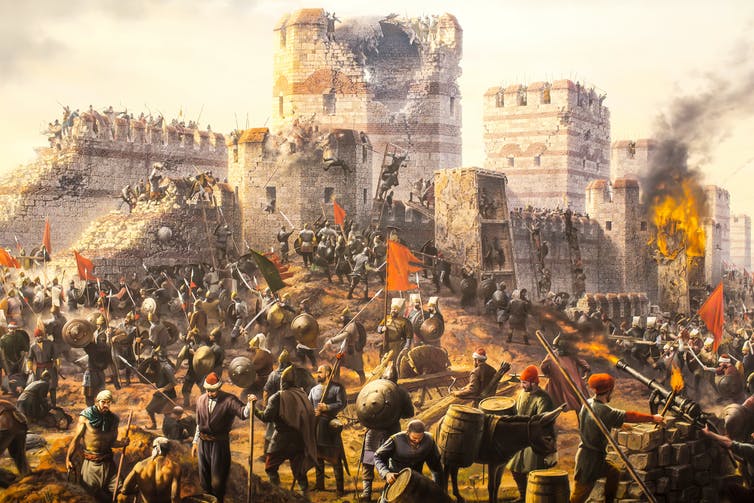
On May 29, Mehmed launched the final assault after weeks of attrition.
European mercenaries attacked first but failed to break through. The Genoese commander Giovanni Giustiniani Longo initially repelled them successfully. However, he soon suffered a severe wound and withdrew toward the harbor.
His departure devastated morale among the defenders.
Soon afterward, waves of Ottoman troops and Janissaries overwhelmed the exhausted Byzantines.
Constantine XI entered the fighting personally and disappeared amid the chaos. Later traditions claimed that Ottoman soldiers recognized his body from his distinctive red boots before decapitating him.
Meanwhile, Ottoman troops breached the city.
Orhan Çelebi attempted to organize a final resistance with surviving followers. Once the situation became hopeless, he reportedly disguised himself as a monk in order to escape the slaughter.
Unfortunately for him, someone identified and denounced him.
Ottoman soldiers captured Orhan shortly afterward and executed him immediately. Mehmed II had finally eliminated one of the last serious dynastic threats to his authority.

A forgotten figure of 1453
Modern discussions of the Fall of Constantinople rarely mention Orhan Çelebi, the Ottoman defender of the City. Nevertheless, his story reveals the human complexity hidden within great historical events.
The siege did not divide neatly between ethnic or religious camps. Greeks, Italians, mercenaries, and even Ottoman rivals stood together during the empire’s final defense.
Orhan’s presence also demonstrates how Byzantine diplomacy survived until the empire’s last breath. Even weakened emperors still maneuvered through dynastic politics and regional rivalries.
Most importantly, Orhan chose loyalty to the city that sheltered him rather than submission to Mehmed.
Though born an Ottoman prince, he died as defender of Constantinople beside the Byzantines.
For Greeks, May 29 remains a day of mourning because the fall of Constantinople marked the end of an entire civilizational era. The city represented continuity with ancient Rome, Orthodox Christianity, and medieval Hellenism itself.
The tragedy survived through songs, legends, liturgy, and collective memory for centuries.
Constantine XI became the eternal symbol of sacrifice and resistance. Yet the story of Orhan Çelebi also deserves remembrance because it reflects the strange humanity of history itself.
An Ottoman prince, raised as a political hostage, ultimately chose to fight and die beside the empire his own dynasty sought to destroy.
Within the smoke, fear, and blood of 1453 stood individuals whose choices carried profound personal meaning. Orhan’s decision remains one of the most remarkable examples.
See all the latest news from Greece and the world at Greekreporter.com. Contact our newsroom to report an update or send your story, photos and videos. Follow GR on Google News and subscribe here to our daily email!

