



Scientists have discovered a new species of ghost pipefish that disguises itself as red algae so convincingly that it fooled researchers, museum curators, and citizen scientists for decades.
The species, named “Solenostomus snuffleupagus,” was hiding in plain sight on coral reefs across the southwest Pacific, consistently misidentified as a known relative.
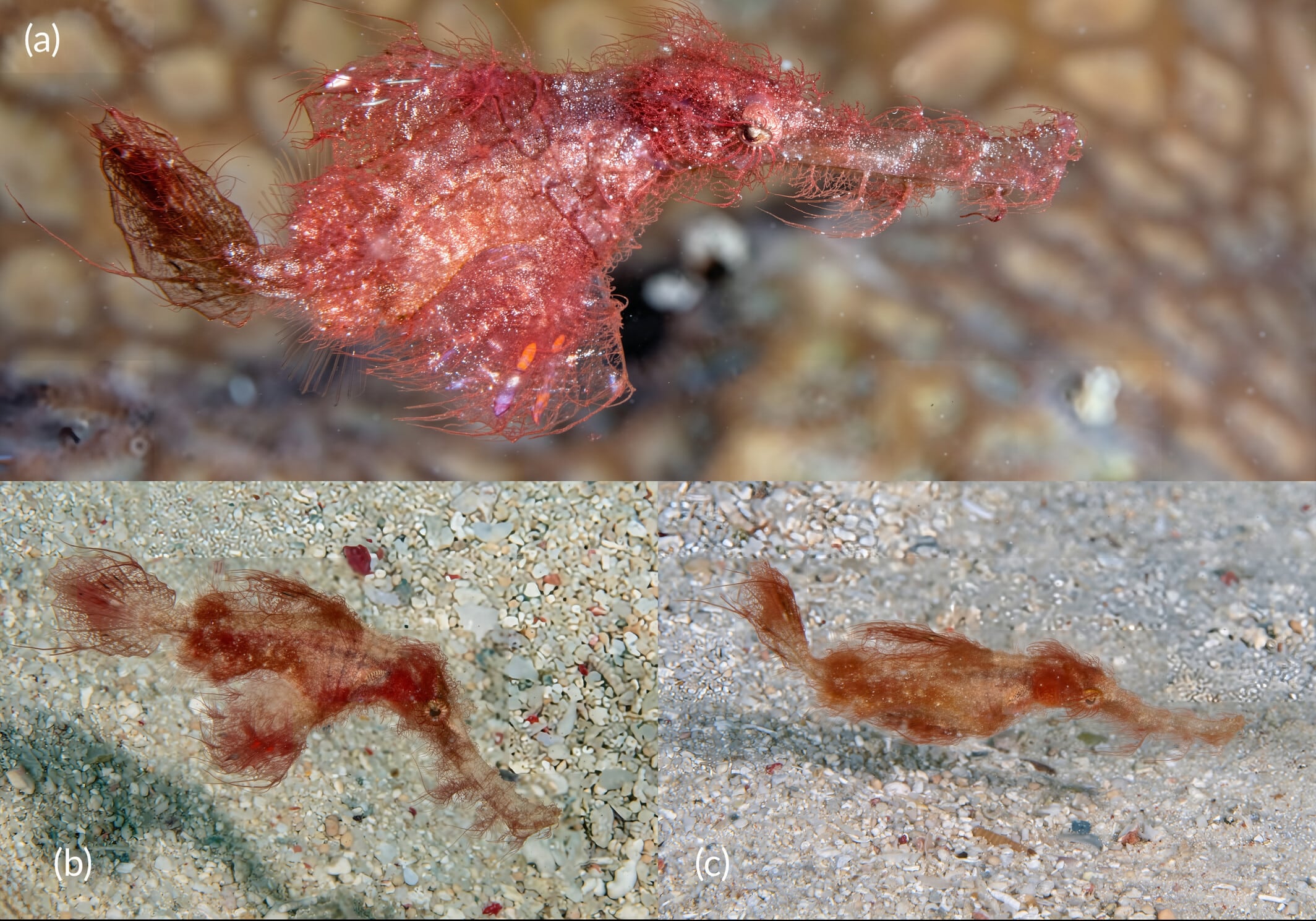
Graham Short of the Australian Museum Research Institute in Sydney led the study, published in the Journal of Fish Biology. The researchers named the species after Mr. Snuffleupagus from Sesame Street because of the fish’s distinctly shaggy, hair-like appearance and elongated snout.
Two museum specimens collected in 1993 from the Coral Sea off Queensland, Australia, had sat in collections unrecognized for over 30 years.
Since 2005, divers regularly photographed the fish at Saxon and Norman Reefs on the Great Barrier Reef and shared images on platforms like iNaturalist and Facebook groups dedicated to reef wildlife. Those records were almost always filed under the wrong species name.
Ghost pipefish disguised as algae fooled scientists for decades
To confirm it as a genuinely new species, the researchers used three methods together. They examined external features, ran high-resolution CT scans to study the internal skeleton, and analyzed DNA.
Genetic testing revealed a 22 percent difference in a mitochondrial gene between the new species and its closest relative, “Solenostomus paegnius.” That divergence points to a split roughly 18 million years ago, during the early Miocene period.
Several features set this fish apart. It has 36 vertebrae, more than any other known ghost pipefish. Its body is unusually compact and deep toward the front. The skull crest follows a reversed pattern of sexual dimorphism compared to its relative, with males carrying a more prominent crest rather than females.
The fish also has only two anchor-shaped internal bone structures near its rear fins, compared to three in the related species. It completely lacks a ventral bone layer that its closest relative possesses.
CT imaging finds fish remains inside a new species specimen
CT imaging of one specimen revealed something unexpected. Partially digested remains of a small fish were found in the gut, the first recorded instance of a ghost pipefish eating another fish. The genus was previously known to feed only on small crustaceans and zooplankton.
The fish typically shows orange to red coloring, closely matching the red macroalgae it lives among. Occasional individuals from Papua New Guinea appear purple, and one green individual was photographed on the Great Barrier Reef. Divers have documented the species as far east as Tonga.
The discovery brings the total number of recognized ghost pipefish species to seven.
See all the latest news from Greece and the world at Greekreporter.com. Contact our newsroom to report an update or send your story, photos and videos. Follow GR on Google News and subscribe here to our daily email!

