



The island of Aegina, only seventeen miles from the Greek capital of Athens, is a gem of the Saronic Gulf which enchants visitors with its simplicity, history, and beauty. History certainly played a part in shaping and making this island distinct.
From the moment a traveler leaves the port of Piraeus, forty-five minutes are more than enough to completely transport him or her, physically and mentally, to this little slice of paradise. Aegina’s history stretches back to pre-Minoan times, and it played a role in the 1800s Greek War of Independence against Ottoman rule. Visitors can gaze upon ancient temples, Byzantine churches, and the simple and distinct Greek island architecture, which exudes harmony and order.
Ancient temple of Aphaia on the island of Aegina
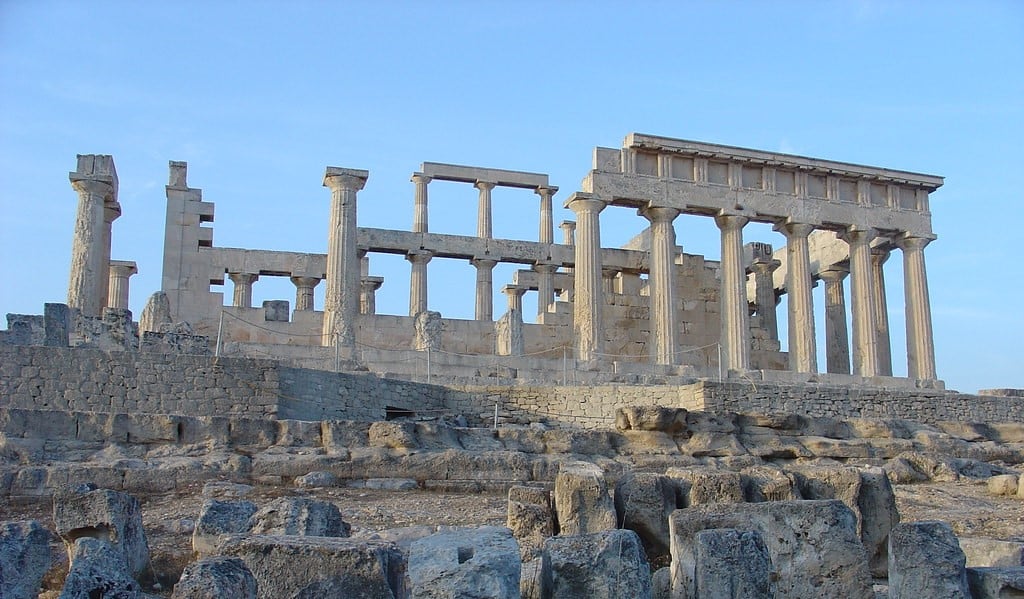
One of the most iconic landmarks of Aegina is the ancient temple of Aphaia. Located within a sanctuary complex dedicated to the goddess Aphaia, the temple stands on a 160-meter (530-foot) peak on the eastern side of the island, approximately 13 kilometers (8 miles) east of the main port.
The goddess Aphaia, who was associated with agriculture and fertility, is thought to be a local deity because the sanctuary complex on Aegina is the only place where the goddess was worshiped. In fact, it forms an equilateral triangle with the Parthenon and the Temple of Poseidon at Sounion, the so-called “holy triangle” of antiquity.
The town of Aegina, the capital of the island that goes by the same name as the island itself, stands out for its well-preserved buildings. For almost two years between 1827 and 1829, Aegina’s current capital was also the temporary capital of the newly-founded Greek State. It was during that period when Governor Ioannis Kapodistrias had impressive neoclassical mansions built to house his headquarters.
On the outskirts of the town, you can find charming little villages with distinctive traditional character, such as Agia Marina, Perdika, Souvala, Kypseli, Agii, and Vagia.
Important religious destination
Apart from the numerous ancient Greek sites that are scattered across the island, Aegina is a major religious destination for many Greeks and other Orthodox Christians around the world.
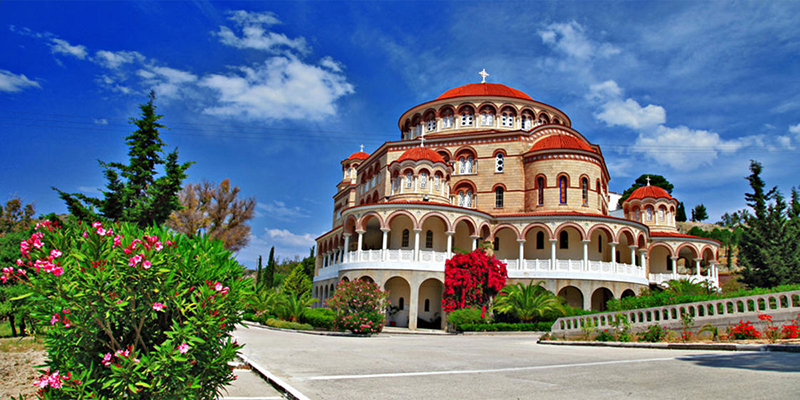
Saint Nectarios is one of the most well-known and beloved saints in Greece’s modern history. He passed away in 1920, and he has been venerated as a saint in the Orthodox world since 1962. He is referred to as the “wonder-worker of the island of Aegina.”
Aegina is home to the imposing Holy Church of Saint Nectarios, an impressive Orthodox church, where thousands of people come every year to show their love for and devotion to the saint.
The famous pistachios of Aegina
The other big draw to visiting Aegina is the pistachios, the island’s most famous produce. The pistachio tree, which is native to Iran, was first brought to the island and the Greek mainland in 1860, and the trees flourished in the Mediterranean climate and unique terrain of Aegina.
While pistachios are found around the world, the variety found in Aegina, called “koilarati,” is rare and exceptionally delicious.
Beaches of the island of Aegina
The island also has several beautiful beaches including:
- Perdika, a quiet pebbly beach in the traditional village of Perdika,
- Souvala, distinctive for its warm, therapeutic waters suitable for curing rheumatism,
- Agia Marina, a cosmopolitan organized tourist destination with numerous hotels, rooms to let, beach bars, and restaurants,
- Marathonas, two sandy beaches, one next to another, 4 kilometers (2.5 miles) away from the town, and
- Vagia, a beautiful sandy beach offering amenities, but if you are willing to walk a little further, you can enjoy beautiful isolated coves.
Whether you’ve been there or not, one thing is clear: Aegina is a land of ancient tales and stories, of beauty and simplicity, and of heroism and spirituality.
As many believe, it is Athens’ most beautiful escape, where the stress of one’s busy everyday life melts away in the timeless beauty of ancient temples and churches and the lovely towns nestled along its seashore.
See all the latest news from Greece and the world at Greekreporter.com. Contact our newsroom to report an update or send your story, photos and videos. Follow GR on Google News and subscribe here to our daily email!

