



Recent underwater excavations at Ampelaki Bay have yielded major breakthroughs regarding the ancient submerged structure discovered at Salamis in 2023.
Originally cataloged simply as a large public building, the 32-meter-long (104-foot-long) ruin has now been definitively identified as a Classical Stoa.
The ongoing research, led by Greece’s Ephorate of Underwater Antiquities, has revealed critical insights into the layout of the ancient city, validated centuries-old historical texts, and unearthed a wealth of artifacts that offer a clearer window into the island’s economic and cultural past.
Using an innovative cofferdam system (a flexible underwater barrier that drains seawater from the site so archaeologists can dig in a dry environment) has officially confirmed the structure is a Stoa. In Ancient Greece, a stoa was a covered walkway or portico. This specific stoa has solid stone walls (23 inches thick) and features a long walkway supported by columns, a porch, and a series of six or seven internal rooms facing west.
The discovery of this stoa has fundamentally reshaped historians’ understanding of the ancient city’s layout. Because it faces west, archaeologists have determined that it served as the official eastern boundary of the Agora, the central marketplace and civic hub of Ancient Salamis, rather than being part of the port itself.
The location and identity of this stoa perfectly validate the writings of the 2nd-century AD Greek traveler Pausanias. In his famous Description of Greece, he noted seeing the ruins of a marketplace near the port of Salamis. Archaeologists have now literally found what Pausanias was looking at nearly two thousand years ago.
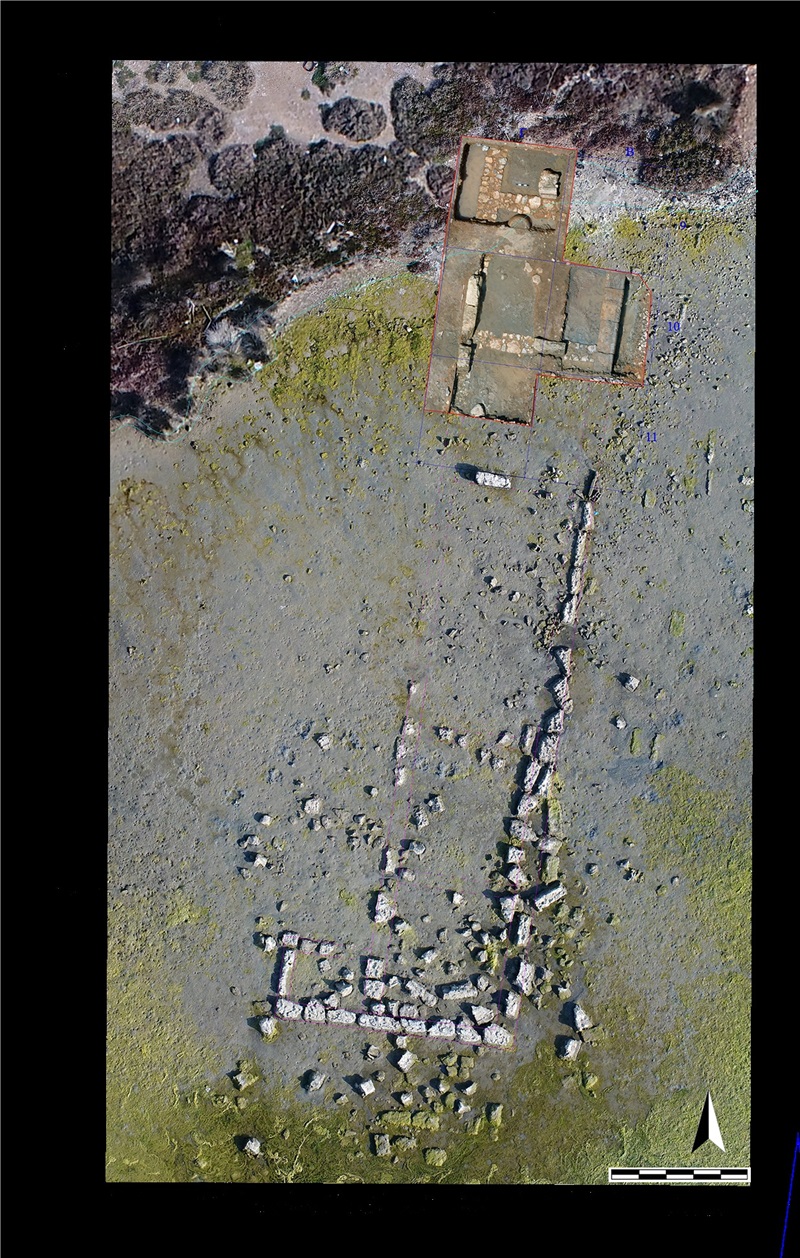
Salamis Stoa includes a series of at least six rooms
The interior includes a series of at least six to seven rooms, of which one was investigated, with internal dimensions of 4.7 x 4.7 meters (15.4×15.4 ft), with large storage pits. It has solid walls, about 60 centimeters (23.6 inches) thick, made of large hewn stone plinths.
The ancient remains, as is the case with other adjacent structures, are stripped of their building material because the specific area has been a convenient field for obtaining building materials throughout the years until the end of the 19th century.
Mobile findings
The excavation of the Stoa also yielded several mobile findings. A large amount of pottery from various periods was recovered.
The ceramic findings related to the building’s function include abundant fragments of vases of various categories and ceramics of the Classical-Hellenistic period, among them many samples of Athenian enamel pottery of the Late Classical period (4th century BC), the Ministry of Culture said in a press release.
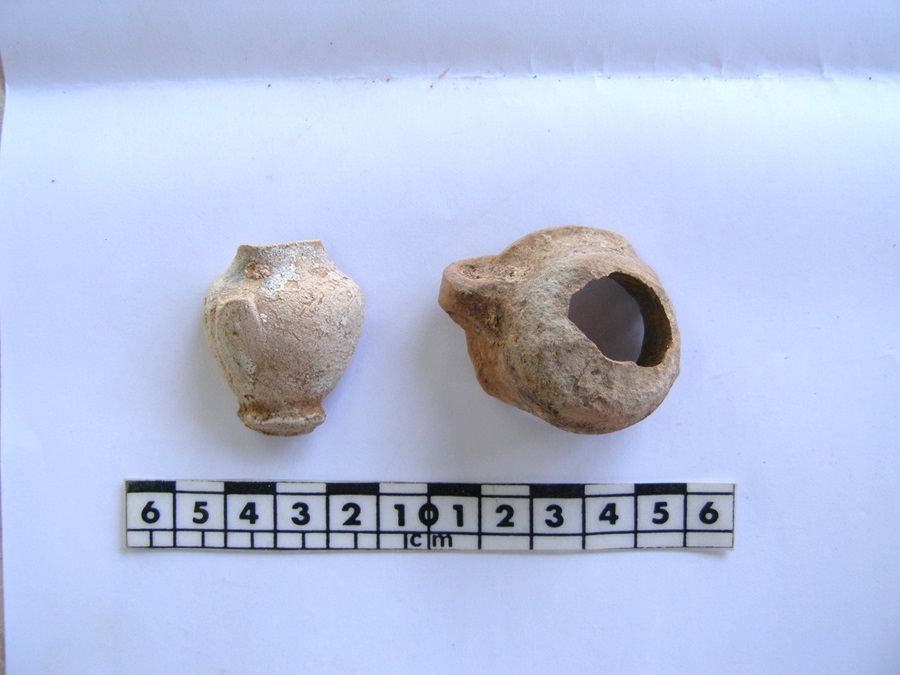
Among other things, many shards of amphorae, prohons, red-painted tablets, one to two intact lamps and fragments of other items from the Late Roman period were found.

More important is the set of Athenian colored vases and shells of the Late Classical period (4th century BC). Many clay objects were also collected, mainly amphora stoppers, fragments of marble objects and twenty-two bronze coins, Athenian and others.
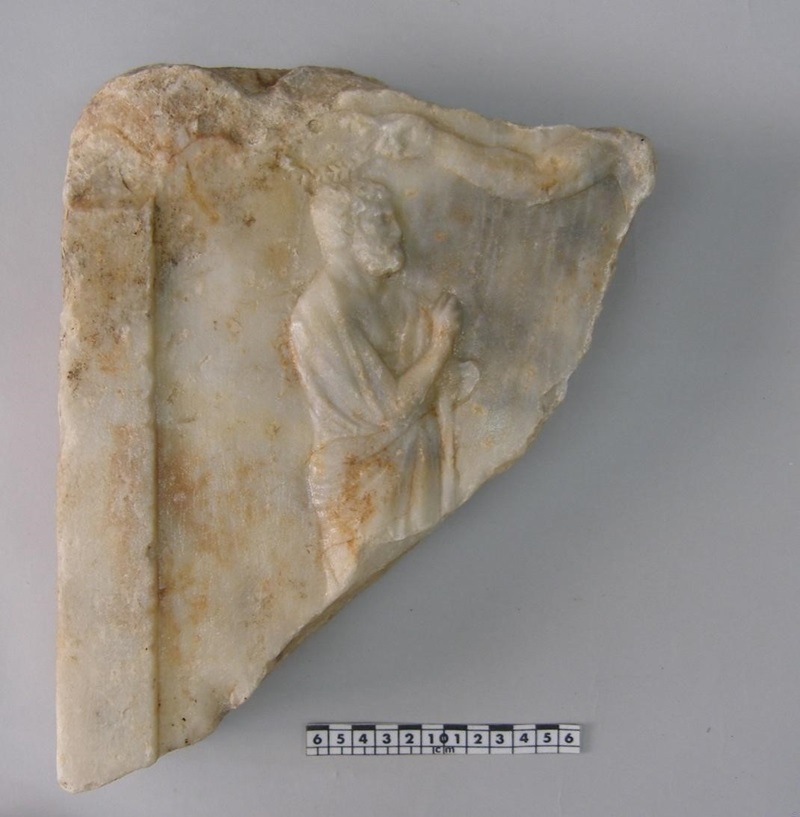
Of the marble findings, two are of particular importance and date back to the 4th century. The first is a column fragment with part of an inscription. The second is the upper part of a stele, with part of a relief representation, of which the bare muscular right hand of a large figure, possibly a hero crowning a standing bearded man is preserved.
Excavations also yielded a remarkable find of a naval nature. A small stone slab-shaped anchor (14 x 11.4 inches, 3.3 inches thick), with a hole for the mooring rope.

Archaeologists say that the discovery of the Stoa and its contents is a critical new element for the study of the topography and residential organization of the ancient city.
Ancient city of Salamis
Salamis was likely first colonized by Aegina and later occupied by Megara but became an Athenian possession in the time of Solon or Peisistratos following the war between Athens and Megara around 600 BC.
According to Strabo, the ancient capital was on the south of the island; in classical times, it was to the east, on the Kamatero Peninsula overlooking the Strait of Salamis; in modern times it is on the west. According to Homer’s Iliad, Salamis took part in the Trojan War with twelve ships under the leadership of Ajax (Aias).
The island of Salamis is known for the Battle of Salamis, the decisive naval victory of the allied Greek fleet, led by Themistocles, over the Persian Empire in 480 BC. It is said to be the birthplace of Ajax and Euripides, the latter’s birth being popularly placed on the day of the battle.
Related: Archeological Finds Shed Light on Ancient Greek Battle of Salamis
See all the latest news from Greece and the world at Greekreporter.com. Contact our newsroom to report an update or send your story, photos and videos. Follow GR on Google News and subscribe here to our daily email!

