



In the picturesque seaside village of Vigklafia, part of Greece’s historic Neapolis in Laconia, a carved stone head and the ruins of a pyramid-like structure have sparked lively debate among locals and visitors for decades.
Although these intriguing sites remain little known to most Greeks, they occasionally capture local attention, particularly when new infrastructure projects, such as a proposed power generation facility, are planned for the area.
Greece’s unknown Sphinx of Laconia
Locals speak of a so-called “Sphinx,” a prehistoric form said to emerge from the very bedrock of the land. Time and weather have softened its features, yet some see in them the outline of a mythic guardian, familiar from ancient Greek art.
However, sphinxes are most often found painted on pottery, carved into temple friezes, or shaped as small statues—large-scale rock carvings were virtually unknown in the wider ancient Greek world. Adding to the enigma, this weathered form lies near the ruins of what locals call the “Pyramid of Vigklafia,” a stone structure whose presence makes the surrounding landscape seem all the more mysterious.

Greece’s little-known pyramid in Laconia
Unlike Egypt’s monumental pyramids, those in Greece are exceptionally rare, and their origins spark heated scholarly debate. The best-known examples are the Pyramid of Hellinikon and the Pyramid of Ligourio in Argolis. These structures are often dated to the Classical or Hellenistic period, though alternative theories place them much earlier, with fans of fringe archaeology suggesting that they might actually be thousands of years older.
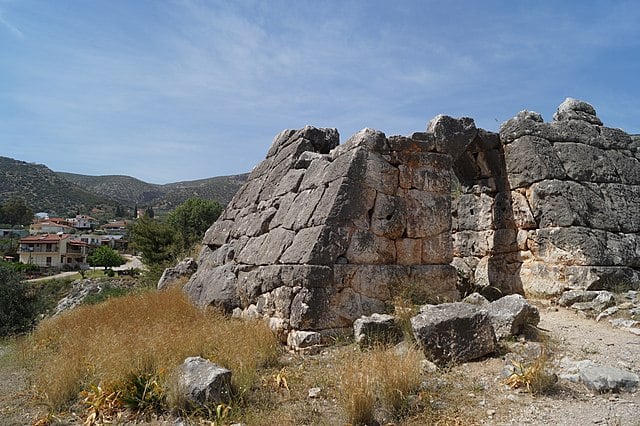
Even more obscure—and hotly debated in terms of its origins and dating—is the Vigklafia structure. Described by local residents as a pyramid-shaped construction, it has evidently been partially dismantled over the centuries. According to oral accounts passed down through generations, its stones were repurposed for the construction of nearby sheepfolds and storage sheds, stripping it of some of its former grandeur. Yet, despite centuries of degradation, much of the mysterious structure remains intact.
There is no consensus among archaeologists as to the exact age or purpose of the pyramid in Greece’s Laconia, largely because no formal archaeological study has ever been conducted in the region. Some speculate it may have served as a watchtower to protect local settlements, a tomb for a ruler or wealthy individual, or simply a fortified storage building for valuable goods. Without proper excavation and detailed research, the site remains shrouded in mystery with our current ideas stemming from casual exploration rather than established archaeological evidence.
Infrastructure work sparks curiosity over site’s true nature
Interest in both the “Sphinx” and the pyramid has been revived in recent years due to plans for an electricity generation plant in the area. While there is no indication that the project will directly affect the ruins, the prospect of modern infrastructure in the vicinity of these little-known heritage sites in a tourist area has ignited debate among locals.
The concern stems from the fact that the Vigklafia pyramid remains one of the largest known pyramid structures in Greece—second only to the stepped pyramid of Amphion in Boeotia. In fact, the Vigklafia pyramid surpasses even the more famous Pyramid of Hellinikon in Argolis in size, which is undoubtedly the most well-known in Greece.
Measuring approximately 57 by 52 feet (17.5 by 16 meters), the structure is bordered on three sides by a deep ditch. Some theories suggest a movable bridge once spanned this ditch, allowing controlled entry into the site. This layout is indicative of a distinctly defensive purpose, intended to protect the pyramid or whatever it may have once contained. Such a feature is quite rare among Greek pyramidal monuments, making the Laconia example especially intriguing. Pottery fragments from the 4th to 5th century BC have been found nearby, though some argue that further archaeological investigation could uncover signs of earlier occupation or construction phases in the surrounding region.
Understandably, the reuse of its stonework for nearby agricultural buildings, alongside the partial collapse of the cliffside to its south, means that much of the site’s original form and context have been lost—making detailed archaeological study more crucial than ever. Nonetheless, visitors can still explore the largely untouched area and draw their own conclusions.
See all the latest news from Greece and the world at Greekreporter.com. Contact our newsroom to report an update or send your story, photos and videos. Follow GR on Google News and subscribe here to our daily email!

