



Holy Friday is the only day of the year when the Greek Evzones, the soldiers of the Presidential Guard, lower their heads while on duty, as Greece marks the Passion of Christ with mourning, prayer, and the Epitaphios procession. As the Epitaphios passes before them, the solemn gesture becomes one of the most striking moments of the day’s observance in Athens.
Under official protocol, the Evzone reverses his weapon, crosses his palms over the barrel, and bows his head in a formal gesture of grief and reverence for Christ. For a unit defined by strict ceremonial discipline and complete stillness, the gesture carries special emotional weight.
The 150-year history of the Greek Evzones behind Holy Friday protocol
The Greek Presidential Guard traces its history back over 150 years to December 12, 1868, when royal decree established the unit in the modern Greek state. At the time, authorities created it as a battalion-sized military formation known as the Agema.
From the beginning, the unit held elite status. Its members ranked one grade above their previous positions, meaning an ordinary soldier serving in the Agema held status equivalent to a lance corporal rather than a private. Today, the Guard takes pride in standing as the last remaining Evzone unit in the Greek Army tradition, linked to the country’s historic elite light infantry and mountain forces.
From royal guard to presidential symbol
As Greece’s political system changed over the decades, the unit changed its name as well. It became the Royal Guard Company in 1940, the Guard of Honor of the Unknown Soldier in 1941, the Flag Guard in 1942, and the Royal Guard in 1946.
Its core mission, however, has remained intact. The unit continued to guard the Palace and the Tomb of the Unknown Soldier. Since 1974, after the reinstatement of democracy in Greece, the unit has been referred to as the Presidential Guard and has served an exclusively ceremonial role under the supervision of the Presidency of the Republic’s Military Office.
The Presidential Guard also holds a unique distinction. It is the only military unit authorized to raise and lower the Greek flag on the Acropolis.
How Holy Friday reveals the symbolic role of the Greek Evzones
Beyond its institutional role, the Guard has become one of the most recognizable symbols of Athens. For visitors, the Evzones rank among the city’s most photographed attractions, especially during the changing of the guard at the Tomb of the Unknown Soldier.
Their movements unfold in a slow, controlled, and highly stylized manner. While on duty, they remain completely motionless and switch positions every fifteen minutes. Two forms of the ceremony take place regularly.
The Little Change takes place every hour, while the Grand Change takes place every Sunday at 11 a.m., when the full Guard, accompanied by officers and a military band, marches from the Guard Barracks to the Tomb of the Unknown Soldier and back through central Athens.
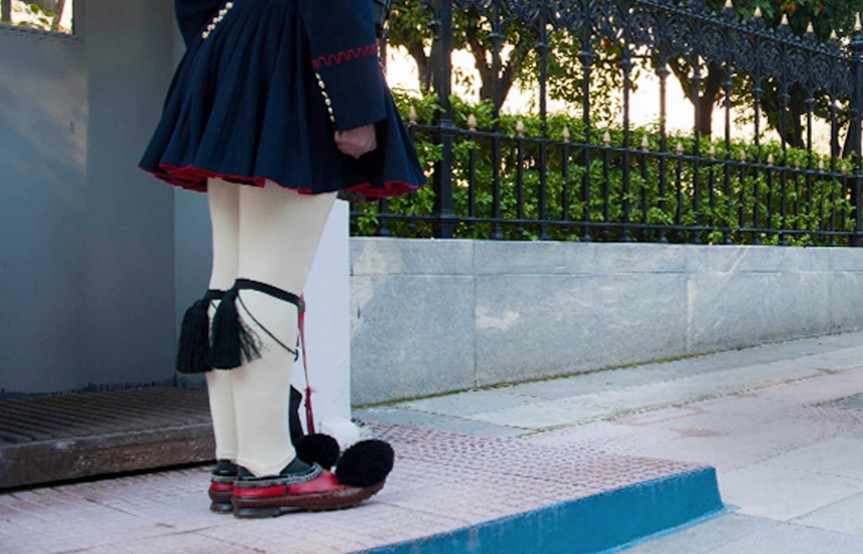
The meaning of the Greek Evzones’ uniform
The historic uniform stands at the heart of the Guard’s identity and draws from the traditional dress of the klephts during the Greek War of Independence. Each part carries its own symbolism. The defining characteristic of the uniform includes the Belt, which denotes the “well-girdled” fighter (from Greek eu:“well” and zonē: “belt”).
The fustanella (a form of kilt), made from thirty meters (about 98 ft) of white fabric, features four hundred pleats that symbolize the years of Ottoman rule. Its white color, like that of the shirt, represents the purity of the struggle for national independence. The fermeli, or vest, ranks among the most intricate elements of the uniform, and artisans hand-embroider it with designs of cultural and folkloric significance in white or gold thread.
The red pharion (cap), marked with the national emblem, symbolizes the blood shed during the liberation struggles, while its black silk tassel represents tears and mourning. Blue and white silk fringes across the uniform evoke the colors of the Greek flag.
The iconic tsarouchi of the Greek Evzones
Among the best-known elements of the uniform is the tsarouchi, the traditional shoe worn by the Evzones. Craftsmen make each pair by hand from hard red leather, and each one weighs about three kilograms (about 6.5 pounds) and includes 120 nails on the sole.
According to tradition, the large black tassel once concealed small blades that could prove useful in close combat. Today, the tsarouchi remains one of the clearest visual links between the modern Presidential Guard and Greece’s military past.
See all the latest news from Greece and the world at Greekreporter.com. Contact our newsroom to report an update or send your story, photos and videos. Follow GR on Google News and subscribe here to our daily email!

