



The discovery of a series of war trophies, specifically rare Greek helmets unearthed at the Acropolis of Velia, is fundamentally rewriting the history of Magna Graecia.
In a breakthrough that bridges the gap between ancient myth and historical fact, archaeologists have concluded a multi-year excavation that provides the first physical evidence linking the city’s origins to a pivotal naval clash that altered the Mediterranean over 2,500 years ago.
Velia, known as Elea in ancient times, is located just 40 kilometers (25 miles) southeast of Paestum, the site of the most well-preserved temples of Ancient Greece, as well as the famous “Tomb of the Diver,” with the only surviving Ancient Greek fresco of those times.
Weapons and helmets discovered at Acropolis of Velia
The centerpiece of the recent finds is an archaic “pre-temple” dedicated to Athena, the Greek goddess of wisdom and strategic warfare. Measuring roughly 18×7 meters (59×23 ft), the structure predates the famous Hellenistic temple that has long dominated the site.
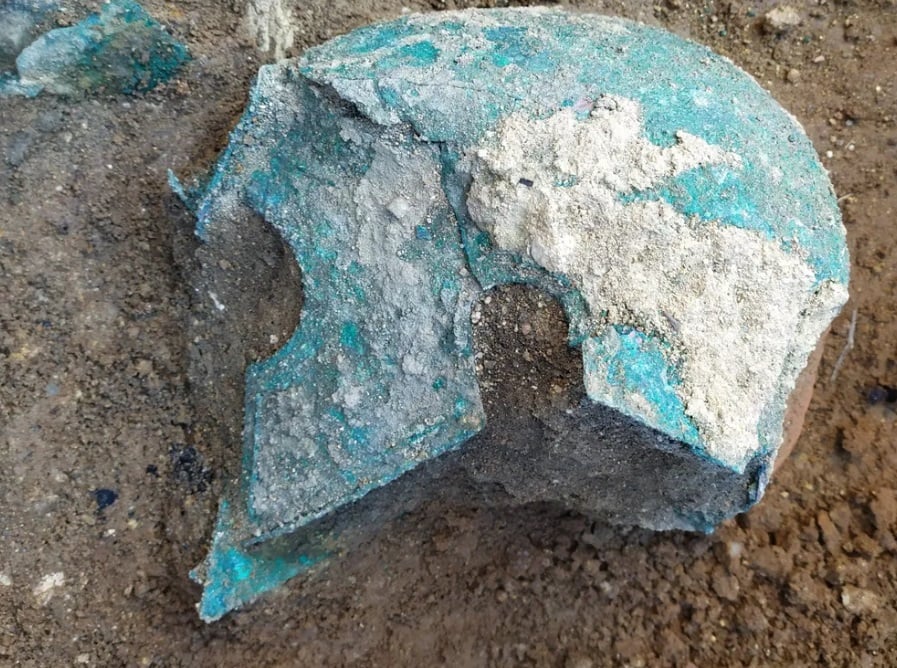
Excavations through late 2025 and early 2026 revealed that the temple’s beaten earth floor was a repository for a “sacred hoard.” Scattered across the site were fragments of weapons, a massive decorated shield, and over three hundred crates of votive offerings. Most striking, however, was the presence of three bronze helmets.
“We are looking at a literal ‘thanksgiving’ offering,” explains Tiziana D’Angelo, Director of the Archaeological Park of Paestum and Velia. “The founders of this city were refugees. They didn’t just build a home; they built a monument to their survival and the gods they believed secured it.”
The battle of Alalia connection
The discovery serves as a dramatic confirmation of accounts written by the historian Herodotus. Around 540 BC, Phocaean Greeks fleeing Persian expansion in Asia Minor established a colony at Alalia, Corsica. Their presence sparked a massive naval confrontation—the Battle of Alalia—against a combined fleet of Etruscans and Carthaginians.
While the Greeks technically won the battle, it was a “Pyrrhic victory.” Their fleet was decimated, forcing the survivors to flee once more. They eventually landed on the Italian coast, purchased land from local tribes, and founded Elea (later renamed Velia by the Romans), one of the most significant cultural hubs of Magna Graecia.
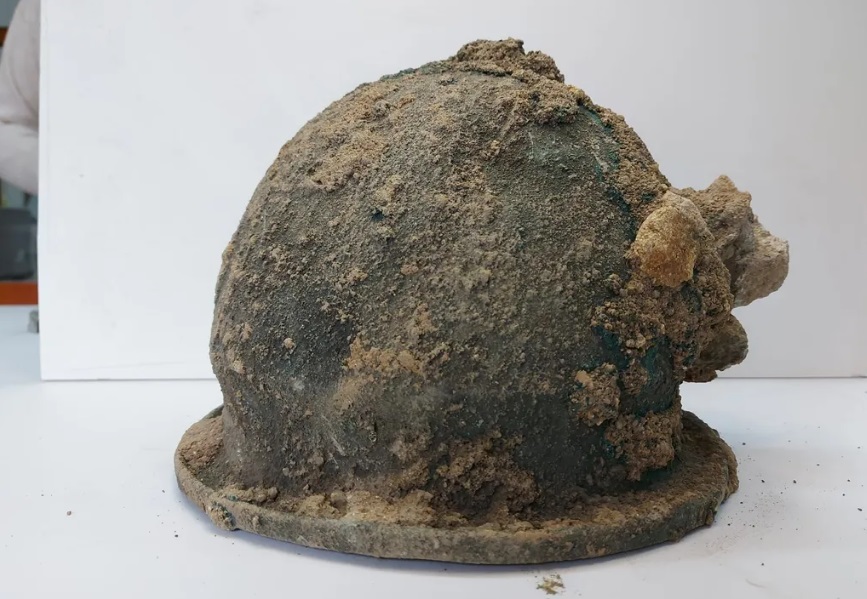
The 2024 analysis of the helmets showed that two helmets are of the Greek Chalcidian style, likely worn by the Phocaean victors. The third is an Etruscan “Negau” or shell-type helmet, almost certainly a trophy stripped from a fallen enemy during the battle and dedicated to the goddess Athena.
A legacy of thought and power
Beyond the armor, the find is significant for what it reveals about the social and religious life of early Greek colonists in Southern Italy, including:
- Religious continuity: Inscriptions on ceramic fragments found at the site bear the word “Hieron” (Sacred), proving the site was consecrated immediately upon the exiles’ arrival. This suggests that the first act of the refugees was to establish a religious bond with their new land.
- A center of thought: Velia would go on to become the home of the Eleatic School of Philosophy, producing thinkers like Parmenides and Zeno. These new finds suggest that the city’s famous intellectual rigor may have been rooted in its early history as a community of survivors who valued strategic wisdom as much as physical strength.
- Archaeological “smoking gun”: It is rare in Mediterranean archaeology to link specific artifacts to a single, dated historical battle. These rare Greek helmets provide a unique chronological anchor for the mid-6th century BC.
The 2026 exhibition and the Greek helmets of Magna Graecia
To mark the conclusion of this research phase, the Italian Ministry of Culture has announced a major exhibition set to open in May 2026. Titled Exiles and Victors: The Helmets of Velia, the show will feature the restored helmets alongside the “votive hoard” for the first time.
The exhibition aims to tell the story of the Phocaeans not just as warriors but as a resilient people who transformed a military catastrophe into the foundation of an intellectual powerhouse, forever changing the cultural landscape of Magna Graecia.
See all the latest news from Greece and the world at Greekreporter.com. Contact our newsroom to report an update or send your story, photos and videos. Follow GR on Google News and subscribe here to our daily email!

