



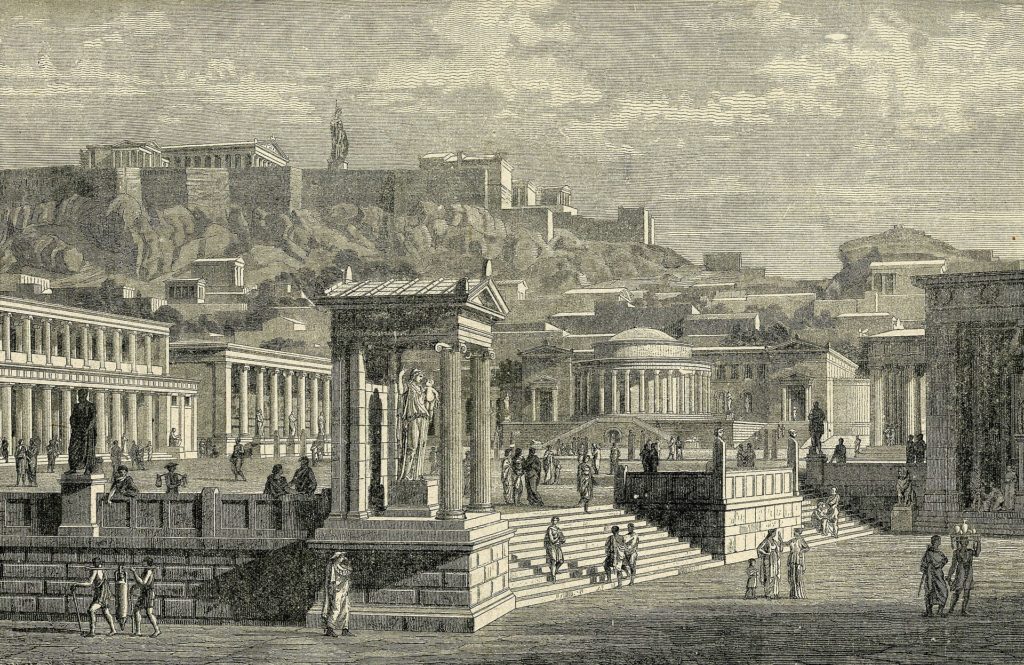
Leisure time was regarded as equally important as work, and the Ancient Greeks of Athens saw it as time devoted to personal growth, reflection, and self-improvement.
Although Ancient Athenians were known for their strong work ethic, they believed that the ultimate purpose of labor was to create space for leisure. This view was most famously articulated by the Greek philosopher Aristotle, who argued that leisure, rather than work, is what truly defines human beings.
In both Nicomachean Ethics and Politics, Aristotle writes extensively about the central role of leisure in a well-lived life. He maintains that the quality of one’s leisure matters far more than the nature of one’s work when it comes to achieving human fulfillment. At the same time, Aristotle cautioned that leisure should not be wasted on empty or meaningless pursuits. He believed that people were prone to misusing their leisure time precisely because they had not been educated in how to spend it wisely and constructively.
For Ancient Athenians, leisure time was not a marginal activity reserved for moments of idleness but a fundamental part of civic, religious, and social life. As Aristotle wrote, “We work in order to have leisure” (scholē, σχολή), emphasizing that it was essential for cultivating virtue and sharpening the mind. When used responsibly, leisure shaped individual identity, strengthened communal bonds, and helped form conscientious citizens.
While amusements and distractions had their place, Aristotle did not consider them true leisure. In Nicomachean Ethics, he explains:
“Amusements are more to be used when one is at work, for one who exerts himself needs relaxation, and relaxation is the end [goal] of amusement, and work is accompanied by toil and strain…we should be careful to use amusement at the right time, dispensing it as a remedy to the ills of work.”
The meaning of leisure in Ancient Athens
In Ancient Athens, leisure time was understood not as idleness but as free time devoted to learning, conversation, and thoughtful reflection, a concept captured by the Greek word scholē, from which the English word “school” derives. Unlike modern notions of leisure, which often emphasize escape from responsibility, leisure for the residents of Ancient Athens was ideally purposeful and intellectually enriching. Aristotle argued that “the first principle of all action is leisure” (Politics, 1337b), and he warned that a city incapable of using leisure wisely would ultimately suffer moral decline.
Writing earlier during the archaic period, Hesiod also linked work and rest to justice, balance, and social order. In Works and Days, he advised moderation, famously stating: “Observe due measure; moderation is best in all things.” Although Hesiod emphasized diligence and hard work, he likewise acknowledged the necessity of rest within a moral framework. Leisure was not seen as opposed to labor but as its essential counterpart.
While work remains a financial necessity, leisure time was regarded by ancient thinkers as the most meaningful time available to individuals. Aristotle urged people to organize their leisure deliberately in order to cultivate the mind and fulfill their potential as human beings. In Ancient Athens, public events were often designed not merely for entertainment but to educate citizens, nourish the soul, and strengthen communal identity.
Public festivals and religious celebrations
Among the most valued types of leisure activities in Ancient Athens were public religious festivals. During these occasions, the city temporarily set aside its ordinary routines and gathered collectively to honor the gods through sacrifice, processions, music, dramatic performances, and athletic contests. Herodotus noted the Greek passion for festivals and competition, observing that “the Greeks hold their games not for money but for honor” (Histories 8.26).
The greatest of all Athenian festivals was the Panathenaea, celebrated in honor of Athena, the city’s patron goddess. This major civic event featured a grand procession, ritual sacrifices, rhapsodic recitations of Homer, musical competitions, and athletic contests. Plutarch later explained that such festivals were intended “to bring the citizens together in joy and harmony, and to soften their manners through shared pleasure” (Life of Pericles).
Equally significant were the Dionysia, festivals dedicated to Dionysus, the god of wine, revelry, and theater. During the City Dionysia, Athenians attended performances of tragedy and comedy staged as formal competitions. The entire citizen body participated, including poorer Athenians, who received state funds to purchase tickets. According to Plutarch, Pericles believed that the state had a responsibility to provide not only for the city’s defense but also “for the delight of the people.”
Tragedy and comedy
The theater was the heart of Athenian entertainment and a central arena of civic life. Tragedy examined themes of myth, fate, justice, the gods, and the limits of human power. Playwrights such as Aeschylus, Sophocles, and Euripides used legendary stories to reflect on contemporary social and political issues. Aristotle later characterized tragedy as producing catharsis—a purging of pity and fear (Poetics 1449b).
Herodotus recorded how profoundly Athenians were moved by drama. He recounts the story of Phrynichus’ play The Sack of Miletus, which brought the audience to tears. The Athenians even fined the poet “because he reminded them of their own misfortunes” (Histories 6.21), illustrating both the emotional power of theater and its intimate connection to civic memory.
Comedy, in contrast, was daring, political, and often risqué. Aristophanes satirized politicians, philosophers, and even the gods. In The Clouds, he lampooned Socrates as a sophist teaching young men to deceive their fathers. Plato later reflected on this influence, noting that comedy shaped public attitudes: “The comic poet was our accuser long before Meletus” (Apology 18d).
As modern historian Moses Finley observed, Athenian theater was far more than mere entertainment; it functioned as a public forum where the city examined itself. The plays were often financed by wealthy citizens as a civic duty, or liturgy, reinforcing the notion that leisure in Ancient Athens served both personal and communal purposes.
Athletic events during Ancient Athenians’ leisure time
Physical training was another central aspect of leisure in Ancient Athens. Young men spent time in the gymnasium exercising, wrestling, running, and engaging in philosophical discussions. The gymnasium served not only as a sports facility but also as a social and intellectual space, with Plato often setting his dialogues there. In the Protagoras, he describes Socrates visiting the gymnasium “to converse and to listen.”
Athletic contests, such as those held during the Panathenaea, embodied the Greek ideal of arete—virtue and excellence. As Pindar wrote, “Become what you are, having learned what that is.” For Athenians, athletics were not merely about winning; they emphasized discipline, physical beauty, and honor.
Herodotus contrasted Greek athletic culture with Persian values, highlighting the Greeks’ focus on bodily training versus Persian luxury. He noted that the Spartans—and, by extension, other Greeks—believed that “men who practice gymnastics are better prepared for war” (Histories 1.136), reflecting the integration of physical education with civic and military ideals.
Symposia
Another important form of leisure was the symposium (συμπόσιο), a drinking party among elite men. After a meal, guests reclined on couches, drank wine mixed with water, listened to music, recited poetry, and engaged in conversation. It was usually accompanied by musicians playing the lyre or the flute. The symposium was both entertainment and intellectual exchange.
Plato’s Symposium presents such a gathering where participants discuss the nature of love. Socrates remarks there that “the unexamined life is not worth living” (a sentiment echoed also in the Apology), showing how leisure could become philosophical inquiry.
Xenophon also described symposia as spaces where “friends test one another’s wisdom” and character. Entertainment was inseparable from education and moral development.
Music, poetry, and dance
In Ancient Athens, the term “music” encompassed not only instrumental performance but also dance, poetry, and lyrical expression. Athenians regarded music as a divine gift, attributing the invention of specific instruments to particular gods. It was considered an essential part of education and featured prominently in theatrical performances, festivals, and competitive recitals.
Music and poetry were central to Athenian leisure. Citizens learned to play the lyre and to sing, while poetry was recited both at public festivals and in private gatherings. Homer’s epics were more than literature—they served as shared cultural memory, instructing and inspiring Athenians across generations. Herodotus famously called Homer “the teacher of Greece” (Histories 2.53).
Hesiod likewise celebrated the pleasures of song, writing, “The Muses taught me their beautiful art, so that I might celebrate things that are and that shall be.” Poetry, in his view, combined delight with moral and practical instruction. Dance, too, was integral to both religious rituals and dramatic performances. Plato, in the Laws, argued that dance educated both the body and the soul, fostering harmony, discipline, and civic order.
Daily leisure time in Ancient Athens
Beyond grand festivals, religious celebrations, and elite symposia, ordinary Athenians enjoyed leisure time in the agora, engaging in conversation, philosophical debate, political discussion, watching street performers, gambling with dice, and listening to storytellers. The marketplace was a vibrant social hub where citizens gathered not only for commerce but also for communal interaction. Socrates himself spent much of his time there, engaging passersby in dialogue and inquiry.
Located in the northwest of the Acropolis, the Athenian Agora had long served as the city’s central gathering place. By the 6th century BC, it had become increasingly popular as a social and civic center. In addition to commercial activities, it hosted religious festivals, some organized by women in honor of Athena, the city’s patron goddess.
Herodotus described Athenians as “lovers of talk” (logou philoi), always eager for stories and spirited debate. Thucydides, in Pericles’ Funeral Oration, similarly observed that Athenians cultivated both beauty and intellect: “We are lovers of the beautiful without extravagance and lovers of wisdom without softness.” These observations reveal how deeply leisure and public life were intertwined in daily Athenian society.
Modern scholars on Athenian leisure
Leisure and entertainment in Ancient Athens were far more than simple diversions from work or obligations. They provided a framework through which Athenians expressed core values such as honor, beauty, competition, piety, and reason. From theater to athletics, and from symposia to festivals, leisure shaped both individual character and communal life.
Modern scholars have highlighted that Athenian leisure was deeply intertwined with politics. As 20th-century philosopher Hannah Arendt observed, in the polis, freedom was not about escaping responsibility but about participating in public life. Leisure offered citizens the opportunity to engage in discussion, exercise judgment, and cultivate a shared civic identity.
Historian Paul Cartledge has similarly argued that “Athenian democracy depended on leisure,” noting that only those with sufficient free time could attend assemblies, courts, and festivals. In this sense, leisure time was not merely a private pleasure but a crucial political condition, enabling citizens to fulfill their civic duties.
See all the latest news from Greece and the world at Greekreporter.com. Contact our newsroom to report an update or send your story, photos and videos. Follow GR on Google News and subscribe here to our daily email!

