



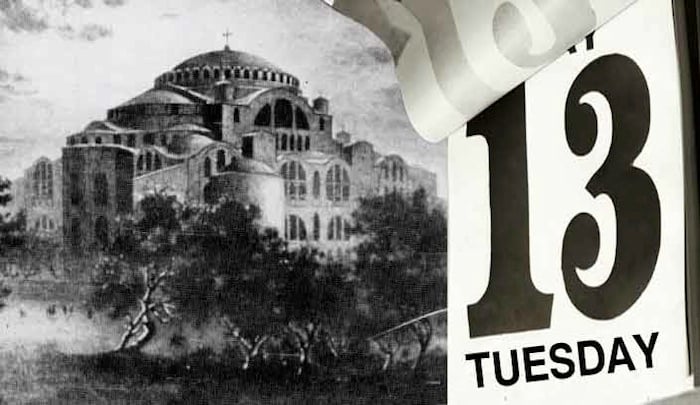
Like the Anglo-Saxons, who consider Friday the 13th a day of bad luck, Greeks have branded Tuesday the 13th as a date on which one would rather stay home and avoid anything that might lead to an accident.
The main reason Tuesday the 13th has acquired such an ominous reputation has to do with Christian Orthodoxy and is closely linked to the fall of Constantinople, which occurred on that fateful date.
Constantinople falls on Tuesday the 13th
The fall of the capital of the Byzantine Empire on Tuesday, April 13, 1204 to the Fourth Crusade was a bleak day for Hellenism, although Tuesday May 29, 1453, was even worse. It was the day Constantinople fell yet again, this time to the Ottoman Empire, followed by almost four hundred years of Ottoman rule across Greece and the subsequent loss of all Greek territories in Asia Minor. By adding the numbers of that fateful year of 1453, you get 13.
However, there are other reasons Greeks have long disliked the number thirteen, reasons that can be traced back to times well before Constantinople and Byzantium. Thirteen is a number that follows the perceived perfection of the number twelve. In addition, the gods of Olympus were twelve; there are twelve months in a year, twelve hours of daytime and twelve hours of nighttime, twelve labors of Hercules, and twelve signs of the zodiac.
Philip II of Macedonia is said to have offended the twelve gods and died shortly after erecting his statue beside theirs, a story often cited as an early warning against disturbing the sacred balance represented by the number twelve. In Christian tradition, the number twelve represents the apostles who spread the word of Christ, while the 13th chapter of Revelation ominously foretells the coming of the Antichrist.
This unease with numbers carries over into the calendar as well. Superstitious Greeks dislike Tuesday because, in Greek, Tuesday is Triti, meaning “third,” the third day of the week. Since bad luck comes in threes according to popular belief, there is not much to like about Tuesday. Adding to its ill fortune, astrology associates Tuesdays with Mars, the belligerent god of war—a final reason the day is viewed with suspicion rather than favor.
Greek superstitions
The Anglo-Saxon culture that has heavily influenced Greece through movies, television, and the internet over the past few decades has brought Friday the 13th to the forefront of popular awareness as well. It is worth noting that Black Friday has now become a fixture in Greek consumer consciousness, so it comes as little surprise that Friday the 13th has acquired significance, too.
Greeks have several superstitions and often believe that if they come across certain signs or omens, the rest of the day—or even the year—may be filled with bad luck. Perhaps the most deeply rooted Greek superstition is the evil eye or “mati.” Some Greeks feel they are under the spell of the evil eye if they are perceived as either too beautiful or too wealthy.
Regardless of the category to which one belongs, some Greeks will turn to the “Xematiastra,” the woman who knows how to relieve the purported victim of the evil eye. Broken mirrors are another source of anxiety, as they are said to bring seven years of bad luck. If a mirror breaks inside a family home, some may even want to pack up and move out immediately.
This is because many believe that a mirror does not merely reflect a person’s image but their soul as well. No Greek wants to walk under a ladder. Most Westerners share this superstition, but, in Greece, it carries an additional layer of meaning. For Greek Orthodox Christians, the ladder forms a triangle when it is placed against a wall, and walking underneath it is considered a sign of disrespect toward the Holy Trinity.
See all the latest news from Greece and the world at Greekreporter.com. Contact our newsroom to report an update or send your story, photos and videos. Follow GR on Google News and subscribe here to our daily email!

