



Troy was destroyed numerous times during its long history. In 2009, archaeologists uncovered evidence for an additional destruction event that had not previously been recognised. This destruction layer occurred at some point during the Iron Age, broadly contemporary with Homer’s own time. When exactly did this occur?
The many destructions of Troy
Archaeologists since the 19th century have established that the city of Troy existed for thousands of years. Identified with the archaeological site of Hisarlik, the remains of the city go back to at least as early as the Early Bronze Age. It continued to exist until its final abandonment in the Ottoman Era.
During that long history, the city was destroyed on numerous occasions. Several destructions occurred in the Bronze Age. The most famous of these is the destruction dated to c. 1180 BC. Many researchers have attempted to connect this event with the legendary Trojan War, described by Homer.
However, that was not the final destruction of Troy. In fact, we know that there were several later ones. One of them occurred during the Greek Dark Ages, in c. 1000 BC. At some point within the decades after that event, it was resettled and started to be built up again. This gradually grew into what archaeologists call Troy VIII. This was the Troy that existed in Homer’s time, which was still regionally significant.

The Iron Age destruction at Troy
In 2009, archaeologists uncovered evidence for a destruction layer which had previously been overlooked. It occurred at some point early in the history of Troy VIII, although the exact timing is unknown. The evidence could be explained either by warfare or an earthquake. The archaeologists found that the layer of the city immediately below the destruction layer was associated with a type of pottery called G2/3 Ware.
This pottery was popular throughout the northeast Aegean Sea. It is partially due to this that we know that Troy was still regionally important at this late date, since Troy VIII was one of the two main manufacturers of G2/3 Ware.
After this Iron Age destruction layer, the city appears to have been abandoned. Then, in c. 625 BC, it was resettled. At this point, archaeologists found that the pottery of the city was almost completely different to G2/3 Ware. In other words, there was almost no continuity between Troy VIII before the destruction layer and after. This supports the conclusion that the city was largely or completely abandoned by those who had inhabited it up until its destruction.
The uncertainty surrounding the date of this Iron Age destruction of Troy
The 2009 paper describing this newly-discovered destruction layer dated it to 675-625 BC. Some subsequent papers have narrowed that down further to c. 650-625 BC. However, what is the basis for this date, and is it as certain as sometimes presented? Could it have actually occurred earlier in the seventh century?
Frequently within archaeology, one of the key types of evidence used to establish the dates of stratigraphic layers is pottery. This is commonly found in settlements worldwide, and pottery styles tend to change fairly frequently. Therefore, they serve as an effective means of dating the different layers of a site.
One of the key stratigraphic reasons for the date of c. 650 BC for the destruction of Iron Age Troy comes from an area in which rubble covered a stony surface. Between the stony surface and the destruction layer was a layer of deposits which included developed G2/3 Ware. Based on the pottery evidence underneath the stony surface, the archaeologists concluded that the surface itself was probably laid down at some point between 750 and 700 BC.
Given the amount of material deposited on top of the stony surface but underneath the destruction rubble, perhaps some fifty years passed between the establishment of the stony surface and the destruction event. Hence, counting from c. 700 BC, this would place the destruction in c. 650.
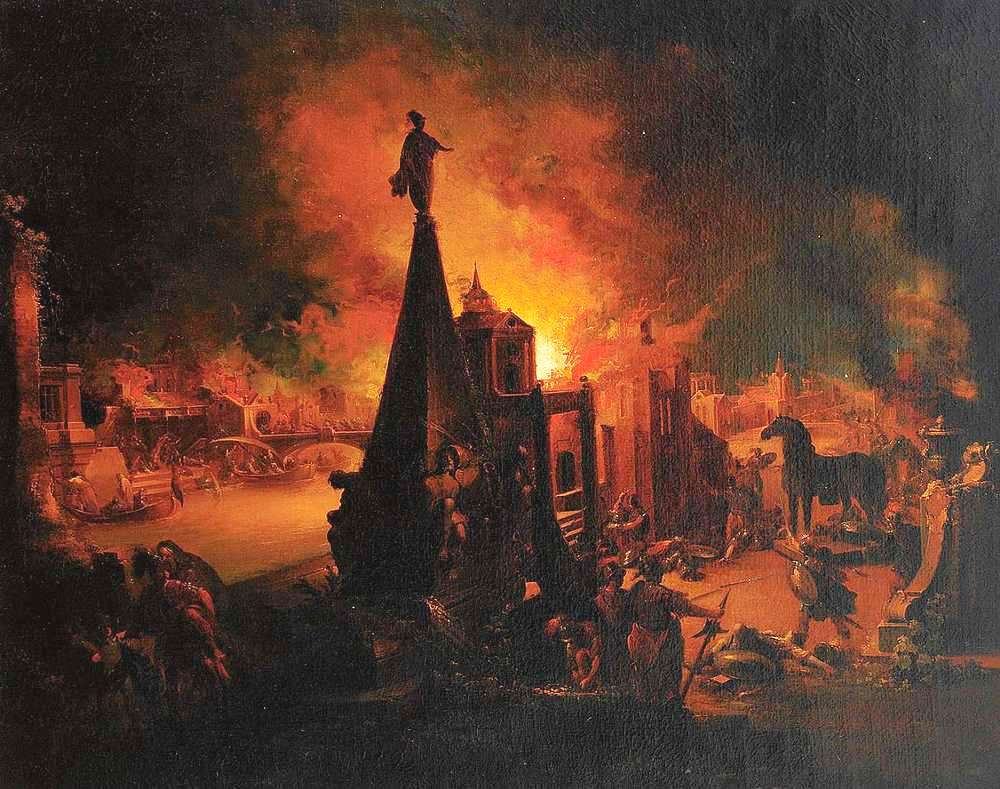
Could it have occurred earlier?
A key issue in this particular chronological reconstruction is that the evidence from the stony surface allows it to have been laid down as early as 750 BC. Hence, even if we place the destruction a full fifty years later on the basis of the amount of material that was deposited over the stony surface, that would allow for the destruction to have occurred in c. 700 BC, much earlier than the date normally given.
Can the chronology of G2/3 Ware help settle the matter? Unfortunately not. It is true that recent studies have gone to great efforts to establish the chronology of this type of pottery. However, one of the most recent studies into G2/3 Ware acknowledged that its chronology was established based on the stratigraphy of Troy. Therefore, trying to use the pottery to date the stratigraphy would be circular.
What we do know is that the layer of Troy VIII beneath the destruction showed examples of possible imports from Chios. These were similar to Chian pottery dating to the early seventh century BC. However, this does not justify placing the destruction of Troy any more precisely than broadly the first half of that century. It could easily have occurred right at the beginning rather than in the middle.
Another relevant pottery type is bird-decorated kotylai, or drinking cups. These were popular in the northeast Aegean between c. 720 to 650 BC. Yet, surprisingly few have been found at Troy VIII. If the destruction of the city had occurred shortly after 700 rather than 650, that would go a long way to explaining this phenomenon.
Was this the real Trojan War?
Some scholars have suggested that the Trojan War legend did not originate in the Mycenaean Era. Rather, they suggest that it more likely originated from Greek expansion into the Troad in the Archaic Era, such as the eighth and seventh centuries BC. One historian who has made this suggestion is Dr Peter Gainsford. Other evidence also supports this later date.
This makes sense of Troy’s strategic importance at the entrance to the Black Sea. During the Mycenaean Era, there is little to no evidence that the Greeks were interested in gaining access to the coastlands of the Black Sea and establishing colonies there. Greek expansion into the Black Sea did not occur until the late eighth or early seventh centuries BC.
Therefore, a conflict over Troy in this later era makes a great deal of sense. If the destruction of Iron Age Troy occurred in c. 700 BC, that could potentially have been the source of the legends which we then see emerge throughout the following century, such as in the poems of Homer.
See all the latest news from Greece and the world at Greekreporter.com. Contact our newsroom to report an update or send your story, photos and videos. Follow GR on Google News and subscribe here to our daily email!

