



The 4th century AD Greek poet Palladas of Alexandria was a witness to the twilight of the ancient Greek world and the dawn of a new religious order with the rise of Christianity.
At the time of Palladas, the Roman Empire was undergoing profound political, religious and cultural transformations. Christianity, once a persecuted faith, was gradually becoming the dominant religion, while the ancient traditions of Greek philosophy, literature and pagan worship were struggling to preserve their place in society. In this changing world, the city of Alexandria in Egypt remained a major center of intellectual activity, a meeting place of cultures, religions and competing visions of the past and future.
Among the literary figures who experienced this extraordinary transition was Palladas of Alexandria, a Greek poet and grammarian whose surviving epigrams offer a remarkable glimpse into the anxieties, contradictions and cultural tensions of Late Antiquity. Although little is known about his personal life, his poetry preserves the voice of an educated man deeply conscious of the transformation of the world around him.
His epigrams and poems covered important topics of everyday life and society, such as the contradictions of life, the instability of fortune, marriage, old age, poverty, education, religion and the decline of the ancient world.
Palladas is particularly interesting because he stands at the intersection of two historical epochs: the declining world of classical Hellenism and the emerging Christian civilization of the Byzantine era.
Alexandria: a city between two worlds
In the 4th century, Alexandria was still one of the most important intellectual centers of the Roman Empire. Its cultural identity had been shaped by centuries of Greek influence, beginning with its foundation by Alexander the Great in 331 BC. The city had inherited the extraordinary legacy of Hellenistic civilization: philosophy, poetry, mathematics, astronomy, medicine and scholarship.
Yet the religious landscape was changing dramatically. Christianity was expanding, pagan temples were losing their traditional authority, and Christian communities were becoming increasingly influential. The conflict was not simply between two religions; it was also a struggle between different understandings of education, philosophy, public life and cultural identity.
Palladas lived within this complex environment. As a grammarian and teacher, he belonged to the traditional intellectual world of Greek paideia, the education system based on classical literature, rhetoric and philosophy. Homer, the Greek tragedians and the ancient philosophical traditions remained central to his intellectual identity.
His poetry suggests that he viewed the transformation of his society with considerable skepticism, irony and sometimes bitterness.
The poet and his uncertain identity
Approximately 150 epigrams attributed to Palladas survive in the Greek Anthology (Anthologia Palatina), while additional poems have been recovered from a fragmentary papyrus manuscript.
The exact chronology of his life remains disputed. Traditionally, scholars placed his activity in the second half of the 4th century, approximately 360–450 AD. Other researchers, particularly Kevin Wilkinson, have argued for an earlier chronology, placing his peak in the early 4th century.
Oxford classical scholar Neil Hopkinson, in the Oxford Classical Dictionary, describes Palladas as a poet whose distinctive voice was:
“black, bitter, and cynically humorous.”
Hopkinson also makes an important observation about the poet’s religious identity: “It is hardly possible to infer from his poems whether he was a Christian, a pagan, or an agnostic.”
This uncertainty is significant. Palladas cannot easily be classified as a representative of one religious community. His poetry reveals a complicated intellectual personality, attached to classical Greek culture but acutely aware of the changing religious and social environment.
Some poems appear to express hostility towards Christian monks, while others demonstrate his attachment to the traditional Greek conception of the gods. His attitude, however, was not necessarily that of a passionate defender of paganism. Rather, he often appears as a disillusioned observer of human behavior, religious enthusiasm and political power.
Palladas’ epigrams and poems
Life is a theater
Anthologia Palatina, X.72
All life is a stage and a play.
Either learn to play, laying aside your seriousness,
or learn to endure its sufferings.
This is perhaps one of Palladas’s most memorable philosophical observations. Human existence resembles a theatrical performance: we are all actors, given roles we did not choose. Wisdom consists either in learning to play one’s part or in accepting the tragedy of existence.
On Gold
Anthologia Palatina, IX.394
Gold, father of flatterers,
son of suffering and anxiety;
possessing you brings fear,
while lacking you brings pain.
The Greek poet makes a remarkably concise observation on the power of money.
On Fortune
Anthologia Palatina, IX.180–183
Fortune, who governs the course of human life,
whose nature is ever-changing,
you have now abandoned your divine dignity
and become a keeper of a tavern!
These epigrams concern a temple of Fortune that had been converted into a tavern.
Palladas uses the transformation to ridicule the instability of human institutions and the reversal of traditional values. The goddess who once governed the destinies of humanity has herself become a victim of changing circumstances.
On the danger of being virtuous
Anthologia Palatina, IX.379
They say, proverbially, that even a sheep
might bite a wicked man.
But I would rather put it differently:
Even a sheep might bite the good and harmless;
Yet the wicked man, whom even a serpent fears,
will escape without a bite.
This is a particularly cynical observation about the injustice of human society. Palladas reverses the conventional proverb to suggest that the innocent are often more vulnerable than the wicked.
On Love transformed into a frying pan Anthologia Palatina, IX.773
The blacksmith has transformed Eros into a frying pan,
and not without reason:
for even in this new form,
he continues to burn.
One of Palladas’s most amusing examples of mythological humor. The god of love, deprived of his divine form, becomes an ordinary domestic object. Yet his essential characteristic remains unchanged: he burns.
On his wife Andromache
Anthologia Palatina, XI.54
The Greek poet frequently makes marriage the subject of satire. In this particular epigram, he plays on the opening words of Homer’s Iliad and the name of his wife, Andromache.
The joke rests on the association between the wrath of Achilles and the idea of a wife who wages war against her husband. It is an example of his characteristic combination of literary learning and domestic humor.
Palladas also wrote about the changing religious and cultural landscape of Alexandria. In several epigrams, he describes ancient statues and pagan divine images being repurposed, melted down or transformed into everyday objects.
Behind the humor of the Greek poet lies a sense of cultural loss. The old gods, once honored in temples and public spaces, have become material for an entirely different world.
The decline of the old gods and the rise of Christianity
One of the most revealing aspects of Palladas’ poetry is his treatment of the changing religious landscape. The traditional gods of Olympus, once central to Greek religious and artistic imagination, were increasingly losing their public prominence. Christian emperors, bishops and monks were transforming the religious character of the empire.
The reign of Constantine the Great (306–337 AD) marked a decisive turning point. Christianity received imperial favor, while the ancient religious institutions gradually lost their privileged position. Constantinople was founded as the new imperial capital in 330, symbolizing the emergence of a new political and cultural order.
Palladas’ poems concerning statues of ancient gods are particularly significant. Some of these statues had been removed from their original religious settings and transferred to Constantinople, where they could be admired as works of art rather than worshipped as divine images.
This transformation carried a powerful symbolic meaning: the gods of the ancient world were becoming objects of cultural memory.
Kevin Wilkinson, in his important study Palladas and the Age of Constantine (2009), challenges the traditional chronology of the Greek poet. He argues that Palladas may have flourished considerably earlier than previously believed, perhaps during the first decades of the 4th century. His interpretation connects the poet’s references to religious transformation with Constantine’s political and cultural policies.
The debate remains unresolved, but it demonstrates how important Palladas’ poetry is for understanding the relationship between paganism and Christianity.

A critical voice against religious extremism
Palladas’ poems contain sharp remarks about monks and religious figures. These passages suggest that he was uncomfortable with the growing influence of ascetic Christianity and the transformation of traditional urban life.
However, it would be misleading to interpret every satirical observation as evidence of a systematic anti-Christian ideology. Palladas was above all a satirist. His criticism extended beyond religious institutions to human vanity, hypocrisy, social ambition and the instability of fortune.
The classical scholar Alan Cameron examined this question in his influential article Palladas and Christian Polemic. Cameron argued that Palladas was probably a pagan, observing: “there can in my opinion be little doubt that, like so many other schoolmasters in 4th and 5fth century Egypt, he was a pagan.”
Cameron’s interpretation highlights the importance of Palladas’ attachment to traditional Greek culture. Nevertheless, other scholars have emphasized the ambiguity of his religious position and the difficulties of reconstructing personal belief from literary satire.
Dimitar Iliev, in his study Christianity and Paganism in the Epigrams of Palladas of Alexandria, offers a particularly interesting interpretation. He describes Palladas as a representative of, “an eclectic common-sense traditionalism.”
This description captures something essential about the poet. Palladas was neither simply a nostalgic admirer of the past nor an uncomplicated opponent of Christianity. He belonged to a generation confronted with the disappearance of familiar cultural structures and the emergence of a new religious order.
The Sarapeum and the end of an era

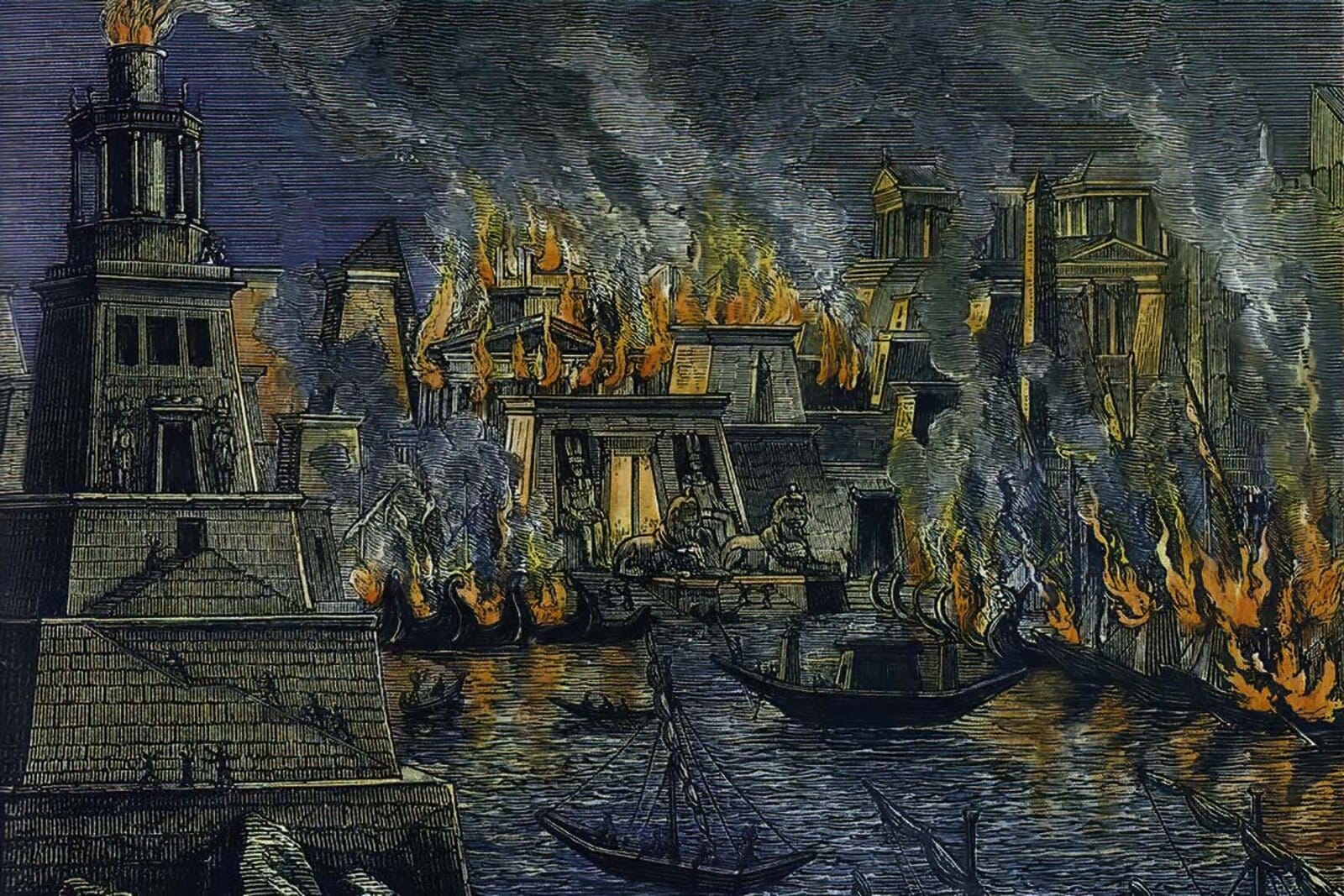
The religious conflicts of 4th-century Alexandria reached a dramatic climax in 391 AD, when the Serapeum, one of the city’s most important pagan sanctuaries, was destroyed during violent religious confrontations.
The temple was dedicated to Serapis, a deity whose worship combined Greek and Egyptian religious traditions. For centuries, the Serapeum had represented the extraordinary cultural synthesis that characterized Alexandria. Its destruction became a powerful symbol of the changing religious identity of the city.
Whether Palladas personally witnessed this particular event depends on the disputed chronology of his life. If the traditional dating is correct, he may have experienced the final years of the sanctuary and the violence surrounding its destruction. If Wilkinson’s earlier chronology is accepted, he would have died decades before it.
This distinction is historically important. Palladas should not automatically be presented as an eyewitness to the destruction of the Serapeum. Nevertheless, his poetry provides valuable evidence of the religious tensions that characterized the period.
His work allows us to approach the transformation of Alexandria not simply through imperial decrees and ecclesiastical histories, but through the perspective of an individual intellectual.
The human condition: pessimism, irony and disillusionment
Beyond religious controversy, Palladas was a poet deeply concerned with the human condition. His epigrams explore the fragility of life, the instability of fortune, the disappointments of education and the contradictions of human ambition. His voice is frequently ironic, sometimes bitter, and often profoundly pessimistic.
As a teacher, he occupied a socially important but not necessarily prosperous position. His poems suggest the frustrations of an intellectual who possessed classical learning but lived in a world that did not always reward wisdom or scholarship. This gives his poetry a remarkably modern quality. His complaints about society, hypocrisy and the uncertain value of intellectual achievement could easily resonate with readers many centuries later.
Classicist Peter Bing, discussing Palladas’ epigrams on statues, emphasizes the poet’s distinctive literary personality, describing his voice as:
“distinctively querulous, world-weary, sardonic.”
The description is especially appropriate because Palladas’ poetry combines literary sophistication with an almost existential sense of disappointment. His world was changing, but his disillusionment was also personal. The decline of traditional religion was only one aspect of a broader crisis of identity, belonging and cultural continuity.
A Witness to the end of Classical Antiquity
The historical importance of Palladas lies not only in his literary achievements but also in the world his poetry preserves. He represents a generation of Greek intellectuals who experienced the gradual transformation of their civilization. The language of Homer and the classical poets remained alive, but the religious and political institutions that had sustained the ancient Greek world and Hellenism were undergoing profound change.
The old gods were losing their temples, the traditional philosophers were confronting new religious authorities, and classical education was adapting to an increasingly Christian society.
Yet Greek literature did not disappear. It continued to influence the intellectual life of the Eastern Roman Empire and eventually became one of the foundations of Byzantine civilization.
Palladas therefore occupies a fascinating position in the history of European culture. He was not merely a poet of decline, but a witness to cultural transformation. His epigrams preserve something that official historical narratives often overlook: the emotions, frustrations, irony and uncertainties experienced by ordinary intellectuals during periods of profound historical change.
Perhaps this is why his poetry remains so compelling. Through his brief and often bitter verses, later readers encounter the twilight of one civilization and the uncertain dawn of another.
See all the latest news from Greece and the world at Greekreporter.com. Contact our newsroom to report an update or send your story, photos and videos. Follow GR on Google News and subscribe here to our daily email!

