



Greece’s ruling New Democracy party maintains a 13.5-percentage-point lead over the opposition Greek Left Alliance (ELAS), according to a new opinion poll released Thursday, October 22, although the findings raise questions about whether the next parliamentary election will produce a single-party government.
The Pulse survey, conducted for SKAI television between October 17 and 20 among 1,107 respondents, places Prime Minister Kyriakos Mitsotakis’ New Democracy at 30% in its vote estimate, followed by former Prime Minister Alexis Tsipras’ ELAS at 16.5% and PASOK at 13%.
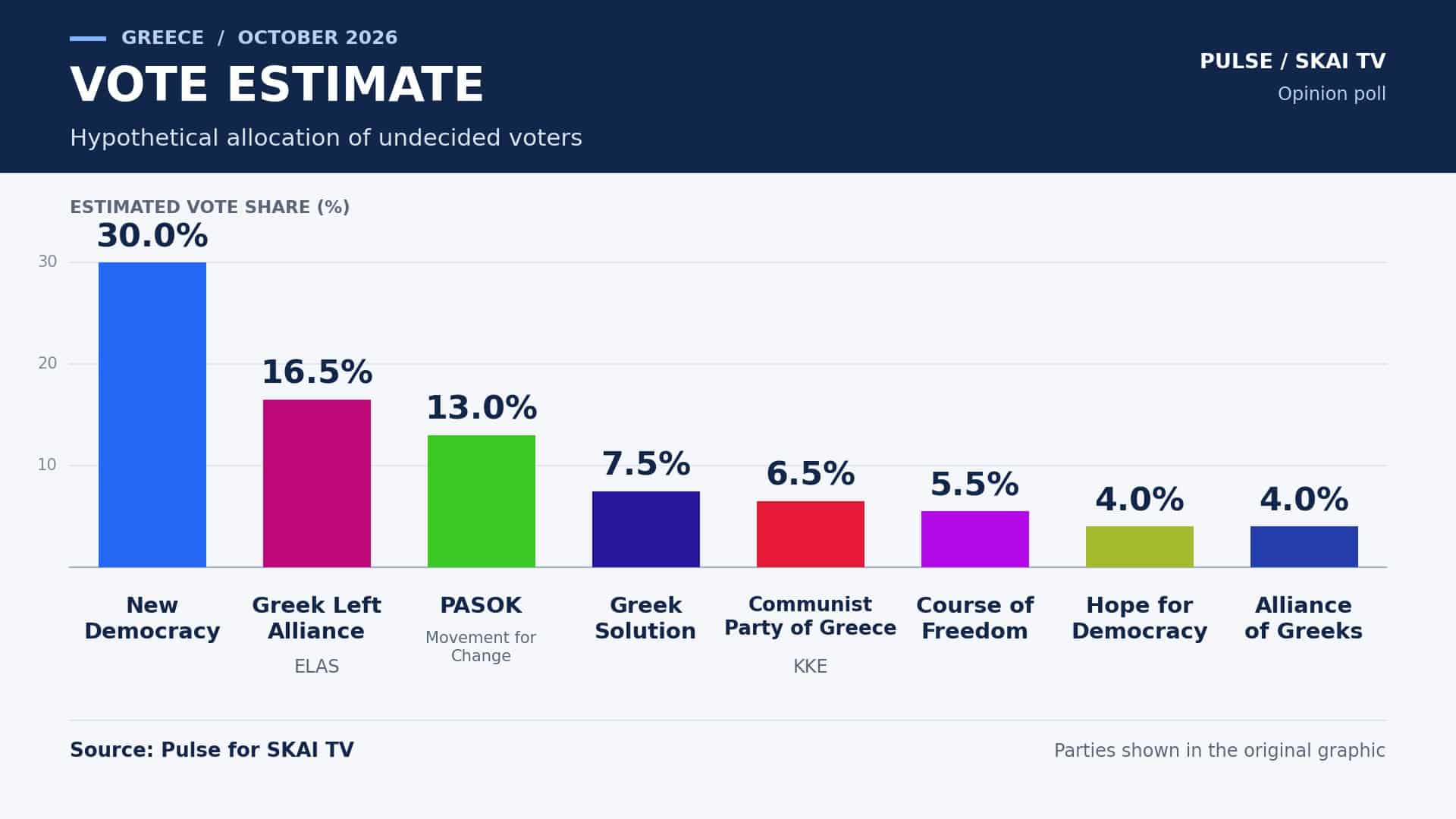
Greek Solution follows with 7.5%, the Communist Party with 6.5% and Course of Freedom with 5.5%. The poll also points to a potentially fragmented Parliament, with four smaller parties polling near the 3% electoral threshold. Hope for Democracy, associated with Maria Karystianou, and the Alliance of Greeks, backed by Ilias Kasidiaris, each receive 4%, followed by Voice of Reason at 3.5% and MeRA25 at 3%. Kasidiaris, a former Golden Dawn lawmaker convicted for his involvement in the neo-Nazi organization’s criminal activities. His support for the Alliance of Greeks comes despite his criminal conviction and imprisonment.
The findings suggest that as many as ten parties could enter Parliament, complicating efforts to form a majority government following the 2027 elections.
Voters Divided Over Single-Party Government
The survey found that 43% of respondents prefer a single-party majority government, compared with 36% who favor a coalition. Another 13% expressed no preference, while 8% were undecided or declined to answer.
Mitsotakis was selected as the most suitable prime minister by 29% of respondents, followed by Tsipras at 16% and PASOK leader Nikos Androulakis at 8%. Another 11% selected none of the available figures.

The poll also examined the potential appeal of a political party associated with former Prime Minister Antonis Samaras. Only 5% expressed willingness to consider voting for such a party, down from 6% in September, while 63% ruled out supporting it.
Economic conditions and the cost of living remain leading considerations for voters ahead of the elections expected in 2027.
Could Greece Face a Second Election in 2027?
Under Greece’s current electoral system, the 300-seat Parliament is elected through reinforced proportional representation, with a 3% threshold for parliamentary representation. The leading party receives a bonus of 20 seats if it secures at least 25% of the national vote, increasing by one seat for every additional 0.5 percentage points, up to 50 bonus seats at 40%. A parliamentary majority requires at least 151 seats. The vote share needed depends partly on how many votes go to parties failing to cross the 3% threshold.
If no party secures a majority, the president assigns exploratory mandates to party leaders to establish whether a government can command parliamentary confidence. Each mandate lasts up to three days. If coalition negotiations fail and no government can be formed, a caretaker administration is appointed and new elections are called.
Unlike the two elections held in May and June 2023, a second election in 2027 would use the same electoral system unless the law is changed.
See all the latest news from Greece and the world at Greekreporter.com. Contact our newsroom to report an update or send your story, photos and videos. Follow GR on Google News and subscribe here to our daily email!

