



The Roman conquest of Greece did not erase the architectural traditions of the Greek world in monuments and buildings. Instead, the Roman rulers added new ones, creating a new architectural landscape in which older Greek monuments and structures and new Roman buildings existed side by side with a few of them functioning today.
This blend of Greek and Roman cultural identities survives today in Athens, Corinth, Nicopolis and Philippi, while later major Roman complexes can be seen at Thessaloniki, Patras, Argos, Sparta, Kos, and other cities.
Archaeologist Vasilis Evangelidis, in his study of Greek urbanism under Rome, observes that “Roman Greece underwent a series of changes” which are particularly visible in the transformation of the ancient agora. He emphasizes the importance of “functionality and monumentality” in the creation of Roman-period urban spaces. This approach is particularly useful because the Roman monuments of Greece were not merely foreign constructions imposed upon passive Greek communities. They were frequently the result of cooperation between emperors, Roman officials, wealthy Greek elites and local civic institutions.

Roman architecture in Athens
Naturally, the most important Roman architectural remains in Greece are found at Athens. Although Athens remained famous for its Classical monuments, the Roman period fundamentally altered its urban landscape. The most significant transformation occurred under Augustus and, above all, Hadrian in the 2nd century AD. As History professor Ian Worthington notes, Hadrian’s building program in Athens included the completion of the Olympieion, a great library and an aqueduct and was one of the largest imperial programs undertaken in the city.
The Temple of Olympian Zeus, or Olympieion, is the most imposing surviving temple in Athens completed under Roman rule. The sanctuary had an extraordinarily long history. Construction of the great temple had begun under the Peisistratid dynasty in the sixth century BC and was resumed under Antiochus IV in the second century BC. It was finally completed in 124/125 AD under the emperor Hadrian. The finished temple was a monumental Corinthian structure, and its completion demonstrated both Roman resources and Hadrian’s special relationship with Athens.
Hadrian did not merely complete an old Greek project. He associated himself ideologically with Olympian Zeus and presented himself as a benefactor of the Athenian city. The temple therefore had both religious and political significance. Within the precinct stood numerous statues, including representations of Hadrian. Recent scholarship continues to investigate how imperial monuments within the Olympieion communicated relationships between Athens, Rome and the emperor.
Close to the Olympieion stands Hadrian’s Arch, a symbolic marker of Hadrian’s intervention in the city. Its inscriptions famously distinguished the older Athens associated with Theseus from the city associated with Hadrian. The monument expressed an imperial claim to participation in the historical identity of Athens. Modern scholars caution against treating the arch as proof that Athens was simply divided into a Greek and a Roman city. It was the emperor’s adoption into Athenian civic and cultural traditions.
The Library of Hadrian
Perhaps the most impressive of Hadrian’s civic buildings was the Library of Hadrian, completed around 131–132 AD. It was not simply a library in the modern sense. The complex included a vast colonnaded courtyard, lecture and study spaces and rooms associated with intellectual and civic activity. The monument incorporated one hundred columns of Phrygian marble, a particularly expensive imported stone. Archaeological evidence indicates that colored marble was used extensively in the complex, creating a spectacular visual statement of imperial wealth.
The Library was part of a broader reorganization of central Athens. Evangelidis describes it as a building that “upgraded the region east of the Agora” and created another important civic nucleus within the city. Its position is significant: Roman Athens did not simply replace the old Classical center but expanded it, creating new monumental zones beside the ancient civic landscape.
The construction of the Roman Agora which begun between 19 and 11 BC with financial support from Julius Caesar and Augustus, was another essential element of this transformation. It was essentially a commercial and administrative complex centered on a large open courtyard surrounded by colonnades. The Tower of the Winds, although originally a Hellenistic monument, became incorporated into this Roman-period urban environment. After the Herulian invasion of AD 267, the administrative and commercial center of Athens shifted increasingly toward the Roman Agora and the Library of Hadrian.
The importance of the Roman Agora demonstrates why the Romanization of Athens should not be interpreted as a simple replacement of Greek culture. Christopher Dickenson has emphasized the complex relationship between old and new public spaces, while recent archaeological research stresses the continuing importance of traditional Athenian monuments.

The glorious Panathenaic Stadium and the Odeon of Herodes Atticus
The Panathenaic Stadium was originally built as a simple racecourse in 330 BC by the Athenian statesman Lykourgos to host the Panathenaic Games. In 144 AD, it was rebuilt in marble by Athenian Roman senator Herodes Atticus. Although the stadium had Classical origins, its monumental marble form and later use belong partly to the Roman imperial world. It was associated particularly with the benefactions of Herodes Atticus, illustrating the ability of wealthy Greek elites to combine Roman imperial culture with distinctly Athenian traditions. Today the stadium hosts big scale concerts and athletic events.
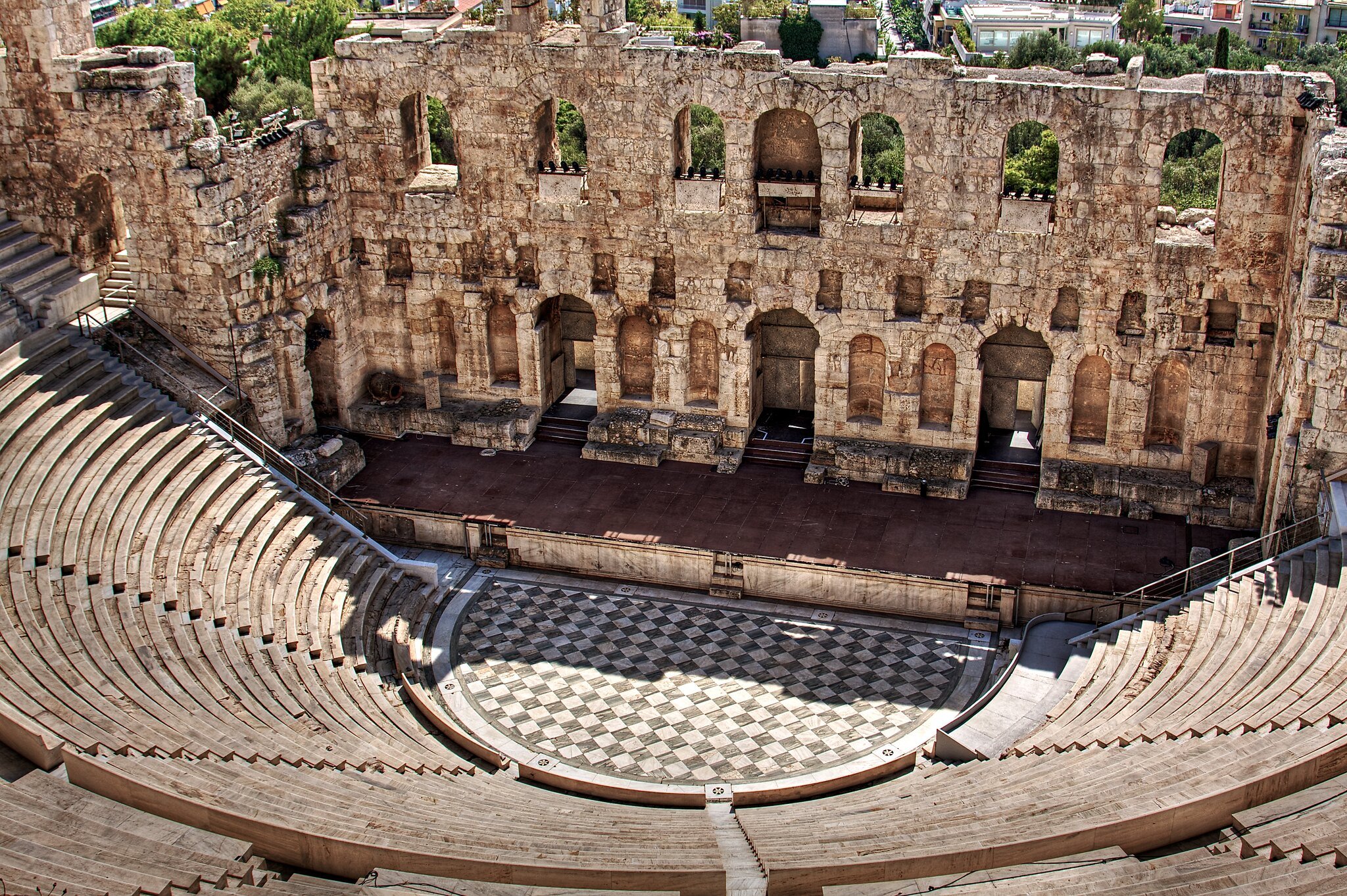
Another major Roman monument is the Odeon of Herodes Atticus, built in the second century AD by Herodes Atticus in memory of his wife Regilla. It stood on the southern slope of the Acropolis and became one of the most impressive performance buildings in Roman Athens. The building combined Roman construction techniques and monumental scale with the Greek cultural tradition of music, drama and public performance. Its elaborate marble decoration and enormous semicircular auditorium made it one of the most prestigious buildings of the city. Modern research connects the monument closely with Herodes Atticus’s position as a wealthy Greek aristocrat and benefactor. After a major restoration completed in 1955, the Odeon of Herodes Atticus holds the Athens Festival for concerts and plays every summer.
The Philopappos Monument, erected in the early second century AD on the Mouseion Hill, demonstrates the role of Greek and eastern provincial elites within the Roman Empire. Gaius Julius Antiochus Epiphanes Philopappos was a prominent member of the Commagenean royal family who became an Athenian citizen and Roman senator. His funerary monument adopted a highly Greek visual language while commemorating a man whose career was thoroughly connected with Rome. Athens therefore provides perhaps the clearest example of the hybrid character of Roman Greek architecture.

Corinth: the Roman capital of Greece
The second great center of Roman architecture in Greece was Corinth. Destroyed by the Romans in 146 BC, the Peloponnesian city was reestablished as a Roman colony by Julius Caesar in 44 BC. Under the Empire it became the capital and administrative center of the province of Achaia and developed into one of the most prosperous cities of Roman Greece. The American School of Classical Studies describes Corinth as having become “the capital of Roman Greece.”
The heart of Roman Corinth was the Forum, an enormous public complex surrounded by temples, basilicas, shops and administrative buildings. Unlike Athens, where Roman architecture was inserted into an exceptionally powerful Classical urban tradition, Corinth was rebuilt extensively as a Roman colony. Its architecture therefore provides one of the clearest examples of Roman urban planning in Greece.
One of its most important monuments is Temple E, a large Roman temple on the western side of the Forum. Its precise identification remains controversial. It has traditionally been identified as the Temple of Octavia, associated with the imperial cult, but researcher Mary Walbank has argued that it may instead have been the Capitolium of Corinth. This debate illustrates an important feature of Roman archaeology: monuments cannot always be assigned functions simply from their architectural appearance.
The Corinth reconstruction by the Romans
The rich city of Corinth was destroyed completely in 146 BC when the army of Lucius Mummius conquered the whole area. The Romans killed all the men and sold the women and children into slavery. A new city was built upon the ruins in 44 BC and became the provincial capital of Achaea. Soon it developed into one of the most prosperous cities of Roman Greece. The American School of Classical Studies describes Corinth as having become “the capital of Roman Greece.”
Corinth’s importance was alsoy economic. Its position on the Isthmus allowed it to control routes between central Greece and the Peloponnese and between the Corinthian and Saronic Gulfs. Recent archaeometric research on Roman Temple E has emphasized the city’s substantial marble-working industry and its connection with regional trade networks.
The Basilica of Corinth was an important public building built at the time. Roman basilicas served judicial, administrative, commercial and civic purposes. The city’s theater and odeon were also modified and rebuilt during the Roman period, while the Fountain of Peirene continued to serve the city. Archaeological excavations have demonstrated that Roman Corinth remained active well beyond the first centuries of imperial rule. Recent excavations northeast of the theater continue to reveal Roman buildings, roads and drainage systems.

The Roman forum
The heart of Roman Corinth was the Forum, an enormous public complex surrounded by temples, basilicas, shops and administrative buildings. The Forum, in essence, functioned as the ancient Greek Agora. Unlike Athens, where Roman architecture was inserted into an exceptionally powerful Classical urban tradition, Corinth was rebuilt extensively as a Roman colony. Its architecture therefore provides one of the clearest examples of Roman urban planning in Greece.
One of its most important monuments is Temple E, a large Roman temple on the western side of the Forum. Built in the Roman style on high concrete and marble-clad podia facing east with monumental staircases, its precise identification remains controversial. It has traditionally been identified as the Temple of Octavia, associated with the imperial cult, the second is that it was a Capitolium temple. Neither has been proven definitively. However, researcher and author Mary Walbank has argued that it may instead have been the Capitolium of Corinth and not a temple. This debate illustrates an important feature of Roman archaeology: monuments cannot always be assigned functions simply from their architectural appearance.
Another sacred building on the Forum terrace was Temple F, dedicated to Caesar’s patroness, Venus Victrix (Victorious Venus). There was also Temple D, following the extension of the Northwest Stoa into the north end of the West Terrace. This one followed the Tuscan style of Roman architecture.
The Nicopolis of Augustus
In Greek, Nicopolis means the victorious city. Located in Epirus near modern-day Preveza, is perhaps the most complete example of a Roman city deliberately created in Greece to commemorate imperial victory. Augustus founded the city after his victory over Mark Antony and Cleopatra at Actium in 31 BC.
UNESCO’s description of the archaeological site emphasizes that Nicopolis was created as a Roman city with a planned orthogonal street system and became the capital of Epirus and Acarnania during the first three centuries of the Roman Empire. The site therefore represents Roman urban planning on an exceptionally large scale.
The Monument of Augustus at Nicopolis commemorated the Battle of Actium. Located in the suburban area north of the main city, it formed part of a monumental landscape that included the theater, stadium and gymnasium. The monument was designed to celebrate Augustus’ victory and to establish the ideological identity of the new city.
The Great Theater of Nicopolis was one of the largest Roman theaters in Greece. Its original construction dates to the Augustan period, although it was substantially reconstructed during the second century AD. The Greek Ministry of Culture describes it as one of the best-known Roman theaters in Greece.
A sophisticated water system
Nicopolis also possessed a sophisticated water system. A roughly fifty-kilometre aqueduct carried water from springs at Louros to the city, where it was distributed through a network of hydraulic installations. The scale of this infrastructure demonstrates that Roman architecture in Greece was not limited to temples and monuments; it also included sophisticated engineering designed to sustain large urban populations.
The Roman Odeon is another exceptionally well-preserved monument. Built during the reign of Augustus, it was used for musical and theatrical performances during the Actian festival and may also have served as a council house because of its proximity to the agora.
Archaeologists Christopher Mee and Antony Spawforth have described Nicopolis as “the best site to appreciate the Roman conqueror’s transforming hand on ancient Greece’s landscape.” This is particularly appropriate because Nicopolis was a new city created specifically to embody the political consequences of Augustus’ victory.
Philippi: a “small Rome” in Macedonia
In northern Greece, Philippi provides another exceptional example of Roman urbanism. After the Battle of Philippi in 42 BC, the city became a Roman colony. UNESCO describes the Roman transformation of Philippi as the creation of a “small Rome.”
The most important Roman building was, again, the Forum, constructed during the first century AD and extensively remodeled under the Antonine emperors. It was a large rectangular civic complex containing temples and public buildings. The Via Egnatia, the great Roman road connecting the Adriatic with the eastern Mediterranean, passed directly through the city and formed its principal east-west artery.
Philippi also possessed a commercial market, palaestrae, baths, public buildings and monumental streets. The Roman Forum occupied a central position within the urban grid and demonstrated the city’s integration into Roman administrative and economic structures.
The survival of Philippi is particularly valuable because it allows archaeologists to see the relationship between a Greek/Macedonian city and Roman colonial planning. The city did not lose its earlier identity, but its streets, political institutions and monumental architecture were reorganized according to Roman models.

Thessaloniki and the imperial architecture of Late Roman Greece
Thessaloniki became one of the most important cities of Roman Macedonia. Its strategic position on the Via Egnatia and its harbor made it a major center of commerce and imperial administration.
The most spectacular Roman complex is the Galerius Palace complex, developed around the turn of the 4th century AD under the emperor Galerius. It included a monumental palace, the Arch of Galerius, a large ceremonial street and the Rotunda. The complex illustrates the increasing emphasis on imperial ceremonial architecture during Late Antiquity.
The Arch of Galerius celebrated the emperor’s victories over the Sasanian Persians and presented imperial military power through sculptural reliefs. The nearby Rotunda, probably constructed as part of the imperial complex, was an enormous domed building whose precise original function remains debated. Its later conversion into a Christian church illustrates the transformation of Roman architecture in the 4th and subsequent centuries.

Thessaloniki demonstrates that Roman monumentalism did not disappear with the end of the early Empire. Instead, architectural priorities changed. Imperial residences, ceremonial spaces and monumental roads became increasingly important as the emperor’s relationship with the city became more visible.
Patras, Argos and other Roman cities
The harbor city of Patras was another major Roman city in Greece. Its importance grew after Augustus reorganized the region and established a Roman colony. The Roman Odeon of Patras, one of the best-preserved Roman-period performance buildings in Greece, is a particularly important monument. It demonstrates the continuing popularity of Greek theatrical and musical traditions under Roman rule.
Argos likewise retained its importance while receiving Roman baths, monumental renovations and other public works. Its theater, originally Greek, underwent modifications during the Roman period. The coexistence of Greek theaters with Roman baths and other imperial-period structures demonstrates the architectural continuity characteristic of Roman Greece.
At Sparta, Roman baths, villas and modifications to older sanctuaries reveal a similar process. Roman visitors and local elites were fascinated by Sparta’s Classical reputation, while the city itself adapted to imperial economic and social conditions.
At Messene, Roman-period interventions can be seen in the modification of earlier monumental spaces and the continued use of major public and religious buildings. Across the Peloponnese, Roman architecture therefore often involved adaptation rather than complete replacement.
The Roman rule is also evident on the island of Kos. The Roman Odeon was constructed between the 1st and 2nd centuries AD and was intended as a venue for musical games. It also served as a house of the Senate. Casa Romana was a Roman villa with three impressive atria and spacious rooms that still preserve frescoes, mosaics, and marble floors.

More Roman buildings and structures
Although temples, theaters, and imperial monuments attract the greatest attention, Roman Greece also possessed numerous less spectacular buildings that are essential for understanding daily life of the era. Bath complexes, for example, became increasingly common in Roman cities. They combined practical functions with social interaction and often contained elaborate mosaics, marble decoration, heating systems and water installations.
Roman villas also transformed the countryside. Wealthy landowners constructed large residences decorated with mosaics, marble revetments, sculpture and gardens. The villa of Herodes Atticus at Loukou in Arcadia, for example, illustrates the extraordinary wealth of provincial elites during the 2nd century AD. Recent scholarship has emphasized the sophisticated display of Greek mythological and Hellenistic sculpture within this Roman-period environment.
Aqueducts, fountains, drains and roads were equally important. The large aqueduct at Nicopolis is the clearest example, but water engineering existed in many Roman cities. These structures demonstrate the practical dimension of Roman architecture:urban monumentalism depended upon infrastructure capable of supporting populations, commerce and public life.
The blending of urban Roman architecture with Greek forms, what Evangelidis calls the “juxtaposition of old and new,” is one of the most characteristic descriptions of Roman Greece. The example of Hadrian who presented himself not as the conqueror but as the benefactor of Athens and participant of the city’s cultural identity sums up the close ties of the two civilizations.
See all the latest news from Greece and the world at Greekreporter.com. Contact our newsroom to report an update or send your story, photos and videos. Follow GR on Google News and subscribe here to our daily email!

