



Ancient Roman bath mosaics in Libya have been reburied at the archaeological site of Sabratha after years of exposure, vegetation growth, and deterioration threatened their survival. Researchers covered about 150 square meters of fragile mosaic floors inside the Baths of Regio VII, using layers of local soil, sand and gravel to protect the remains while keeping them available for possible future conservation.
The work took place over five days in April 2025. Lead author Will Wootton and colleagues carried out the project with Libya’s Department of Antiquities as part of the Managing Libya’s Cultural Heritage project, known as MaLiCH.
Researchers said reburial offered a practical way to protect mosaics that were deteriorating but were not part of Sabratha’s main visitor route. The method recreates some of the protective conditions that preserved archaeological remains underground for centuries. It can also reduce the cost and labor required to maintain exposed ancient floors. The effort comes as archaeologists work to protect other ancient sites in Libya threatened by conflict, environmental damage and looting.
Roman baths date to the second century
The Baths of Regio VII were discovered in 1923 during construction of excavation offices in the southwestern part of Sabratha. The complex was built during the second half of the second century A.D., when the Roman city was expanding.
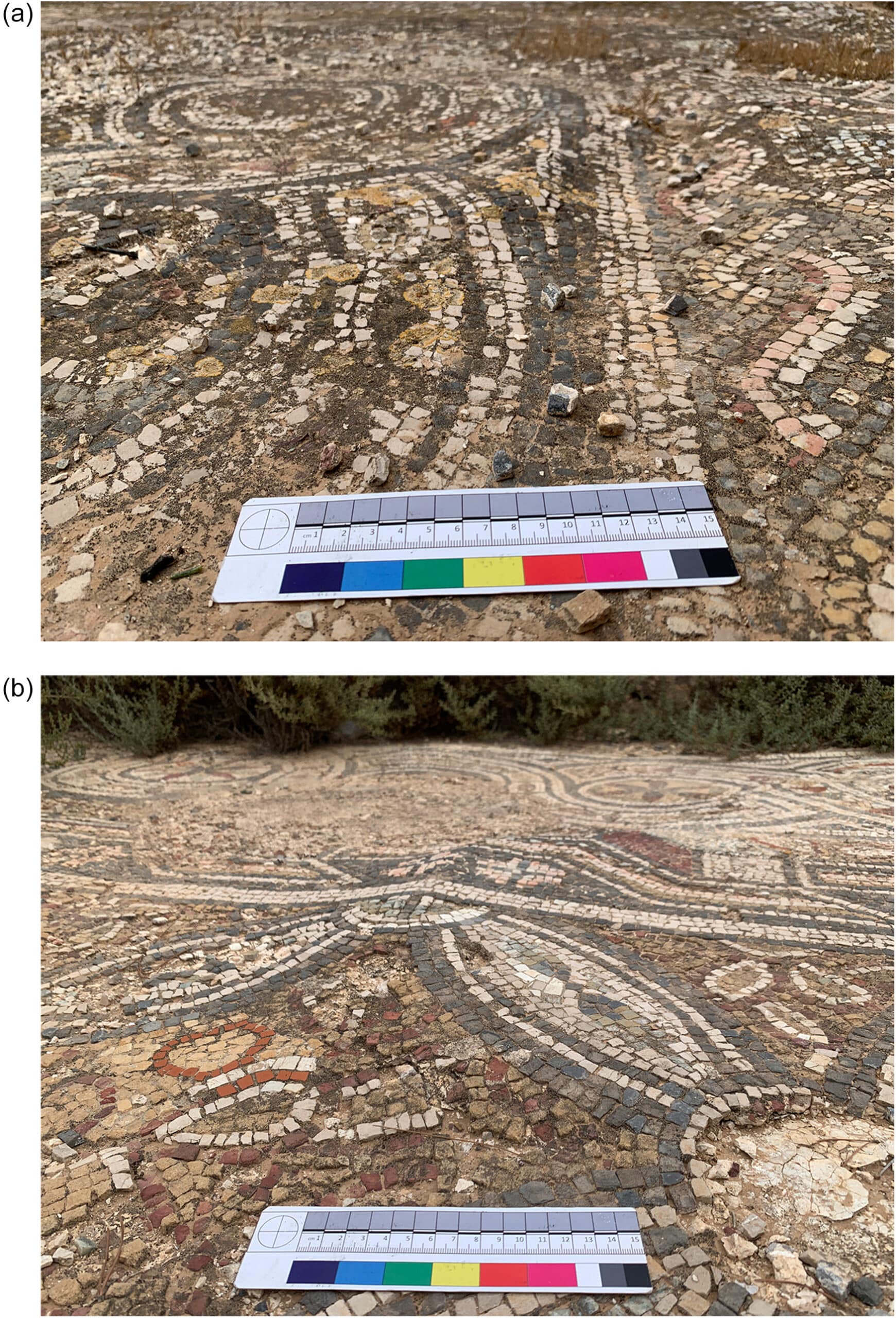
The baths contained cold, warm, and hot rooms arranged around a carefully planned route. Their interiors once featured wall paintings, stucco, sculpture, and elaborate mosaics. Similar discoveries elsewhere in the Roman world continue to reveal the elaborate design of ancient bathing facilities. Archaeologists recently excavated a Roman bath complex at the sunken city of Baiae, where an ancient mosaic floor remains preserved underwater.
The Sabratha floors belonged to at least two major decorative phases. Earlier mosaics largely used black-and-white patterns with some colored elements. Later floors featured more colorful geometric and plant designs. The building remained in use for roughly two centuries. Researchers believe it was abandoned in the mid-to-late fourth century, possibly following the powerful earthquake of A.D. 365.
Vegetation threatened fragile mosaic floors
Decades of exposure left many of the mosaics vulnerable. Researchers had already identified the baths as a strong candidate for reburial during conservation assessments in 2012 and 2013. Political instability in Libya prevented the original plan from moving forward. By 2024, the problem had become more serious. A salt-tolerant coastal shrub called Suaeda vera had spread across the complex. Its roots penetrated beneath and through parts of the mosaic floors.
Conservators found loose mosaic pieces, known as tesserae, along with sections where the decorated surface had detached and bulged upward. Some areas were so fragile that pressure from walking could have caused them to collapse. Workers carefully cut back the vegetation rather than pulling out the deep roots, which could have caused further damage. The team then fenced off the complex while preparing the reburial.
Protecting ancient mosaics often requires balancing conservation with public access. In Greece, authorities are pursuing a different approach at a Roman villa in Kefalonia, where plans include conserving mosaic floors and constructing a protective shelter.
Layers of soil, sand and gravel protect mosaics
Before covering the floors, researchers documented their condition and placed open-weave plastic netting over particularly fragile areas. Ceramic and wooden bowls and curved clay tiles protected bulging sections from the weight of the material placed above them. Workers then installed three protective layers. About 10 centimeters (3.9 inches) of local soil went directly above the mosaics, followed by roughly 35 centimeters (13.7 inches) of coarse sand and about 5 centimeters (5.9 inches) of gravel.
Ancient Roman mosaics in Libya have been reburied after years of exposure, vegetation growth and deterioration threatened their survival.
At Sabratha, researchers covered the fragile 1,800-year-old floors with protective layers of soil, sand and gravel to preserve them. pic.twitter.com/allUMMs2rv— Tom Marvolo Riddle (@tom_riddle2025) September 28, 2026
The completed covering reached about half a meter deep in the main rooms. Researchers designed the system to allow water to pass through while limiting vegetation growth. The layers can also be removed if specialists eventually return to conserve or study the mosaics.
Not every part of the baths could be treated. Fragile wall mosaics inside two basins were left exposed because the team could not obtain suitable materials for a safe support system. The decision highlights the different approaches available for protecting Roman mosaics. In Rome, conservation work recently allowed the public to see a massive Roman wall mosaic beneath the Baths of Trajan while archaeological work continues around it.
Nearly 122 tons of material moved in days
The operation cost about 18,000 Libyan dinars. Workers moved approximately 76 cubic meters of material, weighing an estimated 122 metric tons, into six rooms. Around 11 people worked at the site each day, including project members, Department of Antiquities staff, university students and local laborers. The project amounted to nearly 400 working hours but was completed in about four and a half days.
Researchers described the project as only the second documented mosaic reburial in Libya and the first in the Tripolitania region. The work also gave local heritage staff practical experience with a conservation method that could be used at other threatened sites.
The buried mosaics will now require regular monitoring. Officials will watch for vegetation, erosion and drainage problems. Researchers said severe rainfall since the intervention has not caused visible problems.
The team stressed that reburial does not permanently solve the mosaics’ conservation needs. The floors still require stabilization if expertise and funding become available. For now, however, covering them has substantially reduced their exposure to vegetation, weather, and human activity while preserving the possibility of future treatment.
See all the latest news from Greece and the world at Greekreporter.com. Contact our newsroom to report an update or send your story, photos and videos. Follow GR on Google News and subscribe here to our daily email!

