



Greece’s medieval past lives on in stone fortresses, ruined settlements, and traditional towns shaped by centuries of conflict and trade. Beyond the country’s best-known castle destinations, smaller communities preserve stories of Frankish lords, Byzantine rulers, Venetian merchants, and Ottoman armies.
These five destinations offer different ways to explore Greece’s castle heritage. Some grew around medieval fortresses, while others preserve the remains of settlements that once stood within their walls.
Geraki, Laconia
In southeastern Peloponnese, Geraki offers a glimpse into a medieval settlement that flourished around a fortified hilltop. The castle stands on Palaiokastro Hill, overlooking the plain and routes that once connected central Laconia with the eastern Peloponnese.
The fortress dates mainly to the 13th century, during the Frankish period. According to the Greek Ministry of Culture’s Castle Route project, the settlement developed around the castle and expanded along the slopes. Its remains include houses, churches, defensive structures, and traces of the medieval road network.
Geraki later came under Byzantine control and remained an important regional settlement during the Late Byzantine period. Its churches preserve evidence of the area’s religious and artistic life, including medieval wall paintings.
The castle and its abandoned settlement stand apart from the modern village. Together, they reveal how medieval communities adapted their homes, paths, and defenses to the steep landscape.

Vonitsa, Aetolia-Acarnania
Vonitsa stands on the southern shore of the Ambracian Gulf in western Greece. Its castle rises above the town and overlooks the natural harbor, a position that made the settlement strategically important for trade and military control.
Written sources mention Vonitsa as a regional center by the early 10th century. By the 12th century, it was described as a small fortified commercial city. Its location also connected it with maritime routes leading toward the Ionian Islands.
The castle developed through several historical periods. Its earliest phase dates to Byzantine times, while Venetian rulers made extensive changes to its defenses. Later Ottoman interventions added further layers to the fortress.
The surviving walls enclose several defensive zones, including towers, bastions, and gates. Buildings inside the castle also reflect its changing role over the centuries.
Today, the fortress dominates the town’s skyline and offers views across the gulf. Vonitsa’s history shows how a castle could protect a harbor, support commerce, and become the focus of rival powers.

Androusa, Messinia
Near the fertile Messenian plain in the southwestern Peloponnese, the Castle of Androusa preserves a significant chapter of the region’s Frankish history.
The Ephorate of Antiquities of Messenia identifies the castle with Guillaume II de Villehardouin, a Frankish prince who ruled in the 13th century. The fortress is mentioned in the Chronicle of the Morea, a medieval account of the Frankish presence in the Peloponnese.
Androusa reached its peak during the 14th century. Toward the end of that century, it served as a base for the Navarrese Company, a mercenary force active in the region. In the early 15th century, the castle came under the control of the rulers of Mystras before falling to the Ottomans.
Parts of its walls remain standing. The surviving fortifications include towers and sections of masonry decorated with blind arches and ceramic features. The shape of the walls follows the contours of the ground.
The castle stands near the village of Androusa rather than enclosing the entire modern settlement. Its remains nevertheless offer a tangible connection to the shifting political powers that shaped medieval Messinia.

Karytaina, Arcadia
Karytaina is one of the Peloponnese’s most striking historic settlements, with a medieval castle crowning a hill above its traditional houses. The fortress occupies a naturally defensive position near the Alpheios River valley, overlooking routes that connected Arcadia with neighboring regions.
The castle was built in the 13th century under Frankish rule. Geoffrey of Briel, the baron of Karytaina, is credited with its construction. The settlement became an administrative and commercial center, and a community developed around the fortress.
Karytaina later passed into Byzantine hands before the Ottomans conquered it in the 15th century. The town continued to serve as a regional agricultural and commercial hub under later rulers.
The castle also played a role during the Greek War of Independence. In 1826, Theodoros Kolokotronis repaired its defenses and used the fortress as a base during the struggle against Ibrahim Pasha’s campaign in the Peloponnese.
Today, the castle remains the settlement’s defining landmark. Its elevated position, traditional architecture, and surviving medieval structures make Karytaina a compelling destination for travelers interested in the history of the Peloponnese.
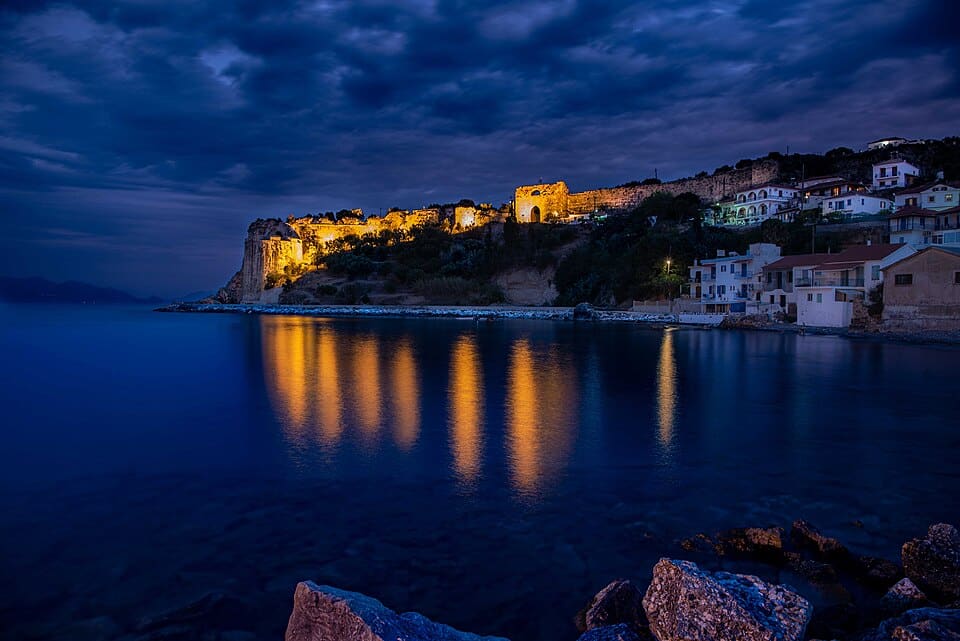
Koroni, Messinia
On the southwestern coast of the Peloponnese, Koroni combines a historic seaside town with one of Greece’s important medieval fortifications. Its castle occupies a peninsula overlooking the Messenian Gulf, a strategic position along maritime routes connecting the eastern Mediterranean.
The site has a long history of habitation. The castle’s earliest foundations date to the Byzantine period, and the Venetians captured the existing fortress in 1209. They rebuilt and strengthened it, turning Koroni into an important commercial port.
The Ottomans later modified the fortifications, adding to the layers of construction that remain visible today. The castle includes defensive walls, towers, bastions, and historic religious buildings. Parts of the complex are still used by the Monastery of Timios Prodromos.
Unlike abandoned hilltop fortresses, Koroni remains closely connected to a living coastal community. The town’s streets, harbor, and traditional buildings sit beneath the castle, giving visitors a sense of how military architecture and everyday life developed side by side.
Together, these five destinations show that Greece’s castle heritage extends far beyond its most famous landmarks. Each preserves a different relationship between fortification, settlement, and landscape, offering travelers a chance to discover the country’s medieval past through places that still bear its imprint.
See all the latest news from Greece and the world at Greekreporter.com. Contact our newsroom to report an update or send your story, photos and videos. Follow GR on Google News and subscribe here to our daily email!

