



Around August 27, people across Greece partake in the tradition of fanouropita, a cake also prepared by Greek communities around the world, to mark the feast of St. Fanourios, a martyr honored by the Orthodox Church.
For generations, believers have baked the cake as an offering, brought it to church to be blessed, and shared it with family, friends, and other worshippers. In popular devotion, the tradition is especially associated with prayers for something that has been lost to be revealed or found. The story behind St. Fanourios is more mysterious than the beloved custom might suggest, however. Much of what is known about him comes from his icon and later religious tradition, while some of the most popular stories about the saint cannot be established as historical fact.
A saint revealed by an icon
According to Orthodox tradition, the story of St. Fanourios begins with the discovery of his icon on Rhodes. The liturgical texts state that the year of his martyrdom is unknown and describe how his church and icon were found after his memory had been hidden and forgotten.
The icon is central to what little is known about the saint. It depicts Fanourios as a young man surrounded by scenes of torture and martyrdom, providing the primary visual basis for the traditional account of his life. There is little surviving written evidence about him from the time before devotion to the saint became established. Rhodes is therefore at the heart of the tradition surrounding St. Fanourios. The island remains closely associated with his name, and a medieval church dedicated to him still stands in the Old Town of Rhodes.

What do we actually know about him?
This is where history and tradition become difficult to separate. The historical evidence for St. Fanourios is limited, and there is no reliable contemporary biography establishing when or where he lived. The traditional account centers on Rhodes, where his icon was discovered, but scholars have proposed different dates and locations for the emergence of devotion to the saint.
Some sources have connected elements of his early veneration with Cyprus and Crete, while academic research has also examined manuscripts describing miracles attributed to Fanourios and the development of traditions surrounding him. As a result, the details that appear in traditional accounts of Fanourios’ life cannot all be treated as established historical fact.
The story of his mother
The most familiar story connected with fanouropita concerns the saint’s mother.
According to popular tradition, she was a sinful woman who treated others badly. After her death, Fanourios supposedly prayed for her salvation.
The story eventually became associated with the preparation of fanouropita, with believers making the cake in memory of the saint’s mother.
There is an important distinction, however: this is a religious tradition, not a documented episode that can be independently established as part of the saint’s historical biography.
The story remains deeply rooted in Greek popular devotion, but it should be presented as tradition rather than fact.
Why do believers make fanouropita?
Fanouropita is traditionally prepared in honor of St. Fanourios, with the cake serving as a food offering shared with others. Traditional recipes are typically plant-based, although ingredients vary between families and regions. Common versions include flour, oil, sugar, orange juice, cinnamon, raisins, and nuts. Some versions call for seven or nine ingredients, numbers that have acquired symbolic significance in popular tradition. However, there is no universal requirement from the Orthodox Church that fanouropita must contain a specific number of ingredients.
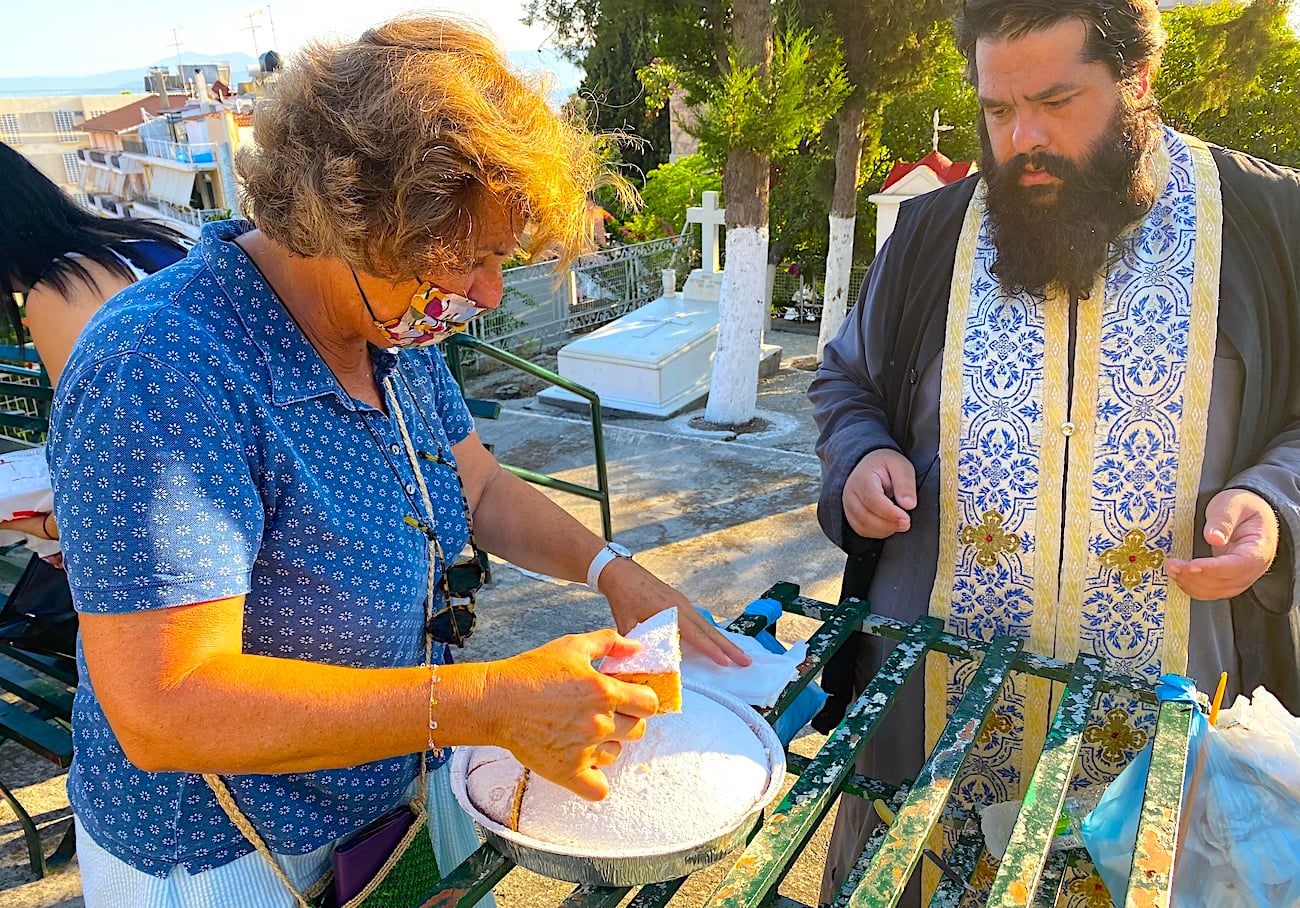
The emphasis is less on following a particular recipe than on the act of preparing, blessing, and sharing the cake. It is traditionally brought to church, where it is blessed before being distributed to family, friends, and other worshippers. In popular devotion, believers may also pray to St. Fanourios for help in finding something lost or for guidance when seeking a solution, opportunity, or way forward.
The tradition of the fanouropita: From Rhodes, Greece to the Greek diaspora
The tradition associated with St. Fanourios eventually spread far beyond Rhodes. The saint’s feast is now celebrated throughout Greece and in Greek Orthodox communities around the world. The August 27 liturgical service used by the Greek Orthodox Archdiocese of America commemorates him as St. Fanourios, the Newly-Revealed Martyr of Rhodes.
Fanouropita has consequently become much more than a local food custom. It is a familiar part of Greek Orthodox religious culture, including among families in the diaspora. For many families, making the cake is a tradition passed from one generation to the next.
@user329613009637
Where history meets tradition: The fanouropita tradition of Greece
The story of St. Fanourios is unusual because so much of his popular identity evolved around an icon and the traditions that grew from it. While the historical record leaves many questions about the saint unanswered, those uncertainties have not diminished his place in religious life. Stories about his mother, the belief that he can help reveal lost possessions, and customs surrounding fanouropita have all become part of the tradition associated with his name.
For generations, believers in Greece and Greek Orthodox communities around the world have prepared fanouropita, brought it to church, and shared it with others in his honor. Whether rooted in documented history or popular devotion, the traditions surrounding St. Fanourios have endured, bringing together faith, folklore, and the communal traditions of Greek food.
See all the latest news from Greece and the world at Greekreporter.com. Contact our newsroom to report an update or send your story, photos and videos. Follow GR on Google News and subscribe here to our daily email!

