



For centuries, the fall of Constantinople has invited one of history’s greatest questions. What if the city had survived?
On May 29, 1453, the army of Ottoman Sultan Mehmed II captured Constantinople after a siege that had begun in April. Byzantine Emperor Constantine XI Palaiologos was killed, and the last capital of the Roman Empire passed into Ottoman hands. The event ended an imperial history stretching back more than 1,100 years.
But the outcome was not necessarily as inevitable as later generations sometimes imagined.
A major new study of the siege by historian Anthony Kaldellis argues that the defenders themselves believed survival was possible and that the final Ottoman victory emerged from a hard-fought and contingent struggle rather than the simple collapse of a civilization already doomed to disappear. The city’s defenses held for weeks, and the final assault followed a costly campaign that had also created pressures inside the Ottoman camp.
So what if one or two things had gone differently?
What if more Western ships had arrived? What if the city’s defenders had held the breached section of the walls? What if Giovanni Giustiniani, the Genoese commander whose withdrawal after being wounded helped trigger panic among the defenders, had remained in the fight?
Constantinople might have survived 1453.
But that does not mean the Byzantine Empire would suddenly have returned to the power it possessed under Justinian or the Macedonian emperors. By the middle of the fifteenth century, the empire had been reduced to a small and politically fragile state centered on Constantinople, parts of Greece and the Peloponnese, while other Byzantine polities such as Trebizond remained independent.
The more fascinating question, then, is not whether Byzantium could have been magically restored.
It is this: Could the survival of Constantinople have changed the history of the Ottoman Empire, the Orthodox world, Renaissance Europe and the eastern Mediterranean?
The answer is almost certainly yes.
Related: Why Constantinople’s Fall Was Not Inevitable
The First and Most Realistic Possibility: Constantinople Survives the Siege

A counterfactual history has to begin with a plausible point of divergence. Fortunately, 1453 provides one.
The final Ottoman victory came after weeks of bombardment, assaults, naval operations and attempts to break the defenses. Constantinople was badly outnumbered, but the city was not simply swept aside. The defenders repeatedly resisted Ottoman attacks, while Mehmed II had committed enormous military and logistical resources to the campaign.
One of the pivotal moments came during the final assault when Giovanni Giustiniani, a Genoese commander responsible for a crucial section of the land defenses, was wounded and withdrew. Contemporary and later accounts differ in important details, and historians continue to debate aspects of the siege, but Giustiniani’s departure clearly became associated with a collapse in morale and the unraveling of the defense in that sector.
Imagine, instead, that the defenders held.
Perhaps Giustiniani was not wounded. Perhaps the Ottoman attack failed to exploit the confusion. Perhaps a Venetian or other Western relief force arrived at a critical moment.
None of these scenarios requires science fiction.
Constantinople had survived Ottoman sieges before. It had resisted attacks in 1411 and 1422, and the failure of those earlier attempts demonstrates why 1453 should not automatically be treated as a foregone conclusion.
If Mehmed’s final assault had failed, he would have faced a difficult choice: continue an expensive siege or withdraw and try again later.
A retreat would not have ended the Ottoman threat. But it could have bought Constantinople something it desperately needed: time.
A Surviving Byzantine Empire Would Still Have Been Extremely Weak
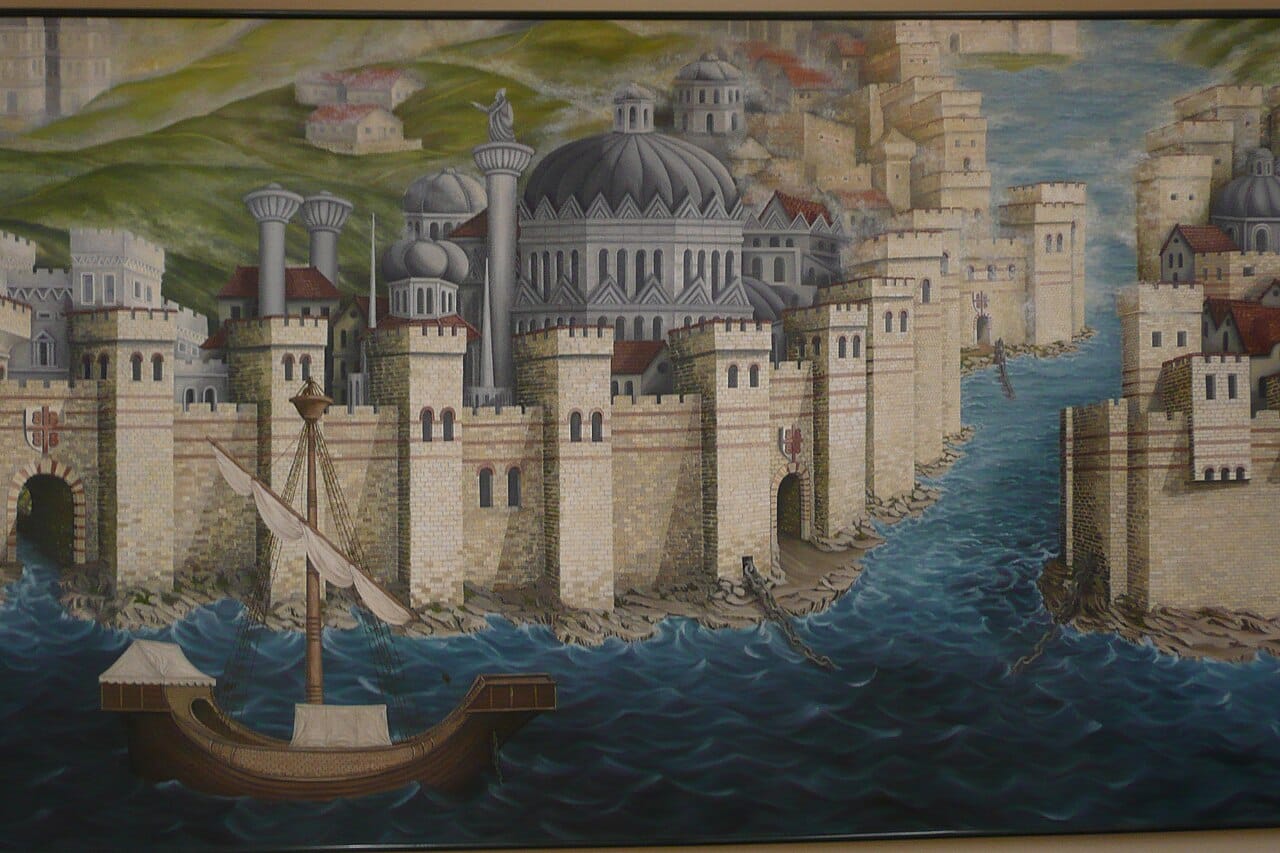
Here is where alternate history can easily become fantasy. A Byzantine victory in 1453 would not have instantly restored the empire’s lost provinces.
By then, the political geography of Byzantium had been transformed. The empire that once controlled much of the Mediterranean world had been reduced dramatically. Constantinople remained immensely important symbolically, strategically and culturally, but the Palaiologan state did not possess the resources needed to challenge the Ottomans across Anatolia or reconstruct the empire of earlier centuries.
The city itself had also declined significantly from its medieval peak. The Metropolitan Museum of Art notes that its population had fallen to around 50,000 by the time of the Ottoman conquest, after centuries of war, economic decline and demographic catastrophe.
So the most plausible alternate future is not “Byzantium conquers the world again.”
It is a smaller, precarious Roman state surviving at the crossroads between Europe and Asia.
And that alone could have changed a great deal.
Could Constantinople Have Become a Buffer Between Europe and the Ottoman Empire?

A surviving Constantinople would have remained an obstacle at one of the most strategically important points in the world.
The city controlled the Bosporus and sat at the intersection of European, Black Sea and Mediterranean networks. Mehmed II wanted it not simply as a trophy but as a strategic and imperial center.
Indeed, the Ottoman conquest transformed Constantinople into a major capital. Under Ottoman rule, the city recovered population and commercial importance, while Mehmed II also positioned himself within the political legacy of Rome.
If the city had remained Byzantine, the Ottomans would have lacked that particular imperial prize.
That does not mean Ottoman expansion would have stopped.
The Ottoman state was already a major power before 1453, and Mehmed possessed military, financial and administrative resources far beyond those available to Constantine XI. But a surviving Byzantine Constantinople could have complicated Ottoman strategy and diplomacy for decades.
It might have remained a Christian enclave surrounded by Ottoman territory—economically dependent, militarily vulnerable, but strategically impossible to ignore.
In that scenario, Western European powers might also have had stronger reasons to maintain relations with Constantinople.
The great irony of 1453 was that Western support existed but was divided, delayed and insufficient. Venice, Genoa, the papacy and other powers all had their own interests, conflicts and calculations.
If the city had survived once against the odds, its continued existence could have become a permanent diplomatic problem for both Christian Europe and the Ottomans.
The Fate of Greece Might Have Been Different—But Not Necessarily Free

The survival of Constantinople would also have raised an immediate question about the Byzantine territories still remaining in Greece.
The Despotate of the Morea in the Peloponnese survived the fall of Constantinople only briefly, before Ottoman conquest in 1460. The Empire of Trebizond followed in 1461.
If Constantinople had successfully resisted Mehmed II, could the Morea have survived longer? Possibly.
A living imperial capital would have provided greater legitimacy and a political center for resistance. More coordinated diplomacy might have been possible, particularly with Venice and other maritime powers that had direct interests in Greece and the eastern Mediterranean.
But there is no reason to assume that Greece would have become an independent Byzantine kingdom.
The Ottomans were powerful, organized and still expanding. The Morea itself faced internal divisions and limited resources. A surviving Constantinople might have delayed Ottoman control over parts of the Greek world without preventing it forever.
The most realistic alternative may therefore be a longer Byzantine afterlife rather than a miraculous Byzantine restoration.
And history has shown that longer survival can matter enormously. A state that survives for another 20, 50 or 100 years can produce entirely different alliances, dynasties and cultural institutions.
Would the Renaissance Have Been Different?
One of the most repeated claims about 1453 is that the fall of Constantinople caused Greek scholars to flee westward and ignite the Renaissance.
The reality is more complicated.
The transmission of Greek learning to Western Europe was already underway before 1453. Italian scholars had been studying Greek texts, Byzantine intellectuals had traveled west, and the Council of Florence had brought Byzantine and Western scholars into direct contact years before the final fall. The cultural exchange between Byzantium and Italy was therefore not suddenly created by Mehmed’s conquest.
At the same time, the fall and its aftermath did contribute to the movement of people, manuscripts and knowledge.
The question is not whether the Renaissance would have happened without 1453. It almost certainly would have. The better question is whether it would have developed differently.
A surviving Constantinople might have remained a major center for Greek scholarship, manuscript preservation and intellectual exchange. Rather than accelerating the movement of some scholars and texts westward through displacement, Europe might have developed an even longer period of direct exchange with a living Byzantine capital.
The Greek intellectual world would not have disappeared either way.
But its geographic center might have remained partly in Constantinople instead of shifting more decisively into other political and cultural environments.
What About the Orthodox World?

This may have been one of the most profound consequences.
After the fall of Constantinople, the political center of the Byzantine Empire disappeared, although the Ecumenical Patriarchate continued under Ottoman rule. Byzantine religious and cultural influence, however, had long extended beyond the empire’s shrinking borders.
A surviving Constantinople could have remained an independent—or semi-independent—center of Orthodox political authority.
That might have affected relations with the Serbian, Bulgarian, Romanian, Georgian and Russian worlds.
Russia’s later development of the idea of Moscow as a “Third Rome” cannot simply be reduced to the fall of Constantinople; religious, political and dynastic factors were involved. But a living Roman emperor in Constantinople would have changed the symbolic landscape in which such claims developed.
The Orthodox world might still have become increasingly decentralized.
But it would have had something it lost in 1453: an independent imperial capital that could claim direct continuity with the Roman Empire.
The Ottoman Empire Would Have Been Different, Too
Perhaps the biggest mistake in imagining an alternate 1453 is to focus only on the Byzantines.
Constantinople’s fall also transformed the Ottoman Empire.
The city became its great imperial capital and a center from which the Ottomans projected power across southeastern Europe, Anatolia and the Mediterranean. The conquest also allowed Mehmed II to present himself in a broader Roman imperial tradition.
If the city had survived, Mehmed would still have ruled one of the most formidable states of the fifteenth century.
He might simply have returned later. Or he might have shifted greater attention elsewhere before trying again under more favorable conditions.
Either path could have changed the sequence of Ottoman expansion. That is an important distinction.
Counterfactual history cannot reliably tell us that the Ottomans would have become weaker, that Europe would have become stronger, or that a surviving Byzantium would have created a completely different modern world.
What it can do is reveal how many later developments were connected to a single strategic outcome.
The Ottoman Empire that emerged after 1453 was not exactly the same empire that existed before it.
Constantinople helped make it an imperial capital on a different scale.
The Most Dramatic Possibility: Constantinople Survives and Becomes a New Kind of State
The strangest—and perhaps most plausible—long-term scenario is that Byzantium would not really have been restored at all.
Instead, Constantinople might have evolved.
The old empire had already survived profound transformations. It had lost territories, recovered from catastrophe, endured civil wars and survived the Latin conquest of 1204 before Byzantine rule was restored in the city in 1261.
If it had survived 1453, the next phase might have produced something closer to a hybrid city-state, dependent on trade, diplomacy and naval alliances.
Imagine a Christian Constantinople functioning like a heavily fortified international port: politically Roman and Orthodox, economically connected to Italian merchants and Mediterranean networks, and permanently negotiating its survival with the Ottoman state around it.
It would have been a very different Byzantium from the empire of Justinian. But it might still have called itself Roman.
And that raises the deepest counterfactual question of all.
What If the Roman Empire Had Never Actually Ended?

The fall of Constantinople is usually described as the end of the Byzantine Empire.
But the people who ruled from Constantinople did not call themselves “Byzantines.” They were Romans, heirs to an empire whose capital had moved east more than a thousand years earlier.
If Constantine XI’s city had survived Mehmed II’s assault in 1453, the Roman state might have continued—perhaps weakened, transformed and reduced to a fraction of its former territory, but still alive.
The history books might not have a clean date for the end of Byzantium. Instead of 1453, students might remember another year. Or perhaps no single year at all.
That is why the fall of Constantinople remains such a powerful “what if.”
The alternative is not a fantasy in which Byzantium suddenly returns to its former glory and rewrites the entire history of Europe.
The more plausible possibility is, in some ways, more extraordinary.
A single failed Ottoman assault might have preserved a dying empire long enough for it to become something new.
And if Constantinople had survived, the map of the Mediterranean—and perhaps the very idea of where Rome ended—might have looked very different.
What We Can—and Cannot—Know
No historian can prove what would have happened if Constantinople had survived. Counterfactual history is not a prediction.
But 1453 is a particularly revealing moment because the fall was the result of identifiable military, diplomatic and human events—not an abstract law of history. Recent scholarship has explicitly challenged the simplistic idea that Constantinople’s defeat was inevitable, while also emphasizing the city’s severe material weaknesses and the extraordinary resources committed by Mehmed II.
The evidence supports a cautious conclusion.
Constantinople could plausibly have survived the siege of 1453. What it could not plausibly have done was return overnight to the age of Justinian.
Its survival would have created possibilities, not certainties: a longer Byzantine political existence, a different Ottoman strategic path, a surviving imperial center for the Orthodox world and perhaps a radically altered relationship between Greece, the Balkans, Russia and the Mediterranean.
In other words, Constantinople did not have to conquer the future. It may only have needed to survive one more day to change it.
See all the latest news from Greece and the world at Greekreporter.com. Contact our newsroom to report an update or send your story, photos and videos. Follow GR on Google News and subscribe here to our daily email!

