



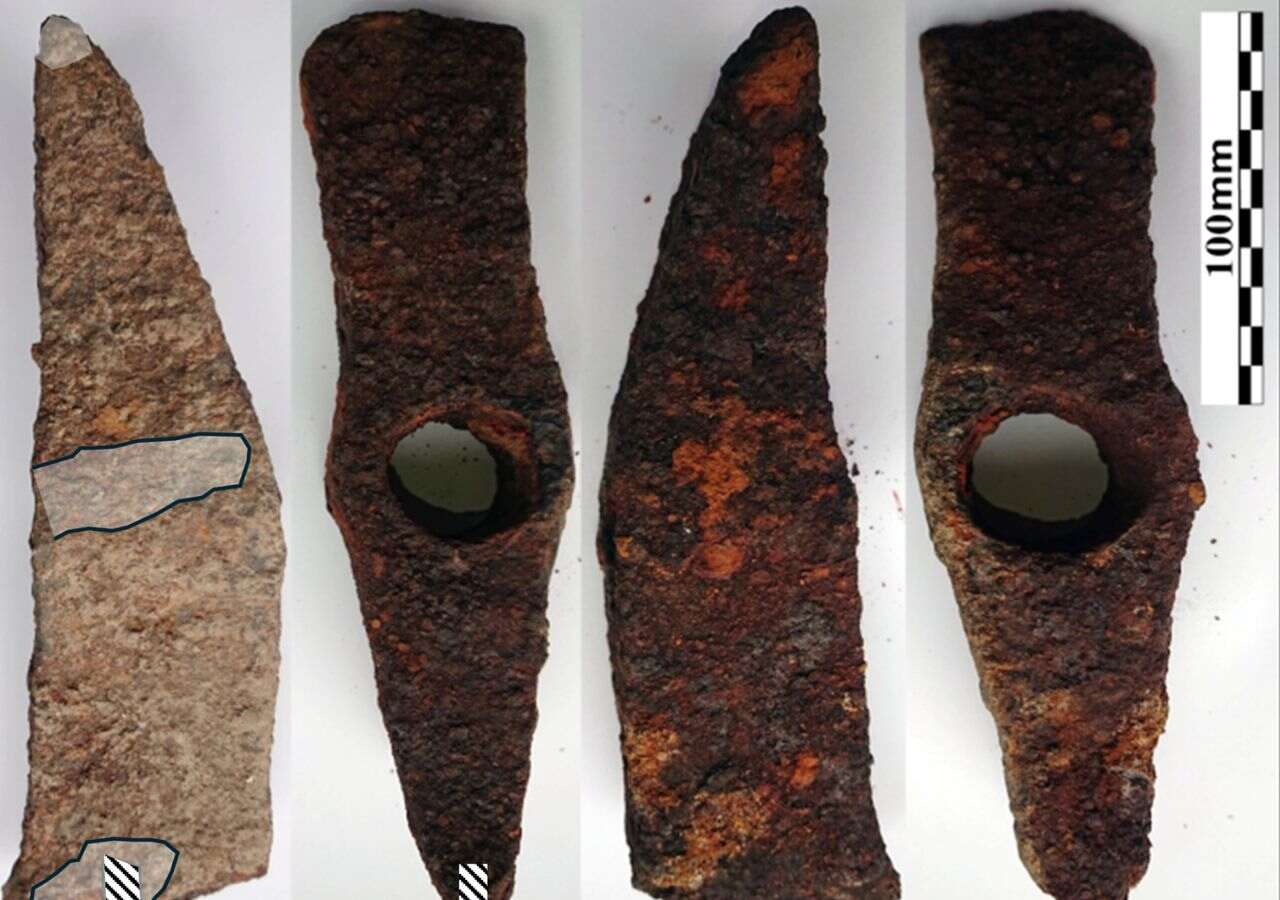
Two Iron Age axes, found thousands of miles apart, are giving researchers new insight into how ancient metalworking methods differed from one region to another.
A study comparing axes from Kazakhstan and northern Germany found that despite dating to roughly the same era, the tools were built using very different iron-making techniques, according to research published in the journal Radiocarbon.
The study was led by Matthias Christian Hüls of the Leibniz-Laboratory for Radiometric Dating and Isotope Research at Kiel University in Germany.
Since iron tools rarely carry visible signs of age, Hüls used radiocarbon dating on carbon trapped inside the metal itself, paired with microscopic and chemical testing, to pin down when each axe was made and how it was produced.
Ancient Kazakh burial mound hides a surprisingly advanced blade
One artifact, known as the Kyzylzhartas Axe-Adze, was unearthed in 2020 from a burial mound in the Karaganda region of Kazakhstan. Testing placed its origin between 357 and 164 BC, a few centuries after the burial site itself was first used.
That gap suggests the axe may have been left behind later, possibly when a neighboring burial mound was being built nearby.

Closer inspection showed that whoever forged the Kazakh axe combined two types of iron on purpose, using softer metal near the handle and harder, carbon-rich iron along the cutting edges. The blades were also heat-treated to make them stronger.
Chemical analysis of leftover slag, a byproduct of the smelting process, showed the iron had been refined with unusual efficiency, a level of quality not typically seen in Europe until the medieval period.
Iron Age axes reveal two very different paths of metalworking
The second artifact, the Högersdorf Axe, was recovered near the town of Bad Segeberg in northern Germany as part of a small collection of similar tools. It dated to between 340 and 53 BC.
Unlike its Kazakh counterpart, this axe was made from softer, phosphorus-rich iron, likely drawn from local bog iron ore found near rivers and wetlands in the region. The smelting process behind it appeared far less efficient, and the metal itself was noticeably softer.
Hüls said the findings highlight how ancient communities that lived during the same broad time period could rely on very different levels of metalworking skill, shaped largely by the resources available to them locally.
The Kazakh toolmakers appear to have had access to more advanced smelting knowledge, while the German axe reflects a simpler, resource-driven approach.
Researchers noted that both axes remain a small sample, but they offer a rare side-by-side look at how geography and material access shaped ironworking traditions across the ancient world.
See all the latest news from Greece and the world at Greekreporter.com. Contact our newsroom to report an update or send your story, photos and videos. Follow GR on Google News and subscribe here to our daily email!

