



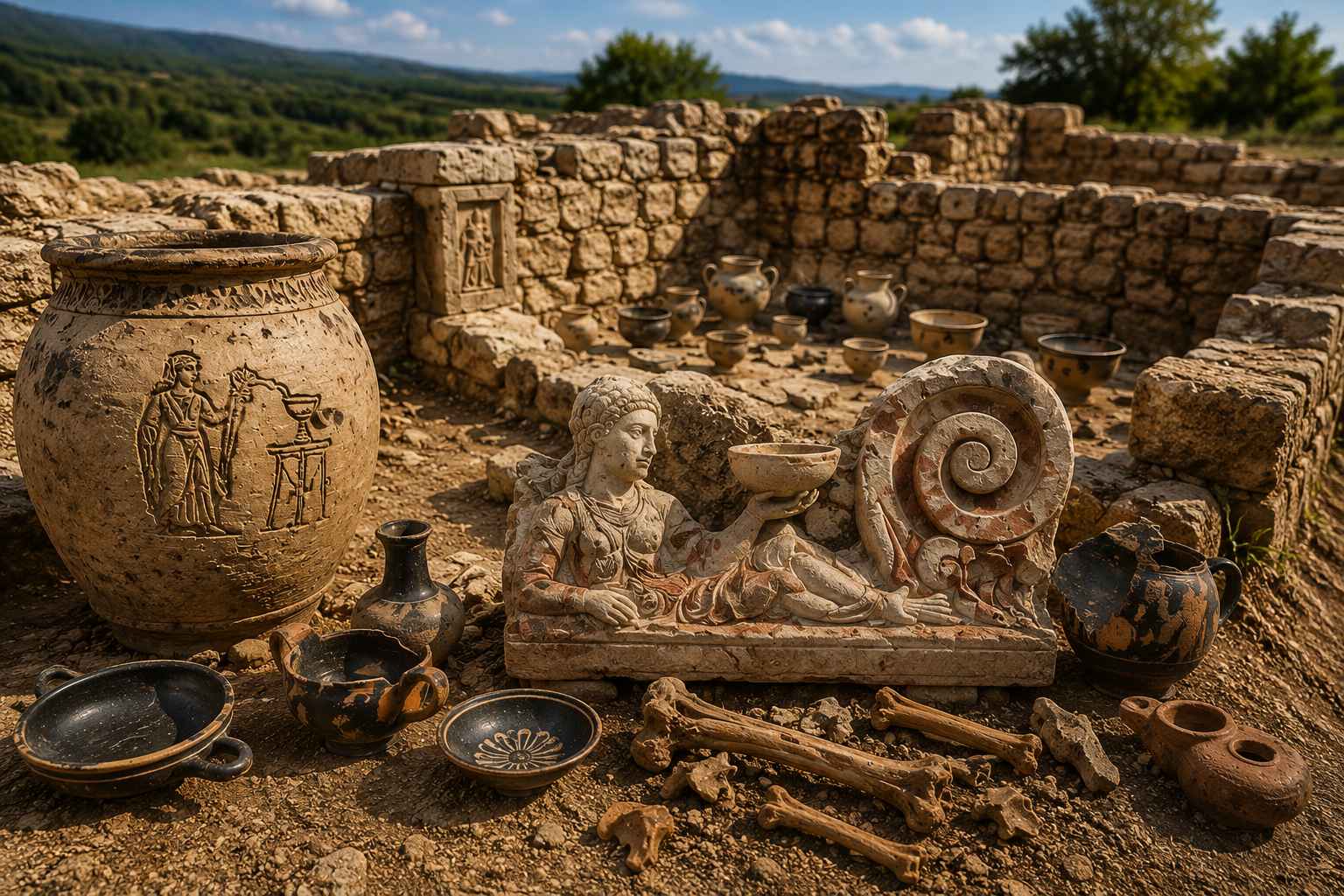
Archaeologists have uncovered a rare Hellenistic feast hall at the ancient settlement of modern-day Gradište in North Macedonia, where ritual banquets, religious offerings, and ceremonial drinking may have taken place more than 2,300 years ago.
The excavation also revealed a stamped image of a female deity believed to represent Greek goddess Demeter, offering new evidence that the site may have served as an important religious center during the Hellenistic period.
The discoveries were made on the Lower Terrace of the settlement near the village of Mlado Nagoričane. Archaeologists uncovered a possible sacred enclosure wall, buildings containing ritual and storage vessels, imported tableware, animal bones, and exceptionally rare fragments of an elaborately decorated ceremonial dining couch.
Together, the finds suggest the terrace functioned as a carefully organized sacred precinct rather than an ordinary residential neighborhood.
Ritual objects point to possible Demeter cult
One of the excavation’s most significant discoveries is a large pithos, or storage jar, stamped with the image of a female deity believed to represent Demeter, the Greek goddess of agriculture and fertility.
The figure holds a cornucopia, a symbol of abundance, while pouring a ritual libation from a kantharos, a two-handled drinking cup, onto a tripod.
Although researchers have not confirmed the deity’s identity, the imagery strongly supports the interpretation that the area served as a place of worship.
Nearby, archaeologists uncovered part of a wall that may have formed a peribolos, enclosing a sacred precinct, or temenos. While no temple has yet been identified, the layout of the buildings suggests religious ceremonies were carried out within a clearly defined sacred space.
Feast hall preserves evidence of ritual banquets
Near the possible enclosure wall, archaeologists excavated a small room that appears to have served as a ceremonial feast hall. Inside, they found the bones of wild boar, goats and other animals alongside a large collection of imported Hellenistic tableware.
The pottery includes West Slope kantharoi, a guttus, black-glazed echinus bowls, amphorae, hydriai, oil lamps and fragments of terracotta figurines.
The combination of animal remains, drinking vessels and fine tableware suggests ritual feasts played a central role in ceremonies performed at the site.
Archaeologists in North Macedonia have uncovered a rare 2,300-year-old Hellenistic feast hall that may have hosted ritual banquets linked to the worship of Demeter. pic.twitter.com/plf0ANnIBN
— Tom Marvolo Riddle (@tom_riddle2025) July 21, 2026
Researchers believe the room formed part of a larger ceremonial complex where purification rites, offerings, libations and communal meals took place. Its layout has been compared with ritual dining spaces at the Sanctuary of Demeter and Persephone in ancient Corinth.
Among the excavation’s most remarkable finds were fragments of an elaborately decorated kline, a ceremonial dining couch, and the remains of a built stone table base. One decorative appliqué depicts a reclining deity holding a phiale, a shallow vessel used for ritual offerings.
Comparable couch decorations are known mainly from wealthy Hellenistic tombs at Pella and the royal burial complex at Aigai, two major centers of the ancient Macedonian world. Unlike those lavish settings, however, the Gradište fragments were recovered from a relatively modest room, suggesting its importance lay in the ceremonies held there rather than its architecture.
Sacred precinct expands Gradište’s history
Previous excavations at Gradište uncovered a large building arranged around a peristyle courtyard with painted plaster walls, imported amphorae and finely crafted pottery.
The newly uncovered feast hall adds an important religious dimension to that picture. The possible image of Demeter, together with votive vessels, imported banquet ware, animal remains and luxury ceremonial furnishings, points to a well-organized ritual tradition that may have brought together members of the local elite and the wider community.
Future excavations will focus on exposing the remaining buildings on the Lower Terrace and determining whether a temple once stood within the sacred precinct. Researchers also hope to clarify how the enclosure wall, feast hall and surrounding structures were connected.
See all the latest news from Greece and the world at Greekreporter.com. Contact our newsroom to report an update or send your story, photos and videos. Follow GR on Google News and subscribe here to our daily email!

