



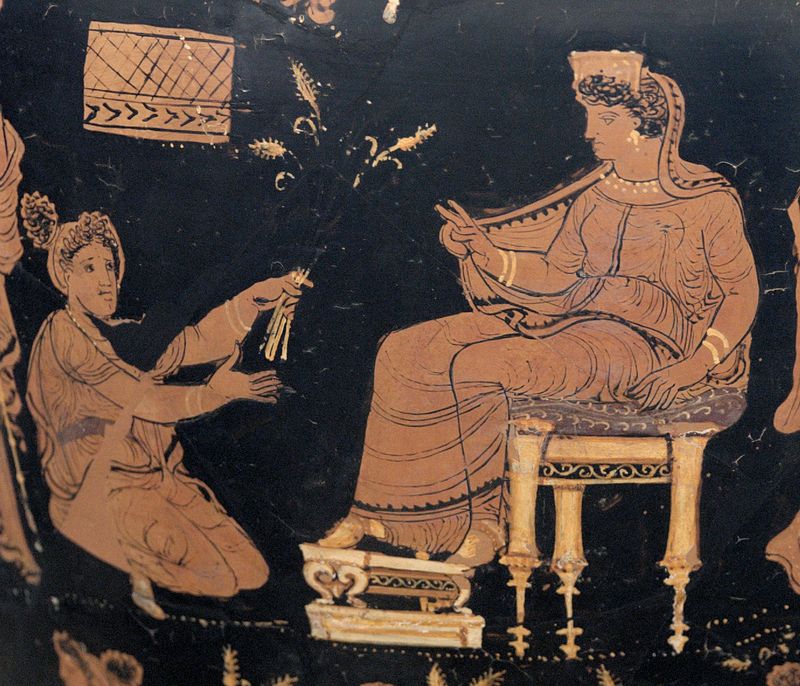
For more than a millennium, thousands of travelers from every corner of the ancient world journeyed down the Sacred Way with a singular purpose: to reach Eleusis and undergo initiation into the Eleusinian Mysteries. Philosophers, emperors, and everyday citizens walked out of the Telesterion (the great initiation hall) profoundly changed, allegedly stripped of their fear of death.
What exactly they witnessed or experienced remains antiquity’s greatest secret. However, sixteen centuries after the rituals were banned, one of the most fiercely debated questions surrounding the ceremony appears to have finally found its scientific answer inside a Greek laboratory.
The Kykeon and the “Ancient LSD” Theory
Before the initiation reached its climax, participants drank the Kykeon, a ritual beverage traditionally made of barley, water, and pennyroyal. The catch? Barley crops are frequently infected by ergot (Claviceps purpurea), a fungus containing alkaloids from the exact same chemical family as modern LSD.
In 1978, Albert Hofmann, the Swiss chemist who famously discovered LSD,co-authored a theory suggesting that the Kykeon contained psychoactive substances derived from this very fungus. However, his hypothesis faced a massive roadblock because raw ergot is highly toxic and even lethal for humans. How could the ancients consume it without mass poisonings? Lacking a chemical explanation, Hofmann’s theory was largely shelved as speculation.
Cracking the code at the University of Athens
Nearly half a century later, the Laboratory of Pharmacognosy at the National and Kapodistrian University of Athens (NKUA) picked up the trail. A research team consisting of Evangelos Dadiotis and Romanos Antonopoulos, led by Professor Prokopios Magiatis, decided to experimentally test a compelling hypothesis: what happens if the toxic fungus is treated with “alysiva” (potash water/wood ash lye), a basic cleaning and cooking agent ubiquitous in antiquity?
After months of exhaustive laboratory experiments and chemical analyses, the results were groundbreaking. Treating the ergot fungus with alkaline ash water triggered a chemical reaction that isolated ergine (LSA), a potent psychoactive compound. Even more impressive was that the exact same process entirely neutralized the fungus’s lethal toxicity.
“For us, the question wasn’t simply whether ancient people were taking LSD,” Magiatis explains. “The question was whether the theory that the Kykeon could produce safe, psychoactive effects had a legitimate basis in chemistry. We have now proven that this chemical pathway is absolutely feasible.”
Archaeological confirmation
This striking chemical discovery aligns perfectly with recent archaeological breakthroughs. In Ancient Empúries (a Greek colony in modern-day Spain), researchers analyzing vessels associated with the worship of the Eleusinian deities uncovered physical traces of these exact ergot alkaloids. The find provides undeniable material evidence that Ancient Greeks were actively handling and using these substances within a ritual context.
The NKUA study, officially published in the prestigious journal Scientific Reports, is already making waves globally. Thousands of years later, Eleusis continues to fascinate, revealing ancient secrets on the depths of human consciousness through the lens of modern science.
See all the latest news from Greece and the world at Greekreporter.com. Contact our newsroom to report an update or send your story, photos and videos. Follow GR on Google News and subscribe here to our daily email!

