



If you know anything about Byzantine history and Thessaloniki, that date, August 1185, should mean something to you.
This date marks one of those moments when everything went spectacularly, tragically wrong for the empire’s crown jewel city, the second-greatest after Constantinople. The Norman invaders sacked Thessaloniki in one of the most brutal incidents of medieval warfare in history.
This relatively unknown historical event captured the essence of an entire era’s problems. It was not just a spectacular military defeat for the Byzantines, but also a perfect storm where Byzantine weakness and advancing Norman ambition met, with catastrophic results for this important European city.
How everything led to the Norman victory over Thessaloniki
To understand what happened, we need to think about the state of the Byzantine Empire in the 1180s. Andronikos I Komnenos was the emperor, but his reign has never been described as particularly efficient. The situation was dire. Andronikos has been described as paranoid, who used political purges in an almost mundane manner. Constantinople’s aristocracy hated him, the military didn’t trust him, and the empire felt as if it was on the verge of disaster.
Meanwhile, across the other side of the Ionian Sea in Sicily, William II was watching all this chaos unfold. Norman rulers had always been opportunistic (as this was their defining characteristic), and William saw his chance against the once-powerful Eastern Roman Empire. William saw an empire tearing itself apart from within, with one of the richest cities in the Mediterranean world just waiting to be conquered.
The Norman preparations were impressive, as William assembled a substantial fleet and army. When they landed and began their march on Thessaloniki, everyone in the region knew what was coming…
Except for the people who were supposed to defend the city.
When Byzantine leadership failed Thessaloniki
David Komnenos, the governor of Thessaloniki, had one job: prepare the empire’s second-largest city for a siege that everyone could see coming. Instead, he did everything else but organise the defences of his city.
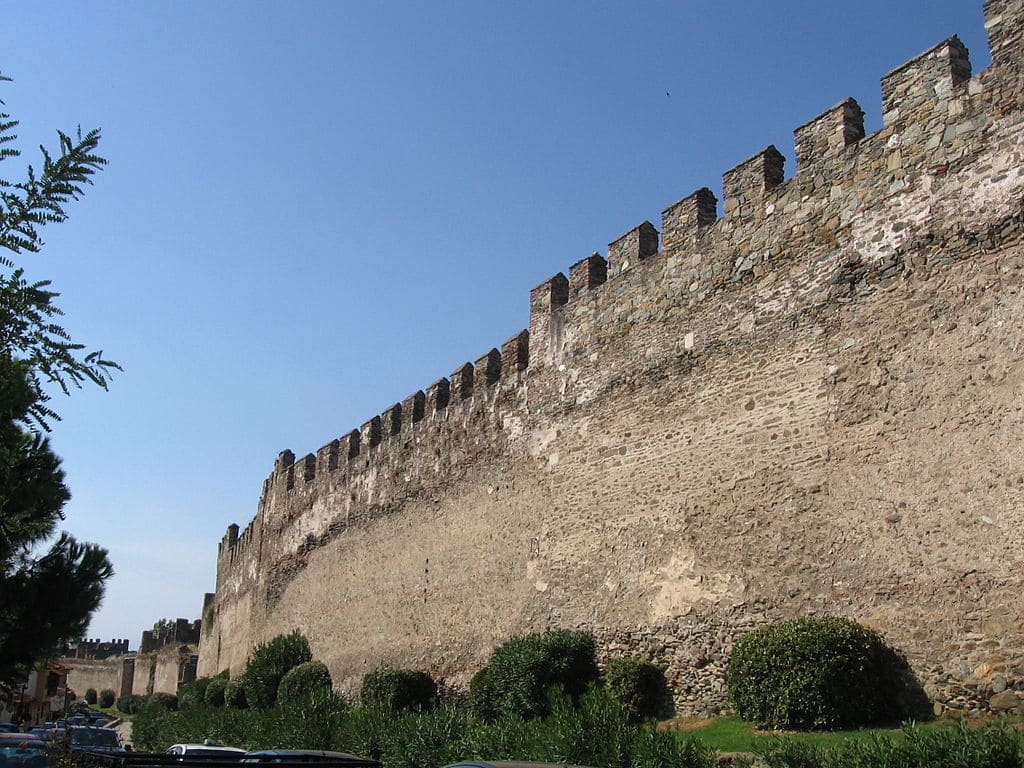
The walls of Thessaloniki were substantial fortifications that should have been able to hold off the Norman assault. But walls don’t defend themselves. They need competent leadership, proper supplies, and troops who believe their commanders know what they’re doing. Unfortunately, Thessaloniki lacked these things at the time.
Nine days of hell
The siege began on August 15th, 1185. For nine days, the Normans battered the walls while the defenders tried desperately to hold them with whatever means they had. Then, on August 24th, the walls were breached.
What happened next is documented in first-hand accounts from a direct witness: Eustathius, the Archbishop of Thessaloniki. His account is one of the most harrowing pieces of medieval writing, partly because it conveys Eustathius’ shock and horror at the events.
The Normans captured the city and systematically destroyed it. Eustathius describes scenes that sound more like something from the twentieth century and World War II than the twelfth century in medieval Europe: mass killings of civilians, the deliberate destruction of churches, the burning of libraries and workshops in a clear attempt to destroy everything.
Children were being killed alongside adults, elderly people murdered in their beds, priests murdered at their altars. The Normans seemed to be destroying things simply because they could, rather than following a grand strategy of intimidation.

What made 1185 different from other medieval sieges was that it genuinely felt like a turning point. The Byzantine Empire had suffered military defeats before—that’s just part of being an empire in a violent world. But the sack of Thessaloniki exposed something deeper and more troubling for the Byzantines.
For one thing, it revealed just how fragile the empire’s defences had become after centuries of wars. Thessaloniki was supposed to be defendable by any competent garrison. The fact that it fell so easily sent shockwaves throughout the empire.
Additionally, there was something symbolic about what happened. Thessaloniki wasn’t just an administrative centre somewhere in the empire—it was a cultural hub, a place where Greek learning and Byzantine traditions were kept alive. When the Normans destroyed its libraries and workshops, they were attacking the very idea of Byzantine civilisation.
The aftermath
The city was eventually retaken by the Byzantines, of course. The Normans couldn’t hold it indefinitely, and Byzantine forces did manage to regroup and drive them out. But the damage was fundamental.
For the people of Thessaloniki, 1185 became a collective trauma. Stories of the siege were passed down through generations, becoming part of the city’s collective memory. Even today, if you know where to look, you can find traces of how that event shaped the city’s identity.
For the broader Byzantine world, the sack was a preview of worse things to come. The Fourth Crusade was still twenty years in the future. However, the patterns were already there: internal weakness, external opportunism, and the growing hostility between the Greek East and Latin West that would eventually tear the empire apart.
Yes, the walls were rebuilt, stronger than before. The city recovered, eventually becoming one of the great centers of late Byzantine culture. But 1185 left a mark that never really faded until the fall of the Empire in 1453. It was proof that even the greatest cities can suffer when a combination of internal decay and external pressure takes the upper hand.
See all the latest news from Greece and the world at Greekreporter.com. Contact our newsroom to report an update or send your story, photos and videos. Follow GR on Google News and subscribe here to our daily email!

