



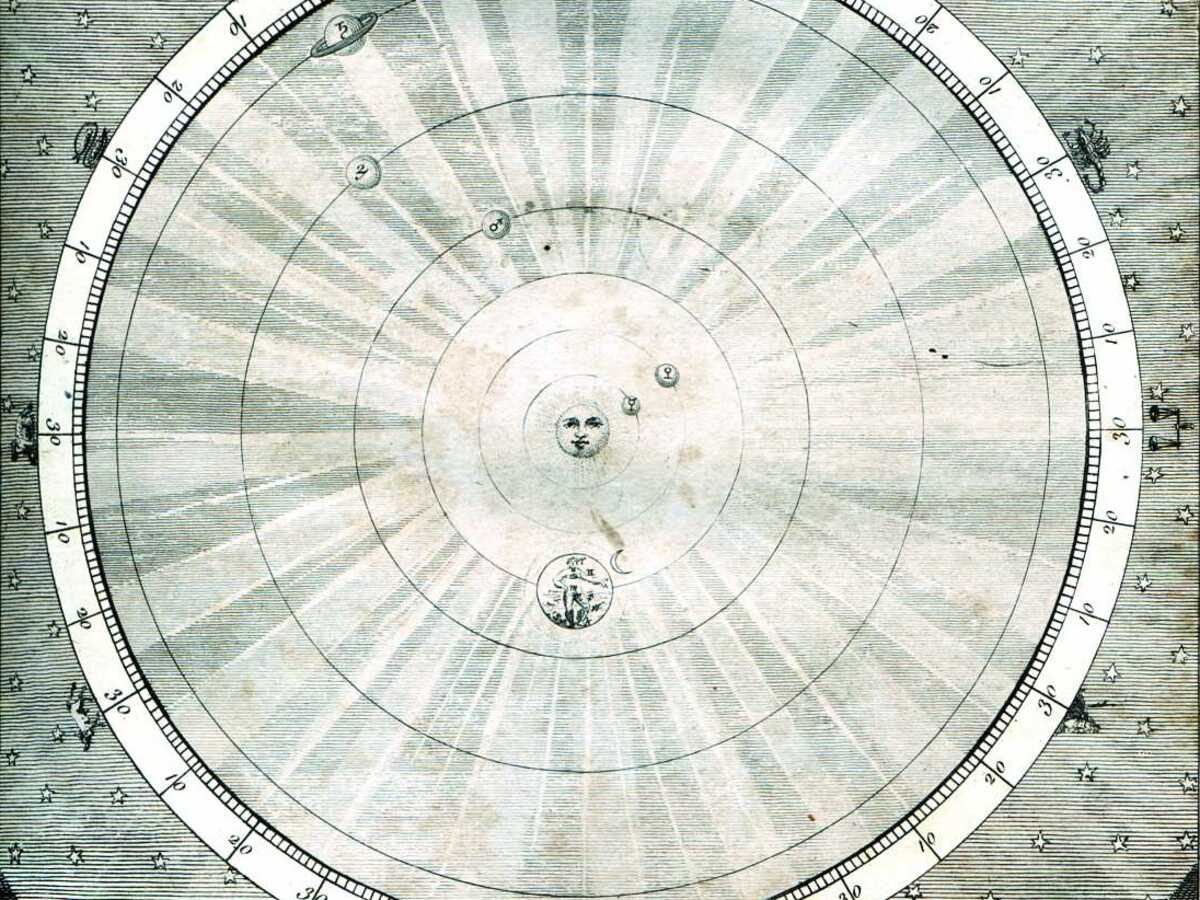
For Pythagoras, mathematics was not an abstract invention but a sacred language revealing the hidden order of the cosmos, from which arose one of antiquity’s most enduring and poetic theories: the harmony of the spheres, or musica universalis.
Ancient Greek philosopher and mathematician Pythagoras observed that strings of different lengths, when struck, produced sounds related by simple numerical ratios. The octave, the fifth, and the fourth—the most consonant musical intervals—could all be expressed through whole numbers. From this, he drew a daring conclusion: if such numerical order governs the harmony of music, it must also govern the heavens. The planets, he proposed, move according to the same mathematical laws that dictate musical intervals. Their distances, speeds, and revolutions are coordinated like notes in a vast celestial scale. In this way, the universe does not merely exist—it sings.
The Pythagorean vision
To the Pythagoreans, the cosmos was an intelligible structure rather than a chaotic expanse. They saw it as a living organism animated by divine proportion. The word cosmos itself, meaning “order” or “ornament,” captures their sense of a universe designed with both aesthetic and moral harmony. Each planet, suspended in its crystalline sphere, emitted a tone according to its motion. Together, these tones formed a perfect harmony, inaudible to human ears yet perceptible to the purified soul.
Pythagoras taught that the soul could attune itself to this celestial music through virtue, contemplation, and the study of mathematics. Just as an instrument must be carefully tuned to produce beauty, the human being must align his inner life with the universal order. The righteous resonate with the music of the stars, while the wicked fall into dissonance. For Pythagoras, ethics and cosmology were inseparable—harmony in the heavens implied harmony in the soul.
This vision inspired an entire school of thought known as Pythagoreanism, which flourished in southern Italy and later influenced Plato. It united arithmetic, geometry, music, and astronomy into a single discipline—the quadrivium—forming the foundation of classical education for over a thousand years. Through this synthesis, music became more than an art; it became a key to metaphysical truth.
Plato and the divine architect
Plato inherited the Pythagorean spirit and gave it philosophical depth. In the Timaeus, he described the Demiurge, the divine craftsman, shaping the world’s soul through harmonic ratios. The planetary spheres were arranged according to musical intervals, binding the universe into a single living organism. When Plato spoke of the eternal ideas—the perfect archetypes existing in the divine intellect—he echoed the Pythagorean belief that number and proportion form the skeleton of reality.
The harmony of the spheres revealed the intelligibility of creation, reflecting divine reason within matter. To contemplate this harmony was to approach the mind of God. The philosopher, therefore, was a kind of musician, seeking to tune his understanding to the rhythm of the cosmos.
Much confusion arose in later centuries regarding the nature of the celestial spheres. Nicolaus Copernicus and later followers of modern science often imagined the ancient spheres as thick shells of solid crystal, and therefore rejected the concept. The Pythagoreans, however, and their successors described the spheres as aetherial—composed of the pure, luminous substance that fills the heavens—not heavy or opaque matter but a divine medium.
The aether transmitted motion and light as sound travels through air, allowing the planets to sing their silent symphony. As Thomas Taylor, the great translator of Plato and the Neoplatonists, explained in his Dissertation on the Philosophy of Aristotle, the ancients used the term “crystal” symbolically to denote transparency, purity, and intelligibility. The spheres were never meant as physical cages confining the planets but as harmonic fields, regions of resonance. Their “crystal” was metaphorical, representing clarity and illumination rather than density. In this vision, the cosmos was not a machine but a musical instrument built from light.
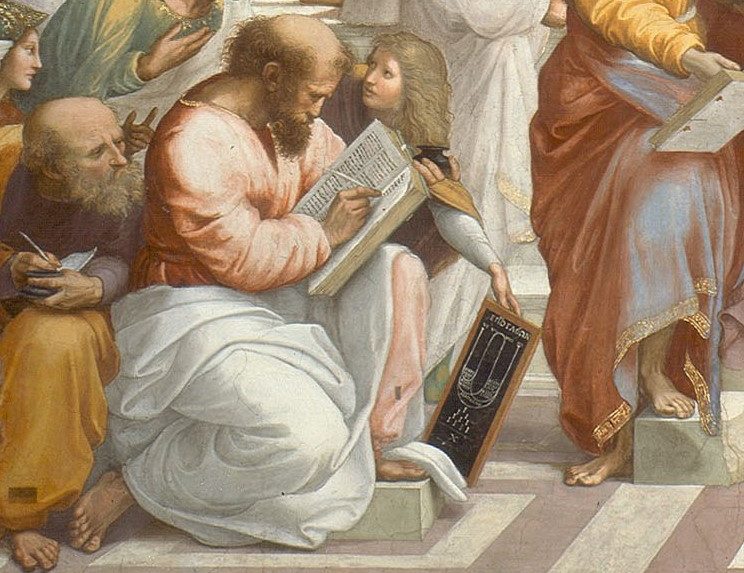
Music as the language of creation
For Pythagoras, music expressed the mathematical principles that structure existence. Every movement of the heavens, every rhythm of nature, echoed a numerical pattern. The orbits of the planets formed a grand cosmic scale, in which each tone corresponded to a degree of perfection. The highest sphere—the sphere of the fixed stars—emitted the purest sound, the divine keynote of the universe.
This harmony extended beyond astronomy into medicine, psychology, and politics. A healthy body was one in which the elements stood in correct proportion, like notes in a chord. A well-governed city mirrored this balance in the relations among its citizens. Discord, whether in the soul or the state, represented a rupture in the cosmic rhythm. Thus, the study of music and number became a moral discipline, training the soul to perceive harmony in all things.
The Pythagoreans even believed that certain melodies could heal the passions. At dawn, they sang hymns to awaken the intellect; at night, they played gentle harmonies to calm the spirit. Music tuned the microcosm—the human being—to the macrocosm of the heavens. This practice reflected the conviction that all creation shares a single mathematical order and that sound itself serves as a bridge between body and soul, matter and spirit.

From Antiquity to the Renaissance
The idea of musica universalis survived long after Pythagoras. In late Antiquity, Claudius Ptolemy, in his Harmonics, and Boethius, in his De Musica, preserved and systematized it. Medieval thinkers inherited this synthesis and regarded music as a reflection of divine order. The spheres continued to revolve, and their music symbolized the perfection of God’s creation.
During the Renaissance, philosophers such as Marsilio Ficino and Johannes Kepler revived the theme with renewed enthusiasm. Ficino saw in the harmony of the spheres the bond between the human soul and the divine. Kepler, though a scientist, sought to express planetary motion through musical ratios, convinced that geometry and harmony were two aspects of the same truth. In his Harmonices Mundi, he calculated the “songs” of the planets, finding in them evidence of cosmic design. For Kepler, as for Pythagoras, mathematics revealed the mind of God.

The soul of the universe
Behind all these reflections lies a single, central insight: the cosmos possesses a soul. Its movements are not random but rhythmic, animated by a principle of order that is both rational and beautiful. The music of the spheres is the voice of this living harmony, the soundless resonance of being itself. Each planet, through its motion, praises the divine source from which it springs. Each human soul, when it acts in accordance with truth and virtue, joins that chorus.
Modern astronomy tends to reject the theory of crystalline spheres or planetary melodies, yet the intuition remains powerful. Physics describes vibrations, frequencies, and waves permeating space—a language not so distant from ancient harmony. Even the atoms within us vibrate in structured patterns, as though echoing the same cosmic rhythm Pythagoras once imagined. The metaphor endures because it captures something essential: the unity of law, beauty, and life.
The theory of the musical harmony of the spheres stands as one of humanity’s most luminous attempts to understand existence. Through it, the Greeks expressed a truth that transcends time: the world is not a chaos of accidents but a composition, and every soul, if attuned, can perceive its music.
See all the latest news from Greece and the world at Greekreporter.com. Contact our newsroom to report an update or send your story, photos and videos. Follow GR on Google News and subscribe here to our daily email!

